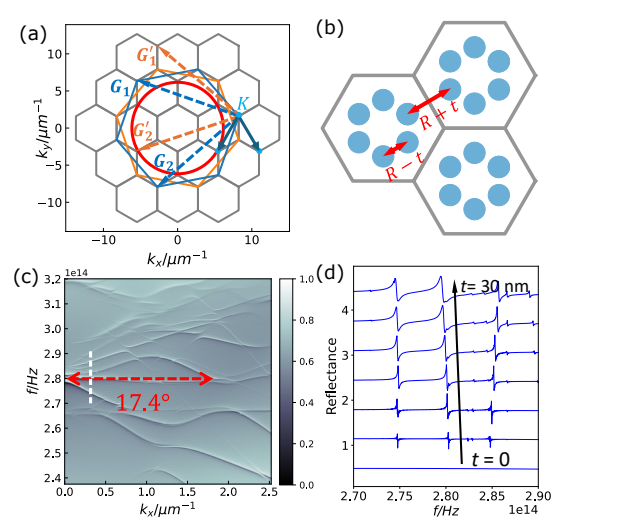
Twisted bilayer structures, already prominent in materials science, now extend into the realm of photonics, offering new ways to control light, and Shupeng Xu, Dun Wang from the University of Pennsylvania, and Ritesh Agarwal develop a comprehensive theoretical framework to understand these systems. Their work establishes a general theory for twisted bilayer photonic crystals, accounting for both how these structures respond to distant light and the subtle interactions between layers, and crucially, connects these properties to the underlying geometry of the photonic crystal. This approach predicts a four-fold splitting of spectral bands, confirmed through simulations, and reveals a suppression of unwanted light scattering, paving the way for the design of highly efficient optical cavities. The team proposes a tunable flat band cavity with potential applications in advanced areas like nonlinear optics, lasing, and quantum optics, representing a significant step towards manipulating light at the nanoscale.
Twisted Bilayer Photonic Crystal Theory Developed
This research presents a comprehensive theoretical framework for understanding twisted bilayer photonic crystals (TBPCs), successfully integrating far-field response and near-field coupling phenomena. The team addresses a need for a unified understanding of these systems, inspired by discoveries of correlated phenomena in twisted bilayer graphene. TBPCs offer a route to engineer photonic band structures and explore novel optical properties, potentially leading to new devices. The authors develop a general theory encompassing both interlayer coupling and far-field radiation properties, deriving a general expression for the interlayer coupling strength based on the field distributions of individual layer eigenstates. Solving for the far-field radiation, the theory predicts a characteristic four-band splitting in the transmission spectrum, a key signature of the TBPC’s unique band structure. This work establishes a versatile platform for future studies into moiré photonic systems, paving the way for exploration of engineered band structures, novel topological effects, and advanced light-matter interactions.
Twisted Photonic Crystals Mimic Material Interactions
Scientists have developed a generalized theory based on perturbation theory, accurately describing interlayer coupling by relating hopping strength to the arrangement of single-layer photonic crystals. For low-energy states in hexagonal lattices, this coupling closely mirrors the Bistritzer-MacDonald model, a well-known framework in materials science. Experiments and simulations reveal a four-fold splitting in the far-field spectrum, confirming the theoretical predictions. Notably, the theory reveals a suppression of scattering towards the centre of the Brillouin zone for low-energy states, offering insights into light propagation within these complex structures. This cavity exhibits a divergent density of states, behaving as a collection of quasi-bound states in the continuum.
Twisted Bilayer Photonic Crystals, Theory and Prediction
The research successfully integrates far-field response and near-field coupling phenomena, establishing a versatile platform for future studies into moiré photonic systems. Scientists developed a generalized theory based on perturbation theory, which accurately describes interlayer coupling by relating hopping strength to the arrangement of single-layer photonic crystals. Applying this model to a honeycomb lattice structure, the team predicted a four-fold splitting in the far-field spectrum, a result subsequently confirmed through numerical simulations. Notably, the theory reveals a suppression of scattering towards the centre of the Brillouin zone for low-energy states, offering insights into light propagation within these complex structures. Building on these findings, researchers propose a novel tunable flat band cavity design, achieved through a combination of large-angle twisting and a perturbation within each layer, which exhibits a divergent density of states and potential applications in nonlinear optics, lasing, and quantum optics.
🗞 General Framework for Twisted Bilayer Photonic Crystal with Interlayer Coupling and Far-Field Response
🧠 ArXiv: https://arxiv.org/abs/2509.23952