

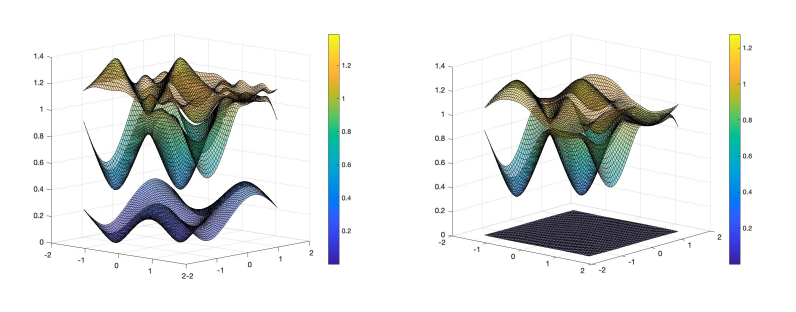
The behaviour of electrons in twisted multilayer graphene presents a fascinating puzzle for materials scientists, and recent work clarifies the possible electronic states within these structures. Bryan Li and Mengxuan Yang, along with their colleagues, demonstrate a surprising range of possibilities, revealing that these materials can exhibit completely flat energy bands, Dirac cones, or more conventional band crossings depending on the precise twisting angle between the graphene layers. This research challenges the previously held assumption that twisted multilayer graphene only supports higher-order band crossings or flat bands, and it establishes a new understanding of topological phase transitions in these materials. The findings open up exciting avenues for designing novel electronic devices and exploring exotic quantum phenomena within atomically thin materials.
Twisting Angle Dictates Graphene’s Electronic States
Researchers have uncovered a surprising principle governing twisted multilayer graphene, challenging previous understanding of its electronic properties. Investigations into this material reveal that the relationship between twisting angle and the resulting band structure is far more complex than initially thought, extending beyond the expectation of only flat bands or higher order band crossings. The team has demonstrated that the system falls into one of three distinct states depending on the precise twisting angle, providing a new perspective on how to control the electronic behavior of this advanced material. In many cases, the first two energy bands exhibit a tangential crossing, where their interaction is proportional to the twisting angle, a behavior distinct from single-layer graphene.
However, at specific, discrete twisting angles, termed “magic angles”, these bands become completely flat, resulting in zero energy and a significant increase in electron interactions, a phenomenon previously observed in bilayer graphene. Remarkably, the research also identifies a separate set of twisting angles where the bands exhibit Dirac cones, a characteristic indicating a different type of electronic behavior not previously known in this type of material. The discovery of these Dirac cones is particularly significant, as it expands the range of potential applications for twisted multilayer graphene. Numerical computations predict that these cones appear at a twisting angle of approximately 0.
This finding opens new avenues for manipulating the material’s electronic properties and potentially designing novel devices, building on existing research into moiré materials, strongly correlated electron behavior, the quantum anomalous Hall effect, and superconductivity. The work builds upon a growing body of mathematical and experimental studies aimed at understanding the complex interplay between twisting, band structure, and topological features in these advanced materials.
Twisted Graphene Exhibits Diverse Electronic Band Structures
The research establishes a detailed mathematical understanding of twisted multilayer graphene, specifically focusing on the behavior of its electronic bands. The team proves that, depending on the twisting angle between layers, the system exhibits one of three distinct characteristics: a standard band crossing, completely flat bands at specific “magic angles”, or Dirac cones at another set of angles. This finding challenges previous assumptions and reveals a new type of topological phase transition. Furthermore, the study demonstrates the existence of a protected Jordan block structure within the system’s Hamiltonian, meaning that certain properties are preserved even with small perturbations. This structure leads to a generalized kernel of dimension n, indicating a robust n-dimensional space of zero-energy states for a wide range of twisting angles, excluding a discrete set of angles. Future research may focus on exploring the implications of these findings for the material’s electronic properties and potential applications, as well as characterising the behaviour at the identified discrete angles.
🗞 Flat bands, Dirac cones, and higher-order band crossings in twisted multilayer graphene
🧠 ArXiv: https://arxiv.org/abs/2508.02011


