Versatile single-photon sources represent a crucial advancement for emerging photonic technologies, and a team led by Jens-Christian Drawer, Salvatore Cianci, and Vita Solovyeva are now demonstrating a significant step forward in their development. The researchers, alongside colleagues including Alexander Steinhoff and Falk Eilenberger, successfully created a tunable single-photon source using tungsten diselenide micro-domes, formed through a precise hydrogen ion irradiation process. They then integrated this emitter into an open microcavity, achieving verified single-photon emission with a correlation value of 0. 3, and detailed analysis reveals how the system’s unique properties, including acoustic phonon emission, enhance control over the emitted light. This achievement highlights the potential of open-cavity designs to tailor the characteristics of atomically thin emitters, paving the way for practical applications in quantum communication and computation.
Strain-Induced Emitters in WS2 with hBN Capping
This research details the creation and characterization of single-photon emitters within layered tungsten disulfide, a material known as WS2. Scientists induced strain in the WS2 using a precise beam of protons, then protected the modified material with a layer of hexagonal boron nitride, or hBN. This combination allows for the creation of emitters that release light as individual photons, a crucial component for emerging quantum technologies. The team used a technique called cavity quantum electrodynamics to enhance and control the light emitted from these tiny devices. The core of this work focuses on creating reliable single-photon emitters, essential for advancements in quantum computing and cryptography.
By carefully applying strain through proton irradiation, scientists create defects within the WS2 that can emit single photons. Encapsulating the strained WS2 with hBN protects it from environmental factors and improves its optical properties. The team then utilized a microcavity to enhance the emitted light and control its interaction with the material. Detailed measurements, including second-order correlation measurements, confirm the single-photon nature of the emitted light. The research involved meticulous preparation of the WS2 material, followed by precise application of the hBN layer and fabrication of the microcavity.
Proton irradiation parameters were carefully controlled to induce the desired strain. Optical spectroscopy was then used to characterize the emitted light, and the data was analyzed to confirm single-photon emission and understand the interaction between the emitter and the cavity. This work successfully created single-photon emitters in WS2 monolayers by inducing strain and protecting them with hBN. Measurements confirmed that these emitters genuinely release single photons, and the cavity enhanced the emitted light. By tuning the cavity parameters, scientists were able to control the properties of the emitted light. Detailed spectral analysis revealed the energy levels and transition rates within the emitters. This research demonstrates a promising approach for creating reliable and efficient single-photon sources, essential for developing future quantum technologies.
Deterministic Single-Photon Emission From WS2 Micro-Domes
Scientists have created a versatile source of single photons by integrating tiny, dome-shaped structures within WS2 into a tunable microcavity. These micro-domes were formed by carefully irradiating the WS2 with a hydrogen beam. This work demonstrates a system where a single emitter is reliably coupled to a microcavity, resulting in the emission of light with a non-classical character, confirmed by measurements showing a correlation value of 0. 3. Detailed analysis reveals the significant influence of acoustic phonons, which contribute to the interaction between the emitter and the cavity.
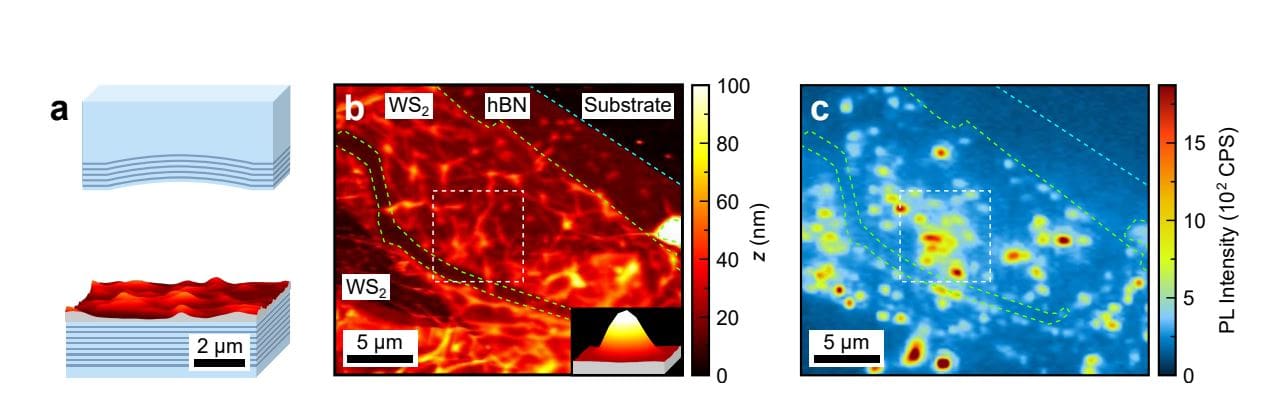
The device fabrication began with a thin flake of WS2, carefully exfoliated and then subjected to a low-energy hydrogen beam. This process created one-atomic-layer-thick domes on the surface. These domes were then capped with a layer of hexagonal boron nitride, stabilizing them even at extremely low temperatures. Atomic force microscopy confirmed the formation of these domes and the wrinkles introduced by the hBN capping layer. By mapping the emitted light at cryogenic temperatures, scientists identified spots corresponding to the location of these micro-domes, revealing highly localized and anisotropic emission.
The team created an open microcavity by mounting a distributed Bragg reflector, consisting of alternating layers of titanium dioxide and silicon dioxide. Precise alignment allowed them to position a pre-selected emitter beneath the center of a spherical indentation in the top mirror. By tuning the length of the cavity, scientists observed a significant enhancement of the emitted light, reaching a factor of approximately 17 when the cavity mode matched the emission line. Higher-order cavity modes were also detected, though they exhibited less pronounced coupling behavior. Measurements confirmed a narrow linewidth for the primary cavity mode, indicating a high-quality resonator.
Micro-Dome Cavity Coupling and Resonance Effects
This research demonstrates a functioning single-photon source created by integrating micro-domes within a tunable, open optical cavity. Scientists successfully verified single-photon emission through detailed analysis, achieving a correlation value of 0. 3, and explored the spectral characteristics of these micro-dome quantum emitters and their interaction with the cavity resonator. A key finding is the pronounced influence of phonons, which contribute to significant non-resonant coupling between the emitter and the cavity, particularly when the cavity is tuned to a specific wavelength. Notably, the team observed a reduction in cavity mode intensity when the system reached resonance, a phenomenon previously seen in other quantum dot systems but not before in van der Waals quantum emitters.
Because the micro-dome quantum emitters can be reliably created in layered materials, this research suggests a pathway towards scalable, spatially and spectrally controlled single-photon sources suitable for technological applications. This also highlights their potential in the field of quantum-optomechanics, which explores the interaction between light and mechanical motion. Future work will likely focus on optimizing the cavity design and emitter fabrication to enhance the efficiency and stability of the single-photon emission, paving the way for more advanced quantum technologies based on these innovative light sources.
👉 More information
🗞 Tunable WS Micro-Dome Open Cavity Single Photon Source
🧠 ArXiv: https://arxiv.org/abs/2511.21630