

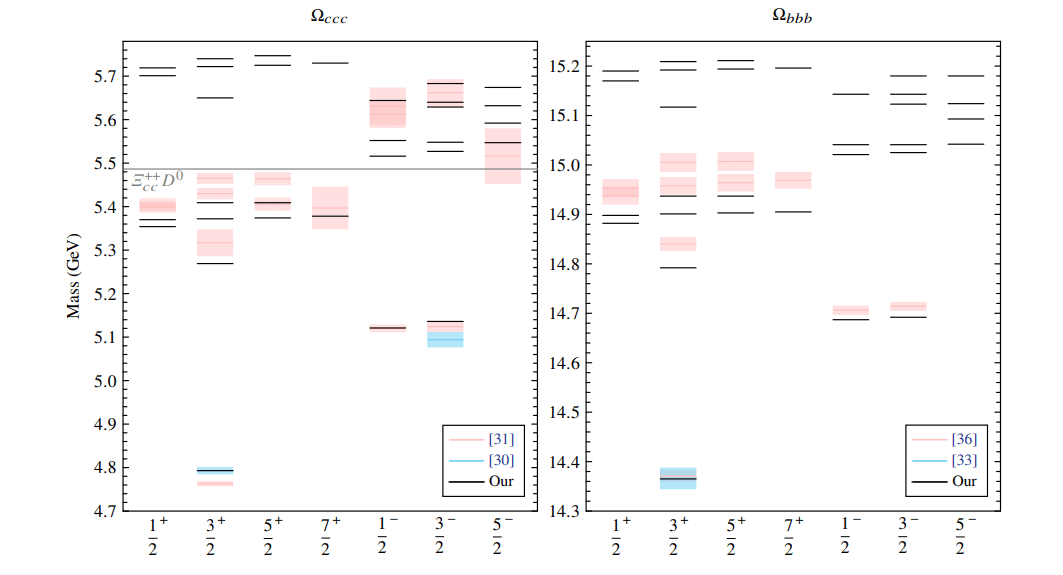
The search for exotic particles containing heavy quarks offers a unique window into the strong force that governs matter, and recent research focuses on triply heavy baryons , particles composed of three heavy quarks. Hao Zhou, Si-Qiang Luo, and Xiang Liu, all from Lanzhou University, present a detailed investigation into the predicted mass spectra of these unusual baryons, including excited states up to higher energy levels. Their work represents the most comprehensive analysis to date using a specific theoretical framework, and it clarifies several previously held assumptions about how these particles behave. By accurately predicting the masses and decay rates of triply heavy baryons, this research provides essential guidance for ongoing and future experiments seeking to observe these elusive particles and deepen our understanding of the fundamental forces at play within the universe.
Triply Heavy Baryons Reveal Strong Force Secrets
The search for new particles continually advances our understanding of the strong force, one of the fundamental interactions governing the universe. A particularly intriguing area of research focuses on triply heavy baryons, exotic particles composed of three heavy quarks, such as charm or bottom quarks. These baryons are exceedingly rare, making their observation challenging, but their study offers a unique window into the behaviour of matter under extreme conditions and tests the limits of current theoretical models. Despite being theoretically predicted, triply heavy baryons have proven elusive, requiring the simultaneous binding of three heavy quarks, a process that significantly hinders their formation.
The recent observation of a double-charm baryon has renewed excitement in the field, with the anticipated upgrade of the Large Hadron Collider promising increased opportunities for discovery. Current theoretical investigations have provided valuable insights, but remain incomplete in their descriptions of these complex systems. Researchers have undertaken a comprehensive study of these triply heavy baryons, employing a nonrelativistic quark model and a sophisticated mathematical technique called the Gaussian Expansion Method. This approach allows for a highly precise calculation of the particles’ mass spectra and provides a more complete picture than previous attempts.
Their work addresses limitations in earlier models, such as neglecting crucial interactions between the quarks’ intrinsic angular momentum. This research not only refines our understanding of the particles’ fundamental properties, but also predicts their behaviour in terms of radiative decay, how they release energy through the emission of photons. By accurately calculating the rates of these decays, the team provides crucial information for experimentalists searching for these elusive baryons, guiding their efforts and helping to interpret future observations. The detailed calculations, incorporating subtle effects previously overlooked, represent a significant step forward in the quest to fully characterise these exotic particles and unlock the secrets of the strong force.
Triply Heavy Baryon Spectroscopy with Gaussian Expansion Method
Researchers undertook a detailed investigation of triply heavy baryons, particles composed of three heavy quarks, to refine understanding of the strong force that governs their interactions. Recognizing limitations in previous studies, the team aimed for a more complete and precise spectroscopic analysis of these elusive particles, building on successful modelling of singly heavy baryons and hyperons. This necessitated a robust theoretical framework and computational method capable of accurately describing the complex interactions within these systems. The core of their approach lies in the nonrelativistic quark model, combined with the Gaussian Expansion Method (GEM).
GEM provides a powerful way to solve the equations governing the behaviour of these multi-quark systems, representing the wave function as a combination of Gaussian basis functions. These functions capture different angular momentum excitations, allowing for a nuanced description of the particle’s internal structure and energy levels. The method transforms the complex problem into a manageable mathematical form, enabling precise calculations of the mass spectra. A key innovation lies in the comprehensive treatment of angular momentum mixing, where different angular momentum states are allowed to interact and influence each other.
Previous studies often neglected this crucial effect, impacting the accuracy of predictions for radiative decays. By fully incorporating these mixing effects, the researchers aimed to achieve a more realistic and accurate description of the particles’ behaviour. Furthermore, the team paid close attention to the symmetry properties of the system, investigating how different orbital excitations contribute to the overall structure of the baryons. They observed that certain baryons favour specific excitation modes, a phenomenon previously predicted and now further explored through a symmetry-based perspective. This detailed analysis, combined with the comprehensive treatment of angular momentum, represents a significant advancement in the field of triply heavy baryon spectroscopy.
Triply Heavy Baryon Masses and Mixing States
Researchers have conducted a comprehensive study of triply heavy baryons, exotic particles containing three heavy quarks, to better understand the strong force that governs their behaviour. These baryons, including combinations of charm, bottom, and beauty quarks, are exceedingly rare, but their observation provides a unique window into the fundamental interactions of matter. The investigation represents the most complete analysis to date using a specific theoretical framework, incorporating the complex mixing of angular momentum states to achieve high precision. The team’s calculations of the masses of these baryons align well with existing data from lattice quantum chromodynamics for lower energy states.
However, the research reveals systematically lower masses for excited, higher-energy states compared to those lattice calculations, suggesting refinements may be needed in current theoretical models. This discrepancy is particularly valuable as it highlights areas where further investigation is required to reconcile theoretical predictions with experimental observations. A key aspect of this work is the detailed calculation of radiative decay widths, which describe how these baryons decay by emitting photons. The results significantly differ from previous theoretical predictions, indicating that earlier calculations may have overlooked crucial factors influencing decay rates.
The team achieved this improved accuracy by directly calculating the full decay amplitude, avoiding approximations used in prior studies and incorporating the mixing of different spin states. Furthermore, the research addresses and resolves several misconceptions present in earlier treatments of triply heavy baryon spectroscopy. This includes correcting inaccuracies in how symmetry constraints are applied and improving the construction of the mathematical functions used to describe the particles’ wave functions. By refining these fundamental aspects of the theoretical framework, the team provides a more robust and reliable foundation for future studies and experimental searches for these elusive particles. The findings are expected to be crucial for guiding experimental efforts at facilities like the LHC.
Triply Heavy Baryon Spectra and Radiative Decays
This study presents a comprehensive analysis of triply heavy baryons, particles composed of three quarks, where at least three are heavy, using a nonrelativistic quark model and the Gaussian expansion method. The calculations provide predictions for the mass spectra of these baryons, up to excited states, and incorporate the complex effects of angular momentum mixing. Results for lower-lying states align well with existing lattice QCD calculations, though discrepancies appear in predictions for excited states, where calculated masses are systematically lower. The research extends to estimating radiative decay widths, the probabilities of these baryons decaying by emitting a photon, revealing differences from previous theoretical work, likely due to the inclusion of identical particle symmetry considerations.
Specifically, the calculated decay patterns distinguish between baryons with three identical quarks and those with two, governed by distinct underlying mechanisms. The team identified and corrected misconceptions in prior spectroscopic treatments of these baryons, particularly regarding symmetry constraints and the construction of relevant mathematical functions. The authors acknowledge that their calculated masses for excited states are lower than those obtained from lattice QCD, suggesting potential areas for refinement in the model or further investigation of the underlying physics. Future work could focus on improving the accuracy of predictions for these excited states and exploring the implications of these findings for experimental searches at facilities capable of producing heavy quarks. These predictions are crucial for guiding future experimental efforts and advancing theoretical understanding of these complex particles.
👉 More information
🗞 Triply heavy baryon spectroscopy revisited
🧠 DOI: https://doi.org/10.48550/arXiv.2507.10243

