Nitrogen-vacancy (NV) centers in diamond represent a promising technology for detecting magnetic fields, but their sensitivity is inherently limited by the structure of the NV center itself. Ankita Chakravarty from Institut, alongside Romain Ruhlmann and Vincent Halde, and their colleagues, now demonstrate a method to overcome this limitation using a technique called triple-tone microwave control. The team experimentally and theoretically investigates how precisely controlling microwave signals directed at the NV centers boosts sensitivity in two key magnetic field detection methods. Their work validates a detailed model of NV center behaviour and reveals specific conditions where triple-tone control significantly improves detection capabilities, paving the way for more sensitive and practical portable magnetic sensors, particularly in situations where power is restricted.
NV Center Magnetometry and Sensitivity Enhancement
This collection of research focuses on utilizing nitrogen-vacancy (NV) centers in diamond as highly sensitive magnetic field sensors, exploring methods to improve their performance and broaden their applications. A central theme is enhancing the sensitivity of NV center magnetometry through techniques like optimizing microwave pulse sequences, employing dynamic nuclear polarization to amplify signals, and mitigating the detrimental effects of high optical and microwave power. Researchers investigate both single NV centers for fundamental studies and high-resolution imaging, and ensemble methods for broader applications. The research highlights a diverse range of potential applications, including biomedical imaging such as magnetocardiography, materials science applications like imaging magnetic domains and detecting defects, and fundamental physics investigations exploring quantum phenomena.
A growing emphasis is placed on sophisticated data analysis techniques, including Bayesian optimization and machine learning, alongside control and optimization of microwave and optical signals. Understanding and utilizing the interactions between the NV center’s electron spin and nearby nuclear spins is also crucial for enhancing sensitivity and achieving precise measurements. Recent studies demonstrate a clear trend towards using adaptive algorithms to dynamically optimize measurement parameters, allowing for more efficient and sensitive measurements. Biomedical applications, particularly non-invasive imaging techniques, are a major driver of this research. While single NV center magnetometry offers high resolution, ensemble methods are gaining traction due to their simplicity and potential for higher signal-to-noise ratio. This body of work paints a picture of a vibrant and rapidly evolving field, with researchers actively pushing the boundaries of NV center magnetometry to develop new techniques, enhance sensitivity, improve data analysis, and expand the range of applications.
Multi-Tone Microwave Enhancement of NV Center Sensitivity
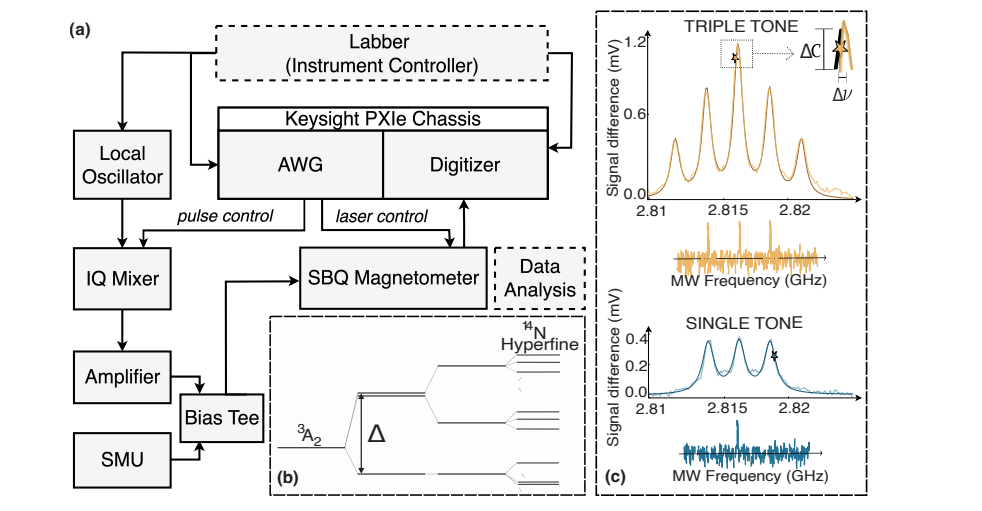
Scientists rigorously investigated the benefits of using multiple microwave frequencies to drive nitrogen-vacancy (NV) center ensembles for magnetic field detection. They employed pulsed optically detected magnetic resonance (ODMR) and Ramsey interferometry, utilizing a well-established experimental setup with NV centers in diamond. Researchers precisely controlled microwave frequencies and amplitudes to manipulate the NV center spins, comparing single-tone and triple-tone excitation schemes. To quantify sensitivity, they measured the fluorescence signal as a function of microwave frequency, establishing key metrics to compare performance under different conditions.
The team validated a theoretical model of NV center dynamics against experimental measurements, ensuring the accuracy of their simulations. This model accurately captured the hyperfine interactions between the NV electron spin and the host nitrogen-14 nuclear spin, which splits each spin transition into three components. Experiments involved applying resonant pulses in both pulsed ODMR and Ramsey interferometry, meticulously controlling the phase and duration of these pulses. This detailed approach enabled a nuanced comparison of single-tone and triple-tone control, clarifying the conditions under which multi-tone driving enhances NV ensemble magnetometry. Scientists systematically varied the microwave power and NV dephasing rates to explore the regimes where triple-tone excitation offered an advantage. They quantified the smallest resolvable magnetic field and total measurement time to determine the magnetometer sensitivity, enabling a comprehensive assessment of performance and providing valuable insights into optimizing NV ensemble magnetometry.
Triple-Tone Control Boosts NV Center Sensitivity
Researchers achieved significant enhancements in the sensitivity of nitrogen-vacancy (NV) center ensembles for detecting magnetic fields by employing a technique called triple-tone microwave (MW) control. NV centers, defects in diamond, are promising platforms for quantum magnetometry due to their unique spin properties and ability to operate under ambient conditions. This work addresses a fundamental limitation arising from the hyperfine structure of the common nitrogen isotope, which typically reduces measurement contrast and sensitivity. By individually addressing each hyperfine transition with a carefully designed triple-tone MW field, the team mitigated this sensitivity loss and explored the conditions under which this approach is most effective.
Experiments and theoretical modeling focused on two established DC magnetometry protocols: pulsed optically detected magnetic resonance (ODMR) and Ramsey interferometry. Validating a master equation model against ensemble NV measurements, scientists investigated how triple-tone excitation compares to standard single-tone control across varying MW powers and NV dephasing rates. Results demonstrate that triple-tone driving improves sensitivity by up to a factor of three in pulsed ODMR, but only when NV dephasing rates are low; as dephasing increases, the benefits diminish. Sensitivity was quantified using two metrics, providing a comprehensive assessment of performance. These findings reveal nuanced trade-offs between the two protocols, clarifying when multi-tone control is advantageous and providing guidance for designing practical, portable NV-based DC magnetometers, particularly for applications where power consumption is a concern. The research establishes clear operating regimes where triple-tone control offers a practical strategy for enhancing NV ensemble magnetometry.
Triple-Tone Control Boosts NV Center Sensitivity
Researchers achieved improvements in the sensitivity of nitrogen-vacancy (NV) center ensembles in diamond, which are promising tools for detecting magnetic fields, by employing a technique called triple-tone microwave control. The team validated a theoretical model against experimental measurements of NV center ensembles, allowing them to explore the conditions under which triple-tone control is most effective. Results indicate that for a pulsed detection method, triple-tone driving can improve sensitivity by up to a factor of three when the rate of quantum decoherence is low, though this advantage diminishes as decoherence increases. For Ramsey interferometry, triple-tone control only enhances sensitivity when the power of the microwaves is limited.
Importantly, the researchers note that even when triple-tone and high-power single-tone Ramsey protocols offer similar sensitivity, the former produces cleaner signals that may simplify data analysis and facilitate advanced measurement techniques. The authors acknowledge that the benefits of triple-tone control are dependent on the specific experimental conditions and that further improvements are possible. They suggest that exploring NV centers with different isotopic compositions, or employing techniques to control the surrounding nuclear spins, could further enhance performance. By mapping out the conditions for optimal sensitivity, this work provides valuable guidance for researchers developing compact and sensitive magnetic sensors based on NV center ensembles.
🗞 Triple-Tone Microwave Control for Sensitivity Optimization in Compact Ensemble Nitrogen-Vacancy Magnetometers
🧠 ArXiv: https://arxiv.org/abs/2510.00913