

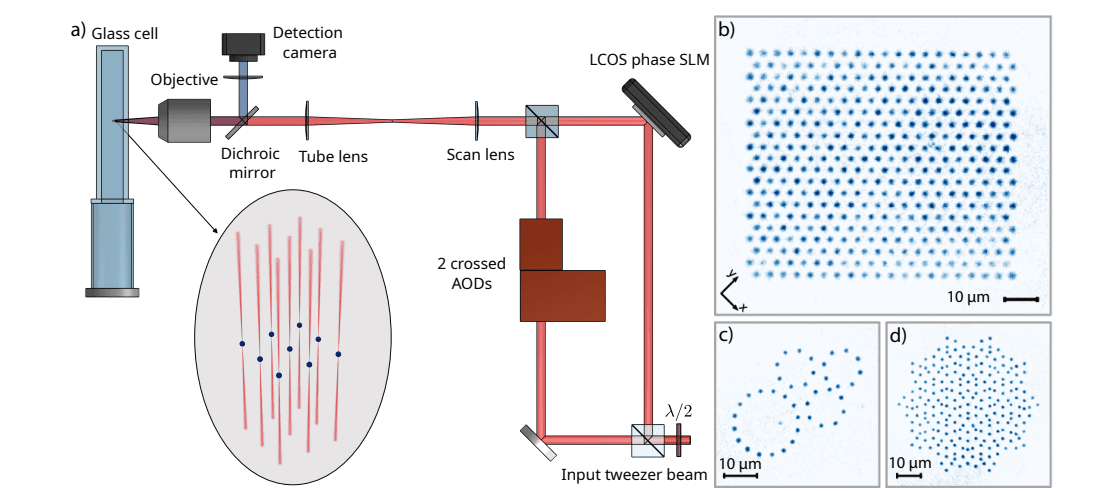
Ultracold atoms, chilled to temperatures just above absolute zero, represent a powerful frontier in both fundamental physics and emerging technologies. Louise Wolswijk, Luca Cavicchioli, and Giuseppe Vinelli, alongside their colleagues, present a comprehensive overview of the techniques scientists now employ to harness the unique properties of these atoms. Their work details how researchers trap, manipulate, and probe these quantum systems, enabling precision measurements, complex simulations, and potentially revolutionary advances in information processing. This tutorial provides an essential resource for newcomers to the field, outlining the experimental toolkit that drives current research and promises to unlock further breakthroughs in science and technology.
Cold Atom Cooling and Trapping Techniques
Researchers have developed a comprehensive toolkit for creating and manipulating cold atomic samples, enabling studies of quantum mechanics and the development of advanced technologies. Techniques such as Doppler cooling slow atomic motion to millikelvin temperatures, while sub-Doppler cooling achieves even lower temperatures. Magneto-optical traps simultaneously cool and trap atoms, offering high capture velocity, while magnetic traps provide high depth. Optical dipole traps utilize far-off-resonance light to create versatile and tailored potentials, and optical lattices create periodic potentials for high controllability.
These techniques offer unique strengths and limitations, impacting applications like atomic clocks, quantum transport, and the study of many-body physics. This work details the strength of dipolar interactions in various atomic and molecular species, including rubidium, chromium, erbium, dysprosium, and several molecules. Parameters such as dipole moment and interaction strength are crucial for understanding many-body physics, creating novel quantum phases, and building quantum simulators. Furthermore, researchers have developed methods for controlling the quantum states of atoms, including Bragg transitions, Rabi and Ramsey techniques, Raman transitions, and the creation of synthetic gauge fields, essential for quantum computing, precision spectroscopy, atomic clocks, and metrology. Finally, the work summarizes methods for detecting atoms and measuring their quantum states, encompassing ensemble detection techniques like absorption and time-of-flight imaging, as well as state-selective detection methods like Stern-Gerlach separation and optical pumping. Quantum gas microscopes enable site-resolved imaging of atoms in optical lattices, providing a valuable resource for researchers in the field.
Laser and Evaporative Cooling to Nanokelvin Temperatures
Researchers have pioneered a comprehensive toolkit for manipulating matter at temperatures near absolute zero, enabling fundamental studies of quantum mechanics and the development of advanced technologies. The process begins with laser cooling, which slows atomic motion, followed by trapping atoms using magnetic and optical fields to achieve microkelvin temperatures. This culminated in the creation of the first Bose-Einstein condensate in 1995, a landmark achievement. Subsequent development of evaporative cooling techniques further reduced temperatures to the nanokelvin scale, enhancing the precision of experiments and allowing for the creation of quantum degenerate Fermi gases.
The team engineered tightly confining traps, both magnetic and optical, to achieve high atomic densities in both real and phase space, crucial for observing collective quantum phenomena. A significant advancement involved the creation of optical lattices, periodic potentials formed by interfering laser beams, which serve as precisely controlled environments for studying many-body physics. Researchers also harnessed Feshbach resonances, allowing them to tune interatomic interactions and observe the superfluid-Mott insulator transition in Bose gases and the Bose-Einstein condensate to Bardeen-Cooper-Schrieffer crossover in Fermi gases. These techniques enabled the creation of dipolar quantum gases and the exploration of highly excited Rydberg states, expanding the range of accessible physical phenomena.
To achieve even greater control and resolution, scientists developed quantum gas microscopes capable of imaging individual atoms within optical lattices, allowing for the study of single-site properties and the observation of complex quantum correlations. Furthermore, researchers engineered synthetic gauge fields and spin-orbit coupling in ultracold atoms, opening new avenues for simulating topological phases and gauge theories. More recently, the development of optical tweezer arrays and large-scale programmable Rydberg quantum simulators has enabled the creation of complex quantum systems with unprecedented control, paving the way for the development of near-term quantum computers and advanced quantum simulations.
Ultracold Atom Control and Laser Cooling Techniques
Researchers have achieved remarkable advancements in manipulating and controlling atoms at near-absolute zero temperatures, establishing a powerful toolkit for fundamental mechanics studies and emerging technologies. This work details a comprehensive set of techniques for trapping, cooling, and detecting ultracold atoms, enabling precise control over their quantum behavior. The foundation of this control lies in laser cooling, where atoms are slowed using light, reaching temperatures in the millikelvin range or below. Building upon laser cooling, scientists employ various trapping methods to confine these ultracold atoms.
Magneto-optical traps (MOTs) simultaneously cool and confine atoms, while magnetic traps utilize weak magnetic fields to hold atoms. Optical dipole traps, and their more refined form, optical tweezers, confine atoms at the focus of far-detuned laser beams, even enabling the trapping of single atoms in reconfigurable arrays. A particularly powerful technique involves optical lattices, created by interfering counter-propagating laser beams, which confine atoms in a periodic potential, serving as a platform for quantum simulations. To reach even lower temperatures, evaporative cooling is employed, selectively removing the highest energy atoms from a trap, reducing the overall temperature of the remaining cloud. Furthermore, miniaturization of these setups is achieved through the use of atom chips, paving the way for more compact and integrated devices. Sub-Doppler cooling techniques further refine temperature control by exploiting atomic transitions and polarization gradients.
Ultracold Atoms Advance Quantum Science and Technology
This work comprehensively reviews the established and emerging techniques used to manipulate and detect ultracold atoms, demonstrating the field’s central role in advancing both fundamental science and technological innovation. Researchers have developed precise methods for cooling, trapping, and controlling neutral atoms, enabling the study of quantum phenomena and the creation of novel quantum technologies. These techniques underpin investigations into strongly interacting quantum matter, many-body physics, topological phases, and dynamics far from equilibrium, offering unique insights into complex physical systems. The convergence of advanced control methods, robust detection schemes, and large-scale engineering is poised to further extend the frontiers of ultracold atom research. While acknowledging the current state-of-the-art, the authors highlight ongoing development in areas such as high-resolution imaging with large tweezer arrays, hybrid imaging systems, and single-particle-resolved detection for quantum processors and networks. These advancements promise to enhance precision measurements and facilitate the scaling of quantum technologies for computation, communication, and metrology.
👉 More information
🗞 Trapping, manipulating and probing ultracold atoms: a quantum technologies tutorial
🧠 ArXiv: https://arxiv.org/abs/2510.20790