

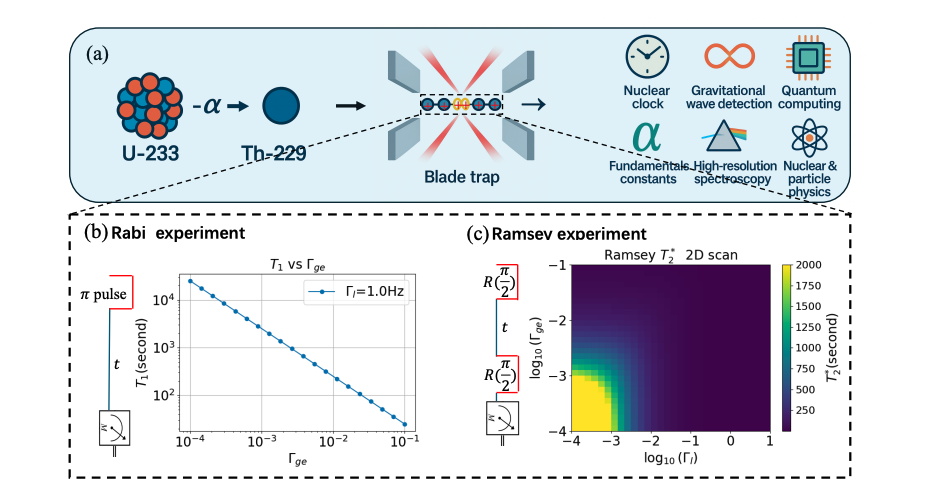
The pursuit of stable and coherent quantum bits, or qubits, has led researchers to explore increasingly exotic systems, and a new study focuses on the nucleus of thorium-229 as a promising platform. Jingbo Wang, Haixing Miao, Shiqian Ding, and colleagues at the Beijing Academy of Quantum Information Sciences and the State Key Laboratory of Low Dimensional Quantum Physics demonstrate the potential for creating high-fidelity qubits using trapped thorium-229 ions. This research establishes a theoretical framework for directly controlling the nuclear energy levels of these ions, enabling state preparation, single-qubit control, and crucially, entanglement between ions. By leveraging the nucleus’s inherent resilience to environmental noise and utilising laser-driven interactions, the team shows that this approach could unlock new possibilities for robust quantum information processing and advance the field of precision measurement.
Hefei 230088, China. Thorium-229 presents a unique opportunity at the intersection of nuclear and atomic physics, offering a promising resource for building resilient quantum technologies. Recent advances in continuous-wave vacuum ultraviolet laser technology, operating at 148. 4 nm, now enable direct and precise control of individual trapped Thorium ions. Building on this breakthrough, researchers have developed a theoretical framework for utilizing trapped Thorium-229 ions as high-fidelity nuclear-level qubits, detailing methods for quantum state preparation, single-qubit control, and entangling operations based on nuclear energy levels.
High-Precision Timekeeping and Quantum Metrology
A comprehensive body of research focuses on pushing the boundaries of precision measurement and quantum metrology, with significant implications for atomic clocks and quantum information technologies. This work explores methods for improving the accuracy and stability of timekeeping devices, such as optical and strontium clocks, aiming to redefine the limits of time and frequency measurement. A central theme is the application of quantum phenomena, including entanglement and squeezing, to enhance measurement precision beyond what is achievable with classical techniques. This research extends to the development of essential building blocks for quantum computers, sensors, and communication systems.
Key areas of investigation include creating and distributing entangled states over long distances, protecting quantum information from noise through error correction, storing quantum information for extended periods in quantum memories, and utilizing quantum systems to simulate complex physical phenomena. Furthermore, many studies leverage precision measurements to test fundamental physical theories, search for new physics beyond the Standard Model, and investigate the nature of dark matter and fundamental constants. A growing trend involves applying these technologies to space-based applications, such as high-bandwidth communication with spacecraft via deep space optical communication, improved navigation and timekeeping using satellite-based clocks, and enhanced sensitivity in gravitational wave detection. Quantum sensing is also receiving considerable attention, with potential applications in medical imaging, materials science, and environmental monitoring.
Researchers are actively exploring techniques like entanglement, squeezing, and quantum non-demolition measurements to improve the performance of these systems. The convergence of these technologies is driving innovation, with efforts to integrate atomic clocks, quantum sensors, and communication systems into more powerful and versatile devices. Miniaturization and integration are key goals, aiming to make quantum technologies more practical and deployable. Quantum simulation is emerging as a powerful tool for understanding complex physical and chemical systems, offering insights into materials science and drug discovery. This research highlights the potential for transformative applications in a wide range of fields, from fundamental physics to space exploration.
Thorium-229 Enables Robust Nuclear Qubits
Researchers have demonstrated the potential of Thorium-229 as a novel platform for quantum information processing, leveraging its unique nuclear properties to create highly stable and controllable qubits. Unlike conventional qubits which rely on electron states, this approach encodes quantum information directly within the nucleus of the Thorium-229 atom, offering inherent resilience to environmental disturbances that typically degrade quantum signals. This nuclear encoding promises significantly longer coherence times, potentially extending the duration for which quantum information can be reliably stored and manipulated. The research team proposes trapping individual Thorium-229 ions and manipulating them with a specialized vacuum ultraviolet laser.
This laser, operating at a specific wavelength, allows for precise control of the nuclear state, enabling the implementation of quantum operations. Simulations demonstrate that this system can achieve high-fidelity control over the nuclear qubit, meaning operations can be performed with minimal errors. The extremely low decay rate between nuclear states ensures that the encoded quantum information remains stable for extended periods, a critical requirement for practical quantum technologies. A key breakthrough lies in the ability to generate entanglement between two of these nuclear qubits. Entanglement, a fundamental feature of quantum mechanics, allows qubits to become correlated, enabling powerful quantum algorithms and enhanced sensing capabilities.
Researchers have designed a method using precisely tuned laser pulses to create this entanglement via interactions mediated by the ions’ vibrational motion. The simulations indicate that strong entanglement can be achieved under realistic experimental conditions, paving the way for multi-qubit quantum systems. This approach offers significant advantages over existing trapped-ion quantum computing platforms. Traditional systems rely on controlling the electronic states of ions, which are more susceptible to external noise. By encoding information within the nucleus, the Thorium-229 system promises dramatically improved coherence times and stability. The development of this technology could unlock new possibilities in precision measurements, advanced quantum clocks, and the exploration of fundamental physics, offering a pathway towards robust and scalable quantum information processing.
Thorium-229 Ions Demonstrate Quantum Potential
This research demonstrates the feasibility of utilizing thorium-229 ions as high-fidelity qubits, leveraging the unique properties of their nuclear isomeric transition. By establishing a theoretical framework for controlling and entangling these ions, the team shows that long coherence times, combined with optical accessibility, offer a promising platform for quantum information processing and precision measurement. Specifically, the analysis details a method for generating entanglement between ions via phonon-mediated coupling, driven by carefully tuned laser pulses, and confirms that high-fidelity entanglement is achievable under realistic experimental conditions. The findings suggest potential advancements in several areas, including gravitational-wave detection, global navigation, and tests of fundamental physics, such as variations in fundamental constants. Future work could focus on scaling up these systems and exploring hybrid encoding schemes that combine nuclear and electronic qubits for enhanced quantum memory and logic operations, ultimately paving the way for more complex quantum technologies and deeper insights into the nature of reality.
🗞 Direct Nuclear-Level Qubits using Trapped Th-229 Ions: A Platform for Entanglement and Universal Quantum Information Processing
🧠 ArXiv: https://arxiv.org/abs/2508.10626


