

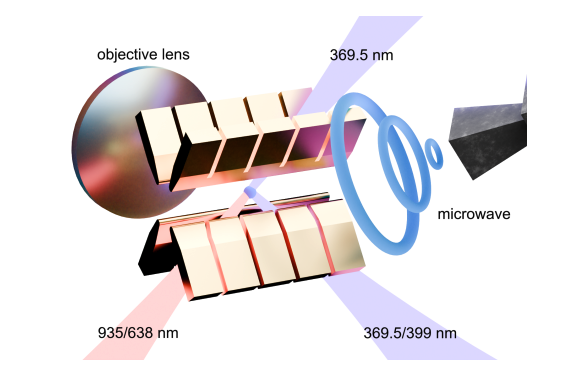
The behaviour of physical systems abruptly driven away from equilibrium, a process known as a quantum quench, reveals fundamental insights into complex many-body physics and the nature of phase transitions. Understanding these dynamics is crucial for advancements in areas such as quantum computing and materials science. Chen-Xu Wang, András Grabarits, Jin-Ming Cui, et al., now present research detailed in “Quantum Quenches from the Critical Point: Theory and Experimental Validation in a Trapped-Ion Quantum Simulator”, where they investigate quenches initiated from a critical point, utilising a trapped-ion system to model the transverse-field Ising model and experimentally verify theoretical predictions regarding defect statistics and scaling behaviour. Their findings establish quench-depth scaling as a precise benchmark for exploring nonequilibrium critical dynamics.
Researchers investigate defect formation during quantum quenches, consistently observing greater fluctuations in the number of defects created than expected by conventional models. A quantum quench represents a sudden change to a system’s parameters, driving it away from equilibrium. Rather than simply counting average defect numbers, the study employs statistical tools called cumulants to characterise the complete distribution of defect counts. Cumulants provide a more detailed picture of fluctuations than standard deviation, revealing a heightened probability of observing substantial deviations from the average. This super-Poissonian behaviour, indicating greater variability than a Poissonian distribution would predict, persists across both rapid and slow quench regimes, suggesting a fundamental characteristic of driven quantum systems.
The research demonstrates strong agreement between theoretical predictions, numerical simulations and experimental observations conducted using a trapped-ion system. This system models the transverse-field Ising model, a standard framework in condensed matter physics used to study magnetic systems and phase transitions. Validation through experiment confirms the robustness of the observed super-Poissonian behaviour. Specifically, the study reveals universal scaling of cumulants with quench depth, the magnitude of the parameter change during the quench. At leading order, this scaling exhibits Gaussian behaviour, meaning the distribution resembles a normal distribution, complemented by systematic, smaller corrections at higher orders.
Researchers utilise trapped ions, individual charged atoms held
Researchers utilise trapped ions, individual charged atoms held and manipulated using electromagnetic fields, to realise the transverse-field Ising model physically. This allows for precise control and measurement of the system’s evolution following a quantum quench. The focus is on quantifying the number of defects created during the quench and characterising the distribution of these defects using cumulants. Defects, in this context, represent deviations from the perfectly ordered state of the system.
The observed scaling with quench depth provides a precise experimental benchmark for investigating non-equilibrium critical dynamics, the behaviour of systems driven far from equilibrium near a critical point. This offers a powerful tool for future studies aiming to explore the behaviour of quantum systems in complex scenarios and test the validity of theoretical models. Researchers intend to investigate increasingly complex systems and refine our understanding of the interplay between quantum mechanics, statistical mechanics and non-equilibrium phenomena.
Figure 10 illustrates approximately constant, super-Poissonian behaviour across varying driving times, suggesting that the statistical properties of defects are not strongly dependent on the duration of the quench itself. This finding highlights the fundamental dynamics of defect creation, providing valuable insight into the underlying mechanisms governing this process.
Future research will focus on exploring the limitations
Future research will focus on exploring the limitations of this model and investigating the effects of different types of interactions on defect formation. Researchers also aim to explore potential applications of these findings in areas such as materials science and quantum computing, demonstrating the broader impact of this research.
🗞 Quantum Quenches from the Critical Point: Theory and Experimental Validation in a Trapped-Ion Quantum Simulator
🧠 DOI: https://doi.org/10.48550/arXiv.2507.01087


