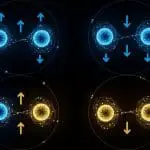
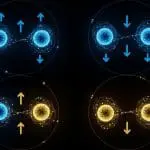
A new hybrid strategy merges analytical shortcuts to adiabaticity with numerical optimisation techniques to enhance protocol performance, as demonstrated by Bo Xing and colleagues at MIT. The approach successfully separates two trapped ions, delivering improvements of up to three orders of magnitude without increasing experimental complexity. This analytical-numerical method unlocks solutions within a challenging parameter space and provides a key set of tools for rapid and accurate quantum control without inducing unwanted excitation.
Hybrid analytical-numerical methods optimise rapid trapped ion segregation
Improvements of up to three orders of magnitude in the performance of trapped ion separation have been achieved, exceeding the capabilities of previously reported methods. This leap allows control of the ions’ separation within timescales previously inaccessible, opening avenues for more complex quantum computations. Previously, achieving such precision was hampered by the difficulty of simultaneously satisfying multiple boundary conditions required for accurate control; the new analytical-numerical approach circumvents this limitation. The ability to rapidly and accurately manipulate qubits, the fundamental units of quantum information, is paramount for advancing quantum technologies, and this work represents a significant step towards that goal.
Analytical shortcuts to adiabaticity, combined with numerical optimisation, unlocked solutions within a complex parameter space, yielding sharply enhanced control over these fundamental quantum systems. Trapped ion separation performance improved by up to 3 orders of magnitude over existing techniques. The gains were realised using a hybrid approach, combining pre-calculated solutions with optimisation algorithms to explore a complex solution space and identify more effective control parameters. Adiabatic quantum control, ideally, involves slowly evolving a quantum system to its desired state, minimising transitions to unwanted energy levels. However, this is often impractical due to time constraints. Shortcuts to adiabaticity aim to mimic adiabatic behaviour even when the evolution is rapid, effectively ‘fooling’ the system into behaving as if it had evolved slowly. The analytical component of this hybrid method provides an initial, informed guess for the control parameters, significantly reducing the computational burden on the numerical optimisation stage.
Simulations employing the normal mode approximation of the Hamiltonian demonstrated that the excitation energy, a measure of optimisation success, could be minimised across a range of final times. Analysis of the final excitation energy revealed that several algorithms yielded similar solutions, indicating comparable ion control. However, calculations relying on this approximation do not yet demonstrate performance in a fully realistic environment including anharmonic effects, and including these terms increases the complexity of the problem, making the choice of numerical method important for achieving optimal results. The normal mode approximation simplifies the Hamiltonian, the operator describing the total energy of the system, by considering only the collective vibrational modes of the ions. While computationally efficient, this approximation neglects the anharmonicity of the potential energy landscape, which arises from the non-parabolic nature of the trapping potential. Incorporating anharmonicity would provide a more accurate representation of the system but would substantially increase the computational cost of the simulations. The researchers employed various numerical optimisation algorithms, including gradient-based methods and evolutionary algorithms, to search for the control parameters that minimise the excitation energy. The fact that multiple algorithms converged to similar solutions suggests the robustness of the approach and the existence of well-defined optima within the parameter space.
Refining quantum control via algorithm optimisation without hardware investment
Precision in controlling quantum systems is vital for building future technologies, and this method offers a promising route to faster, more accurate manipulation of qubits. Currently, the success is limited to separating two trapped ions; extending this hybrid approach to more complex scenarios, involving many interacting qubits, presents a significant hurdle. While the method avoids adding to experimental costs, the computational demands of the numerical optimisation component remain largely unexplored, potentially limiting scalability. Trapped ions are particularly attractive as qubits due to their long coherence times, the duration for which they can maintain quantum information, and their ability to be individually addressed and entangled. However, scaling up to many qubits requires precise control over their interactions, which becomes increasingly challenging as the system size grows.
Despite current limitations to two trapped ions and the growing computational burden as complexity increases, this hybrid approach nonetheless marks a valuable step forward. It offers a pathway to refine quantum control without necessitating expensive hardware upgrades, as algorithms can optimise existing systems. The three-orders-of-magnitude improvement in performance, achieved through combining analytical calculations with numerical optimisation, demonstrates the potential for significant gains even before scaling up to larger, more practical quantum devices. The computational cost of the numerical optimisation scales rapidly with the number of qubits, potentially becoming prohibitive for large-scale systems. Future research will need to focus on developing more efficient optimisation algorithms and exploring techniques for parallelising the computations to overcome this limitation. Furthermore, investigating the impact of experimental noise and imperfections on the performance of the protocol is crucial for ensuring its robustness in real-world applications.
A new technique for controlling trapped ions, fundamental building blocks of quantum computers, has been demonstrated. Performance was boosted by three orders of magnitude, refining control without costly hardware changes. An analytical and numerical strategy for optimising quantum control protocols was established, demonstrating its efficacy by improving the separation of two trapped ions. By integrating pre-calculated analytical solutions with the precision of numerical optimisation, scientists navigated a complex parameter space to identify enhanced control settings; trapped ions are individual, electrically charged atoms held in place by electromagnetic fields. This combination not only yielded substantial performance gains but also did so without requiring additional experimental resources, a key factor for practical implementation. The ability to achieve such significant improvements using existing hardware underscores the power of algorithmic optimisation in unlocking the full potential of quantum systems and paves the way for more sophisticated quantum computations.
A significant improvement in the control of trapped ions was achieved through a combined analytical and numerical optimisation approach. This method boosted performance by up to three orders of magnitude without requiring upgrades to experimental apparatus, meaning existing quantum systems can be refined through software alone. Researchers demonstrated this by successfully optimising the separation of two trapped ions, a key operation in quantum information processing. The authors note that future work will focus on developing more efficient optimisation algorithms to address computational limitations as systems scale up.
👉 More information
🗞 Numerically Optimizing Shortcuts to Adiabaticity: A Hybrid Control Strategy
🧠 ArXiv: https://arxiv.org/abs/2604.01301