The article explores the use of arbitrary circuits in a universal two-qubit register as a computational module in a trapped-ion quantum computer. This is based on the quantum charge-coupled device architecture and uses a two-ion Coulomb crystal of 9Be ions. The system uses chip-integrated microwave addressing and microwave-micromotion sideband transitions for individual-ion addressing. Trapped-ion quantum computers have the potential to revolutionize computing due to their long coherence times, high-fidelity quantum gates, and all-to-all connectivity. However, challenges remain in scaling the trapped-ion platform and optimizing quantum gates and addressing methods.
What is the Significance of Arbitrary Quantum Circuits in a Trapped-Ion Quantum Processor?
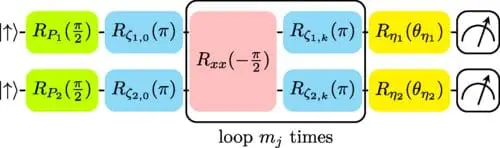
The article discusses the implementation of arbitrary circuits on a universal two-qubit register that can function as the computational module in a trapped-ion quantum computer. This is based on the quantum charge-coupled device architecture. A universal set of quantum gates is implemented on a two-ion Coulomb crystal of 9Be ions using only chip-integrated microwave addressing. Individual-ion addressing is implemented using microwave-micromotion sideband transitions. The researchers obtained upper limits on addressing crosstalk in the register. Arbitrary two-qubit operations are characterized using the cycle benchmarking protocol.
Trapped ions are considered one of the most promising platforms for building a universal, general-purpose digital quantum computer. Some of the key features of this technology include the availability of long-lived state pairs, long coherence times, high-fidelity quantum gates, and all-to-all connectivity. This can be either within one crystal or enabled by transport. Photons may be used to generate distributed entanglement for networking of remote trapped-ion quantum computers.
How Does the Quantum Charge-Coupled Device Architecture Work?
Microfabricated and surface electrode ion traps provide a scalable platform for the implementation of the quantum charge-coupled device (QCCD) architecture. In this architecture, all necessary operations are implemented in different specialized zones interconnected by the transport of ions. An elementary quantum core could consist of a two-qubit computation register combined with a junction and suitable storage registers, as well as an individual-ion readout and state preparation register.
In terms of scaling the trapped-ion platform, it is desirable to integrate core aspects of the control of trapped-ion qubits into a scalable microfabricated trap structure. Recent examples include trap-integrated detectors or optical addressing. An earlier example is the two-qubit gate based on chip-integrated microwaves.
What is the Role of the Two-Ion Coulomb Crystal of 9Be Ions?
The two-ion Coulomb crystal of 9Be ions plays a crucial role in the implementation of the universal set of quantum gates. These gates are implemented using only chip-integrated microwave addressing. This means that the individual ions are addressed using microwave-micromotion sideband transitions. This method has been found to limit addressing crosstalk in the register, which is a significant advantage in quantum computing.
Arbitrary two-qubit operations are characterized using the cycle benchmarking protocol. This protocol is a method for characterizing the performance of quantum gates and is crucial in the development and optimization of quantum computing systems.
How Does the Trapped-Ion Quantum Computer Work?
The trapped-ion quantum computer works by using ions as quantum bits or qubits. These ions are trapped using electromagnetic fields and manipulated using lasers or microwaves to perform quantum computations. The ions’ quantum states, such as their spin or their motion, can be used to store and process information.
One of the key advantages of trapped-ion quantum computers is their long coherence times. This means that the qubits can maintain their quantum states for a long time, allowing for more complex computations. Additionally, trapped-ion systems have high-fidelity quantum gates, meaning that the operations performed on the qubits are highly accurate.
What is the Potential of Trapped-Ion Quantum Computers?
Trapped-ion quantum computers have the potential to revolutionize computing by performing calculations much faster than traditional computers. They can also handle complex problems that are currently intractable for classical computers. This could have significant implications in various fields, including cryptography, optimization, and materials science.
Moreover, trapped-ion systems offer all-to-all connectivity, either within one crystal or enabled by transport. This means that any qubit can interact with any other qubit, providing a high degree of flexibility in the design of quantum algorithms. Photons may also be used to generate distributed entanglement for networking of remote trapped-ion quantum computers, further enhancing their potential for large-scale quantum computing.
What are the Challenges and Future Directions in Trapped-Ion Quantum Computing?
Despite the promising features of trapped-ion quantum computers, there are still challenges to be addressed. One of these is the need for scalable microfabricated trap structures to control the trapped-ion qubits effectively. Recent developments in this area include trap-integrated detectors and optical addressing, but more work is needed to fully realize the potential of these technologies.
Looking forward, the continued development and optimization of quantum gates, addressing methods, and benchmarking protocols will be crucial in advancing trapped-ion quantum computing. The integration of these components into a scalable, efficient, and reliable quantum computing system will be a significant step towards the realization of a universal, general-purpose digital quantum computer.
Publication Date: 2024-06-24
Authors: N. Pulido-Mateo, H. Mendpara, M. Duwe, T. Dubielzig, et al.
Source: Physical review research
DOI: https://doi.org/10.1103/physrevresearch.6.l022067