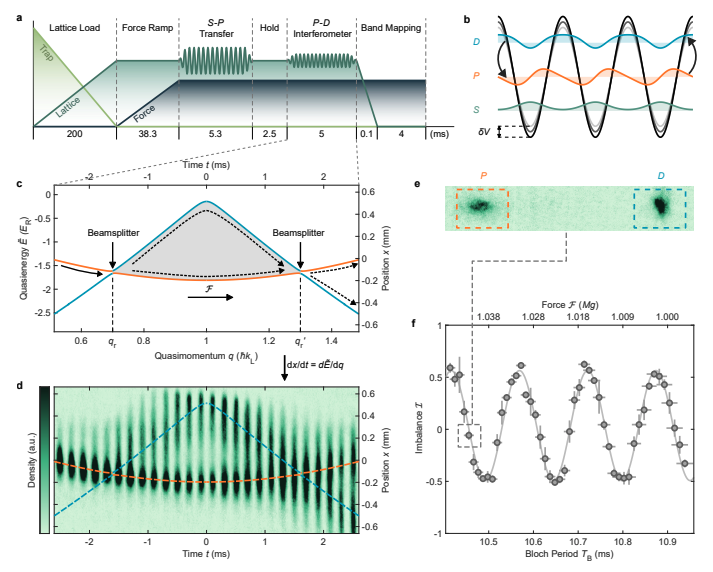
Atom interferometry, a technique leveraging the wave-like properties of matter to measure fundamental forces with exceptional precision, faces persistent challenges regarding the influence of external disturbances on trapped systems. Researchers are now exploring innovative approaches to mitigate these effects and enhance the stability of compact interferometers. A team from the University of California, Santa Barbara, led by Xiao Chai, Jeremy L. Tanlimco, Eber Nolasco-Martinez, and including Xuanwei Liang, E. Quinn Simmons, Eric Zhu, Roshan Sajjad, Hector Mas, and S. Nicole Halawani, alongside David M. Weld, details a novel platform in their article, “Continuously trapped matter-wave interferometry in magic Floquet-Bloch band structures”. Their work demonstrates a method utilising engineered, oscillating lattice potentials – known as Floquet systems – to create ‘magic’ band structures where the interferometric phase remains stable despite fluctuations in lattice intensity, offering a pathway to robust and tunable force sensors.
Atom interferometry represents a highly sensitive technique for detecting forces and accelerations, and recent advances demonstrate unprecedented stability through a continuously trapped, engineered system. Researchers now utilise a non-interacting Bose-Einstein condensate, a state of matter formed by cooling bosons to near absolute zero, subjected to amplitude-modulated optical lattices, creating a platform where the principles of Bloch oscillations and Landau-Zener tunneling underpin a Mach-Zehnder interferometer for precise force sensing. This innovative approach actively addresses systematic errors commonly encountered in traditional trapped atom interferometers, surpassing the limitations of designs relying on free-fall expansion.
The creation of ‘magic band’ structures within the optical lattices is central to this enhanced stability. These structures render the interferometric phase, the difference in the wavefunctions of the atoms, largely insensitive to fluctuations in lattice intensity, a significant source of noise in previous designs. Lattice depth, a measure of the potential energy experienced by the atoms, is calibrated in situ using S-D modulation spectroscopy, a technique that measures the energy difference between lattice bands, ensuring accurate control and maintaining the integrity of the interference pattern. Precise calibration of the modulation depth to 0.35 recoil energies (ER), a unit of energy related to the momentum of the atoms, is crucial for achieving a balanced beamsplitter in the Landau-Zener tunneling process, maximising the interferometer’s sensitivity.
A high degree of stability is achieved through
A high degree of stability is achieved through active stabilization loops controlling key experimental parameters. Lattice depth drift is maintained at less than 0.1 recoil energy after warm-up, facilitated by precise control of laser power, beam pointing, and gradient coil current. PID controllers, a feedback control mechanism, maintain stable laser power and precisely control beam pointing, minimising fluctuations in lattice depth and ensuring consistent interference conditions. The gradient coil current, which generates a magnetic field gradient, also undergoes active stabilization, maintaining consistent Bloch oscillations, periodic movements of atoms in a lattice, that drive the interferometer.
Researchers demonstrate a high degree of programmability, allowing for the creation of diverse interferometer structures tailored to specific force sensing applications. This flexibility stems from the precise control over the amplitude modulation of the optical lattices, enabling the creation of complex potential landscapes and manipulation of the atomic wavefunctions, opening up possibilities for exploring new sensing modalities and optimising performance for different measurement scenarios.
The experiment actively mitigates systematic errors, particularly those stemming from trap noise and finite pulse durations, through the continuous trapping of the atoms and the use of precisely controlled optical lattices. By eliminating the need for free-fall expansion, the system avoids the effects of gravity and reduces sensitivity to external vibrations, allowing for longer interrogation times, enhancing the sensitivity of the interferometer and enabling the detection of weaker forces.
Careful calibration of the modulation depth, performed at the magic condition, ensures optimal beamsplitting for interferometric measurements and maximises the signal-to-noise ratio. This ensures that the atomic wavefunctions are equally split at the beamsplitter, resulting in a clear and well-defined interference pattern. The team also investigates the impact of interatomic interactions, currently minimised through the use of a dilute gas, as a further avenue for exploration and optimisation.
The measured Bloch frequency serves as a direct
The measured Bloch frequency serves as a direct calibration point for the applied force, enabling quantitative force sensing with high precision and accuracy. Researchers carefully analyse the interference fringes to extract the Bloch frequency, which is directly proportional to the applied force, eliminating the need for complex calibration procedures and ensuring that the measurements are traceable to fundamental standards.
While the current implementation demonstrates the principle and achieves significant stability, future work focuses on extending the measurement time and improving the signal-to-noise ratio, involving optimisation of experimental parameters and implementation of advanced noise reduction techniques. Researchers also plan to investigate the potential for miniaturisation and integration of this platform, paving the way for developing compact, portable force sensors with a wide range of applications.
🗞 Continuously trapped matter-wave interferometry in magic Floquet-Bloch band structures
🧠 DOI: https://doi.org/10.48550/arXiv.2506.11881