

Creating stable and scalable quantum computers requires overcoming significant hurdles in qubit design and performance, and researchers are now focusing intensely on optimising these fundamental building blocks. Jonnalagadda Gayatri and S. Saravana Veni, both from the Department of Physics at Amrita Vishwa Vidyapeetham, alongside their colleagues, present a comprehensive approach to improving transmon qubits, a leading architecture for scalable quantum systems. Their work addresses the critical link between material properties and qubit performance, demonstrating how careful material selection and design iteration can significantly enhance coherence and reduce energy loss. This research offers a practical framework for developing more reliable quantum systems, paving the way for continued progress towards fault-tolerant and scalable quantum computing.
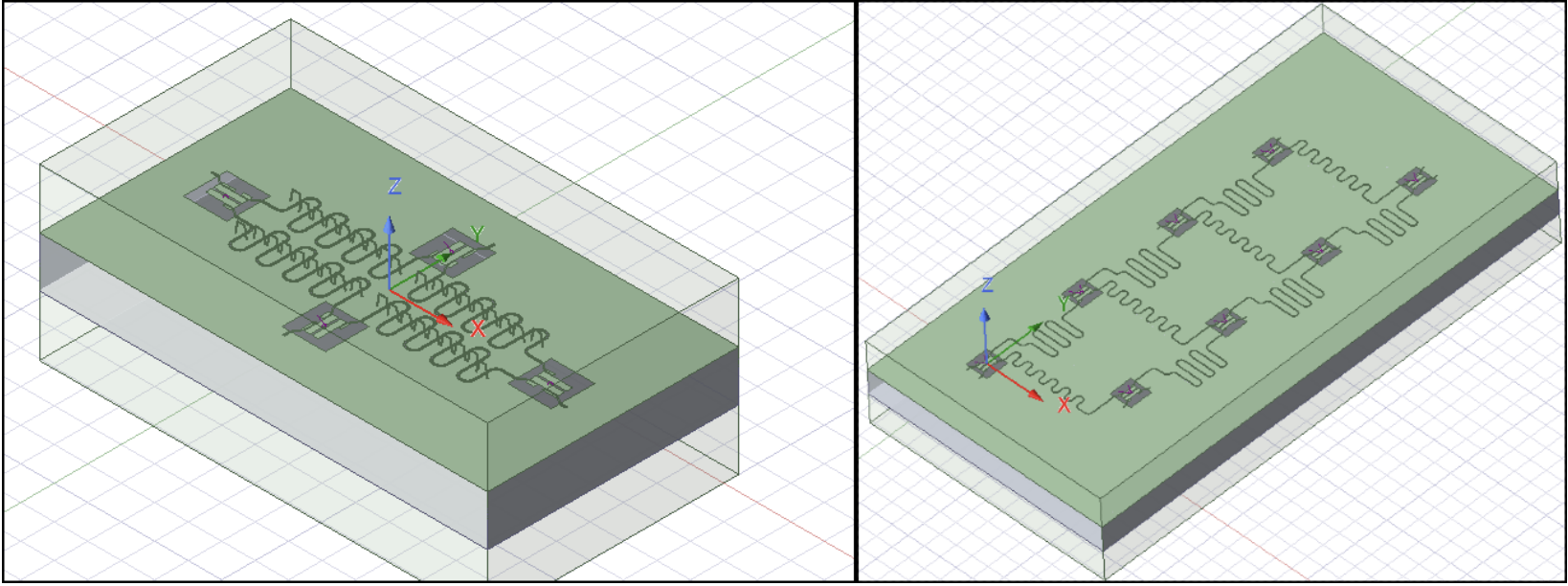
Superconducting qubits, particularly those based on the Transmon architecture, are leading candidates for building scalable quantum computers due to their compatibility with standard fabrication techniques and reduced sensitivity to noise. This work addresses the challenge of optimising superconducting qubit performance through a combination of design iteration, material analysis, and simulation. The team created Transmon-based layouts for both four-qubit and eight-qubit systems using specialised design software, subsequently performing detailed analyses for each qubit within these layouts. Investigations focused on key characteristics like anharmonicity and the extraction of eigenfrequencies, with participation ratios computed across multiple design passes to refine performance.
Quantum Control and Error Mitigation Techniques
Researchers are actively developing techniques to control and correct errors in quantum computations, essential for building reliable quantum computers. These techniques involve sophisticated control pulses, error detection codes, and strategies for mitigating the effects of noise and decoherence. The development of these techniques is crucial for overcoming the inherent fragility of quantum states and achieving fault-tolerant quantum computation.
Transmon Qubit Performance via Design Optimisation
Researchers are making significant strides in the development of superconducting qubits, essential building blocks for practical quantum computers. Their work focuses on optimising the design and materials used to create these qubits, specifically those based on the Transmon architecture, which are known for their relative resilience to noise. This research demonstrates a comprehensive approach, combining detailed simulations with material analysis to improve qubit performance and scalability. Simulations of both four-qubit and eight-qubit structures revealed that increasing the ratio of Josephson energy to charging energy within the qubits leads to a flattening of energy bands.
This flattening is crucial because it significantly reduces the qubits’ susceptibility to charge noise, a major obstacle in quantum computing. The eight-qubit designs consistently outperformed the four-qubit designs, demonstrating improved fabrication uniformity and greater stability. Further analysis revealed that the eight-qubit chip exhibited significantly lower dispersion, a measure of, ranging from.
👉 More information
🗞 Material-Driven Optimization of Transmon Qubits for Scalable and Efficient Quantum Architectures
🧠 ArXiv: https://arxiv.org/abs/2508.05339


