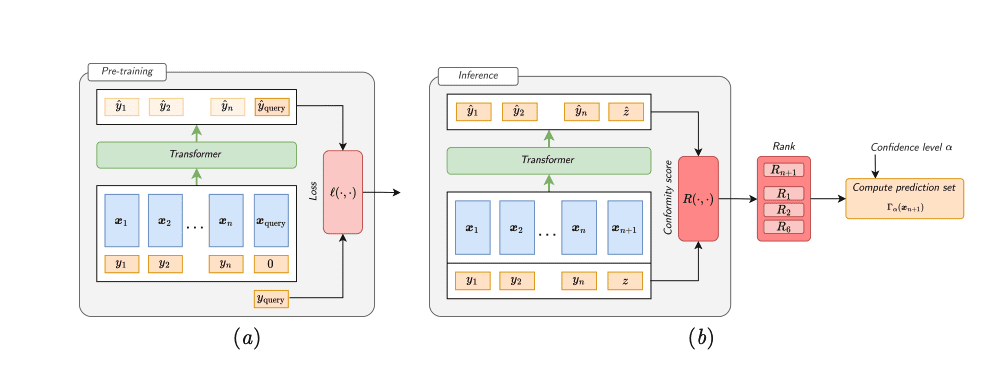
On April 22, 2025, researchers Zhe Huang, Simone Rossi, Rui Yuan, and Thomas Hannagan published a study titled From predictions to confidence intervals: an empirical study of conformal prediction methods for in-context learning. The paper explores applying conformal prediction techniques to enhance uncertainty quantification in transformer-based models, specifically focusing on their in-context learning capabilities. By leveraging these methods, the authors propose an efficient approach to constructing confidence intervals during inference, which they validate through comparisons with ridge regression-based conformal methods and evaluations under distribution shifts.
Transformers demonstrate strong in-context learning (ICL) abilities, but uncertainty quantification remains challenging, especially in noisy regression tasks. This paper proposes a method leveraging ICL for distribution-free uncertainty estimation using conformal prediction, enabling efficient construction of prediction intervals with guaranteed coverage. Unlike traditional conformal methods requiring repeated model fitting, this approach generates confidence intervals in a single forward pass. Empirical analysis shows that conformal prediction with ICL achieves robust and scalable uncertainty estimates compared to ridge regression-based methods. The framework also performs well under distribution shifts and establishes scaling laws for model training, bridging ICL and conformal prediction for transformer-based models.
The article discusses in-context learning (ICL) as a method for machine learning models to adapt without extensive retraining, focusing on its efficiency and practical applications. Here’s a structured summary addressing potential questions and clarifications:
- In-Context Learning Mechanism: ICL allows models to adapt by providing context or examples during inference, often through prompts. This approach enables the model to leverage existing knowledge for new tasks without additional training.
- Conformal Prediction: Conformal prediction is a statistical method that provides uncertainty estimates for predictions. It helps in evaluating the reliability of ICL by generating accurate prediction intervals, ensuring trustworthiness in model outputs.
- Wasserstein-1 Distance vs. KL Divergence: Wasserstein-1 distance (Earth Mover’s Distance) measures the difference between probability distributions by considering the cost to transform one distribution into another. Unlike KL divergence, which can be undefined for non-overlapping distributions, Wasserstein distance is more robust and interpretable.
- Scaling Laws in ICL Context: Scaling laws describe how model performance improves with increased size or data. In ICL, larger models tend to produce more reliable prediction intervals. The study used JAX’s AOT compilation for precise computation optimization and fitted scaling laws to predict performance changes with varying resources.
- Limitations of ICL: While not explicitly mentioned, potential challenges include the need for careful context provision, computational overhead during inference, and the effectiveness of ICL across diverse tasks compared to traditional methods.
ICL offers a promising approach for efficient model adaptation, validated through conformal prediction and distribution comparison metrics. Understanding its mechanisms, validation techniques, and scaling implications provides insights into its potential and challenges in practical applications.
👉 More information
🗞 From predictions to confidence intervals: an empirical study of conformal prediction methods for in-context learning
🧠 DOI: https://doi.org/10.48550/arXiv.2504.15722