Crystals manipulate light at incredibly small scales, forming the basis for advances in photonics and quantum technologies, and understanding how light travels through these materials requires detailed analysis using band diagrams. Generating these diagrams, however, is computationally demanding, particularly when designing new crystal structures, and this limits progress in the field. Valentin Delchevalerie, Nicolas Roy, Arnaud Bougaham, and colleagues at the University of Namur now present a breakthrough approach, the first to generate band diagrams using diffusion models, offering a significantly faster and more efficient alternative to traditional methods. By combining a transformer network, which understands the structure of the crystal, with a latent diffusion model, the team demonstrates a powerful new technique that promises to accelerate the design of complex photonic materials and scale to three-dimensional structures, opening up exciting possibilities for future innovation.
Diffusion Models Design Photonic Bandgap Structures
This research details the implementation and results of utilizing diffusion models for the design of photonic bandgap structures, offering an innovative approach to photonics research. The core innovation lies in automatically designing structures that control light based on desired optical properties, a process known as inverse design. The system relies on several key components working in concert. A Material-to-Code Encoder transforms the physical representation of a photonic structure into a compressed code, capturing its essential features. Simultaneously, a Band Diagram Encoder/Decoder processes the optical properties of the structure, compressing and reconstructing band diagrams, which represent how light propagates through the material.
A Latent Diffusion Model, the central generative component, learns the relationships between these codes and generates new designs. Within the diffusion model, a U-Net architecture performs the crucial task of denoising the latent representation, refining the generated designs. The training process involved carefully tuning several parameters, including batch size, the AdamW optimizer, learning rate, weight decay, cosine annealing, and Exponential Moving Average, to improve performance and prevent overfitting. The architecture incorporates convolutional layers for feature extraction, residual blocks to facilitate training of deeper networks, and attention blocks to focus on important features. The Band Diagram encoder utilizes a Vision Transformer, leveraging the power of transformer architecture for image processing. The results demonstrate the ability to generate structures and predict their optical properties, offering a new pathway for designing advanced photonic devices.
Latent Diffusion Models Accelerate Band Diagram Calculation
Photonic crystals, structures that control light propagation, are vital for advances in telecommunications and optical computing. Traditional design requires computationally intensive band diagram calculations, creating a bottleneck for optimization. Researchers addressed this challenge by developing a novel method for generating band diagrams directly from the geometric structure of photonic crystals, bypassing traditional simulation methods. This work pioneers the application of latent diffusion models, combined with transformer encoders, to create a scalable surrogate modeling strategy for photonics research.
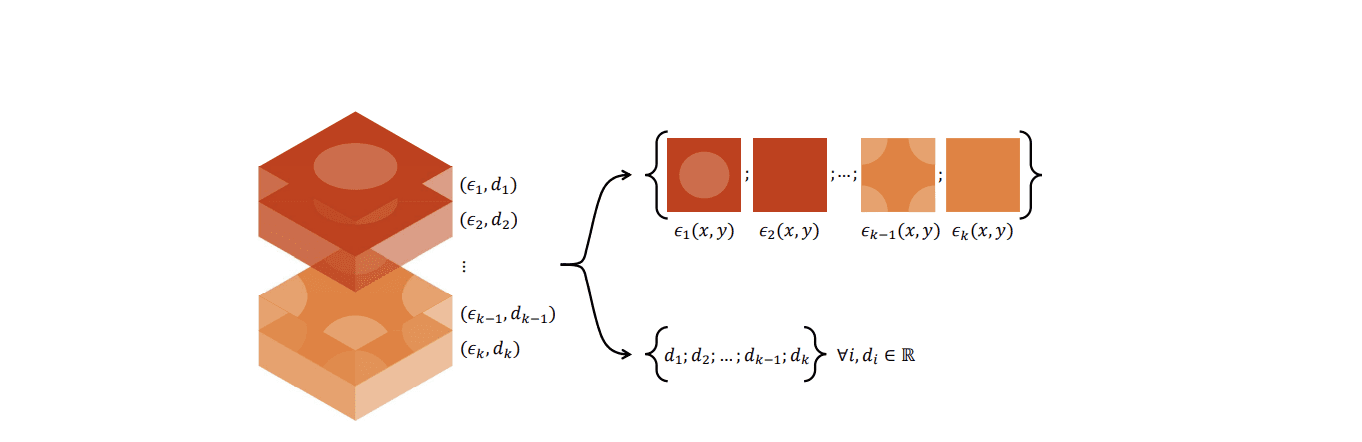
The team engineered a system that couples a transformer encoder with a latent diffusion model to generate band diagrams. The transformer encoder processes the three-dimensional structure of the photonic crystal, extracting contextual embeddings that capture the complex relationships within the material. These embeddings then condition the latent diffusion model, guiding the generation of the corresponding band diagram as an image. Crucially, the researchers adopted a slicing strategy, representing the 3D structure as a sequence of 2D slices, which avoids the computational burden of 3D convolutions and enhances scalability to arbitrary 3D designs. This approach leverages the transformer’s ability to model sequential data, effectively capturing the complex couplings inherent in photonic crystal structures. The method offers a significant speedup compared to conventional methods, paving the way for more efficient design and optimization of photonic crystals for a wide range of applications.
Diffusion Models Generate Photonic Crystal Band Diagrams
Scientists have developed a new method for generating band diagrams, essential tools for understanding how light propagates through complex three-dimensional photonic crystals. This breakthrough addresses a significant computational challenge, as traditional methods for calculating band diagrams require solving complex equations for numerous configurations, making the process extremely time-consuming. The research team introduced the first approach leveraging diffusion models, a type of generative artificial intelligence, to efficiently produce accurate band diagrams. The core of this work lies in coupling a transformer encoder, which extracts contextual information from the crystal structure, with a latent diffusion model to generate the corresponding band diagram.
This innovative combination allows the model to learn the complex relationships between the crystal’s geometry and its optical properties. To train and validate their method, the team generated a dataset of thousands of photonic crystals, each constructed from stacks of layers containing air holes and dielectric materials. Rigorous coupled-wave analysis was used to compute the band diagrams for these structures. Measurements confirm that the model can accurately predict the behavior of light within these crystals, even with variations in layer thickness, hole radius, and material properties. The resulting band diagrams exhibit strong variations and discontinuities, demonstrating the model’s ability to capture complex optical phenomena. This represents a significant advancement in computational efficiency and paves the way for the design of more complex and sophisticated photonic devices.
Fast Band Diagram Prediction via Diffusion Models
This work introduces a novel method for generating band diagrams, crucial tools for investigating light propagation within three-dimensional photonic crystals. Researchers successfully combined transformer encoders with latent diffusion models, creating a system capable of rapidly predicting band diagrams for complex structures. The transformer encoders effectively capture the intricate relationships within the photonic crystal’s geometry. The resulting models offer substantial speedups compared to conventional rigorous coupled-wave analysis simulations, achieving significant acceleration for both smaller and more detailed structures.
While acknowledging a reduction in fidelity when increasing the number of layers within the photonic crystal, the team emphasizes that these surrogate models are not intended to replace rigorous simulations entirely. Instead, they provide a valuable tool for accelerating computationally intensive tasks, particularly during the exploration of large design spaces for inverse design applications. This approach offers a pathway to accelerate the development of advanced optical technologies and may extend to other areas of physics, such as the calculation of electronic band structures in solid-state materials.
👉 More information
🗞 Towards Photonic Band Diagram Generation with Transformer-Latent Diffusion Models
🧠 ArXiv: https://arxiv.org/abs/2510.01749