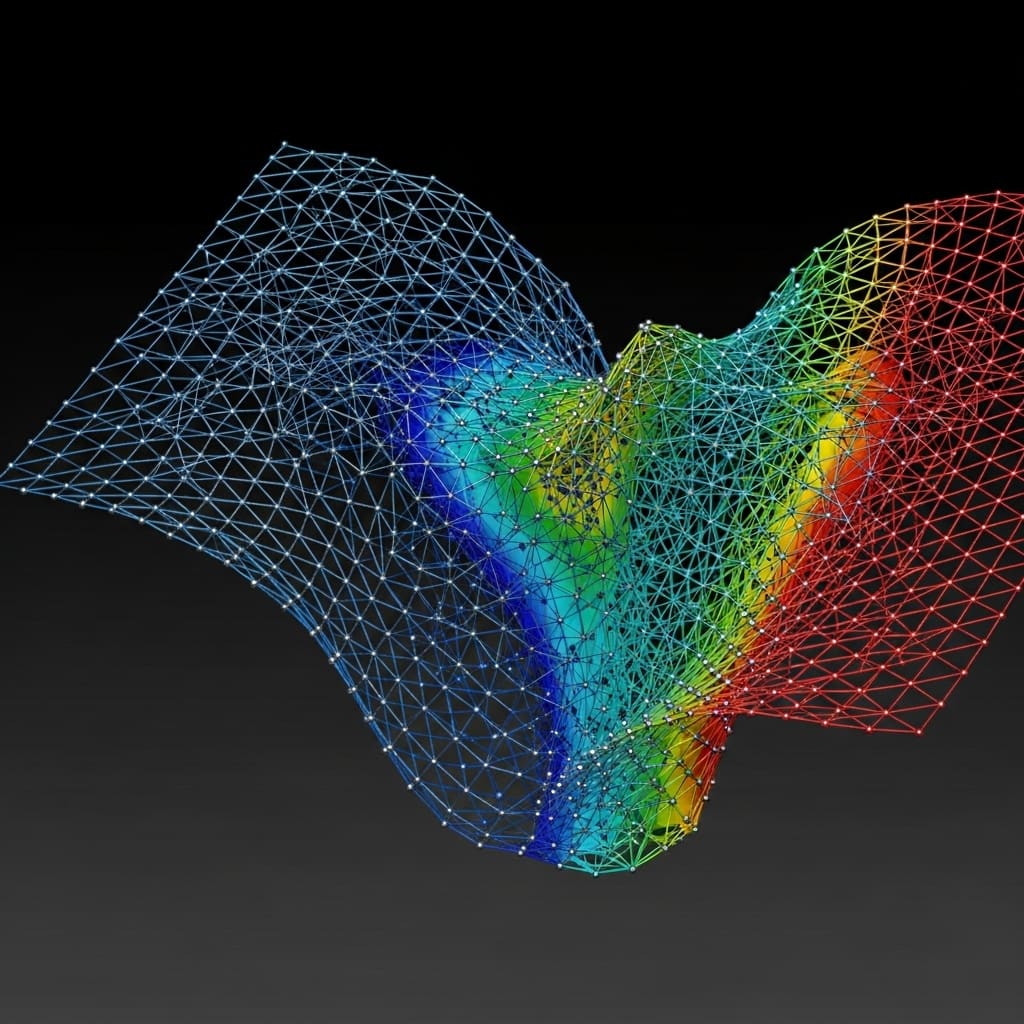
Researchers are tackling the challenge of simulating complex solid mechanics with a new approach called MeshGraphNet-Transformer (MGN-T). Mikel M. Iparraguirre, Iciar Alfaro, and David Gonzalez, all from Universidad de Zaragoza, alongside Elias Cueto et al, have developed this novel framework which combines the strengths of Transformers and MeshGraphNets to overcome limitations in processing large, high-resolution meshes. MGN-T introduces a physics-attention mechanism enabling efficient, simultaneous updates of nodal states, crucially improving long-range information propagation and allowing for accurate modelling of phenomena like impact dynamics, self-contact, and plasticity at an industrial scale. This advancement represents a significant step towards practical, efficient learned simulation, surpassing existing methods in both accuracy and parameter efficiency.
The research overcomes a key challenge with standard MeshGraphNets, inefficient long-range information propagation on large, high-resolution meshes, by introducing a physics-attention Transformer as a global processor.
This innovative approach simultaneously updates all nodal states while explicitly preserving crucial node and edge attributes, enabling efficient learning on complex meshes with varying geometries, topologies, and boundary conditions at an industrial scale. The team achieved this breakthrough by directly capturing long-range physical interactions, eliminating the need for deep message-passing stacks or hierarchical, coarsened meshes often required by existing methods.
Experiments demonstrate that MGN-T successfully handles industrial-scale meshes for impact dynamics, a scenario where standard MeshGraphNets struggle due to message-passing under-reaching. The method accurately models complex physical phenomena, including self-contact, plasticity, and multivariate outputs encompassing internal, phenomenological plastic variables.
This study reveals that MGN-T outperforms state-of-the-art approaches on classical benchmarks, achieving higher accuracy with significantly fewer parameters than competing baselines. By leveraging a physics-attention mechanism, the research establishes a new paradigm for scalable mesh-based learned simulation.
The work opens possibilities for accelerating simulations in fields like automotive crash safety, aerospace engineering, and materials science, potentially reducing reliance on computationally expensive finite element methods. Furthermore, the research demonstrates the ability to accurately model intricate behaviours, such as plasticity, using only a fraction of the parameters needed by alternative techniques.
The innovative architecture facilitates generalisation to unseen meshes, offering a robust solution for real-world applications demanding high fidelity and computational efficiency. This advancement promises to accelerate the development of more accurate and efficient simulations across a range of engineering disciplines.
Physics-informed global attention for efficient impact dynamics modelling enables accurate and fast simulations
Scientists developed MeshGraphNet- (MGN-T), a novel architecture combining global modelling with the geometric inductive bias of MeshGraphNets, while maintaining a mesh-based graph representation. The research team addressed a key limitation of standard MGN, inefficient long-range information propagation on large meshes, by implementing a physics-attention mechanism as a global processor.
This physics-attention simultaneously updates all nodal states, explicitly retaining both node and edge attributes, thereby directly capturing long-range physical interactions. The study pioneered a method eliminating the need for deep message-passing stacks or hierarchical meshes, enabling efficient learning on high-resolution meshes with varying geometries, topologies, and boundary conditions at an industrial scale.
Experiments employed industrial-scale meshes to assess impact dynamics, a scenario where standard MGN suffers from message-passing under-reaching. The technique accurately models complex physical phenomena including self-contact, plasticity, and multivariate outputs encompassing internal, phenomenological plastic variables.
Researchers engineered a system that outperforms state-of-the-art approaches on classical benchmarks, achieving higher accuracy with a fraction of the parameters required by competing baselines. The approach leverages graph neural networks operating on graph-structured inputs derived from finite element models, where nodes represent state variables and edges define mesh connectivity.
This work focused on learning from high-fidelity simulations by integrating physics knowledge during training, overcoming limitations of traditional finite element methods which demand high computational cost, especially for many-query problems. The team’s innovative method addresses the under-reaching problem inherent in node-centric formulations by enabling global information propagation, thus improving accuracy and efficiency in complex simulations.
Physics-informed global processing enhances learning on industrial-scale meshes by improving generalization and robustness
Scientists have developed MeshGraphNet-Transformer (MGN-T), a novel architecture combining global modelling with the geometric inductive bias of MeshGraphNets, while maintaining a mesh-based graph representation. The team overcame a key limitation of standard MGN, inefficient long-range information propagation, through the implementation of a physics-attention mechanism serving as a global processor.
This processor simultaneously updates all nodal states while explicitly retaining both node and edge attributes, enabling efficient learning on high-resolution meshes with varying geometries, topologies, and boundary conditions at an industrial scale. Experiments revealed that MGN-T successfully handles industrial-scale meshes for impact dynamics, a setting where standard MGN experiences message-passing under-reaching.
The method accurately models complex physical phenomena including self-contact, plasticity, and multivariate outputs encompassing internal, phenomenological plastic variables. Measurements confirm that MGN-T outperforms state-of-the-art approaches on classical benchmarks, achieving higher accuracy with a fraction of the parameters required by competing baselines.
Results demonstrate that MGN-T eliminates the need for deep message-passing stacks or hierarchical, coarsened meshes, addressing a common issue in partial differential equation solutions that cause non-compliance with energy conservation laws. The breakthrough delivers reliable accuracy without requiring excessively fine discretizations, significantly reducing computational demands.
Data shows that the work leverages physics knowledge during training, embedding human expertise within the physical models and constitutive equations. Scientists recorded that MGN-T’s architecture combines two Message Passing Neural Network (MPNN) blocks for local updates with a Transformer physics-attention for global updates, facilitating efficient global updates while preserving mesh-based structure.
Tests prove that this approach retains the powerful feature engineering of MGN, explicitly modelling collisions and self-contact, while capturing long-range interactions without the limitations of iterative message passing. The breakthrough offers potential for accelerating simulations and improving the accuracy of predictions in complex physical systems.
MGN-T achieves efficient and accurate simulation of complex mechanical behaviours through advanced finite element methods
Scientists have developed MeshGraphNet-T (MGN-T), a new neural network architecture for simulating complex physical phenomena. This model combines global processing with geometric understanding, utilising a mesh-based graph representation to efficiently model systems with varying shapes and conditions.
MGN-T addresses limitations in existing methods by employing a physics-attention mechanism, enabling simultaneous updates to all nodal states and eliminating the need for extensive message-passing procedures. The research demonstrates MGN-T’s ability to accurately simulate industrial-scale impact dynamics, including self-contact and plasticity, where conventional methods struggle.
Importantly, the model achieves higher accuracy than current state-of-the-art approaches while using significantly fewer parameters. The method’s success extends to both impact dynamics and quasi-static regimes, showcasing its versatility in handling diverse mechanical problems. Authors acknowledge that the current implementation relies on synthetic training data generated from high-fidelity simulations, which may introduce biases.
Future work could explore training on real-world data to enhance robustness and generalizability. Further research directions include extending the model to handle more complex material behaviours and exploring its application to a wider range of engineering simulations, potentially incorporating fluid-structure interaction or multi-physics problems.
🗞 MeshGraphNet-Transformer: Scalable Mesh-based Learned Simulation for Solid Mechanics
🧠 ArXiv: https://arxiv.org/abs/2601.23177