

Scientists are tackling the crucial challenge of error correction in quantum computing, essential for safeguarding information from noise by distributing it across numerous qubits. Hoang Viet Nguyen, Manh Hung Nguyen, and colleagues from Hanoi University of Science and Technology, alongside Van Khu Vu of VinUniversity and Yeow Meng Chee from Singapore University of Technology and Design, present a novel decoder architecture called QuantumSMoE. This research is significant because it combines the strengths of both classical algorithms and machine learning, utilising a vision transformer to explicitly incorporate the geometric structure of stabilizer codes , specifically the surface code , and offering improved scalability through a mixture of experts layer. Their experiments on the toric code demonstrate QuantumSMoE surpasses existing machine learning decoders and established classical methods, paving the way for faster and more reliable quantum computation.
Vision Transformer Decodes Toric Code Geometry
Scientists have unveiled QuantumSMoE, a novel decoder for quantum error correction that significantly improves the fidelity of surface code decoding. This breakthrough addresses a central bottleneck in scalable, real-time quantum computation, the efficient decoding of syndrome information obtained from stabilizer measurements. The research team achieved this by developing a vision transformer based decoder that explicitly incorporates the geometric structure of topological codes, specifically the toric code, through innovative plus-shaped embeddings and adaptive masking techniques. These methods effectively capture local interactions and lattice connectivity, enhancing the decoder’s ability to infer error patterns and apply appropriate recovery operations.
The study reveals a new approach to decoding that moves beyond traditional methods, which are often limited by computational overhead or a failure to fully exploit the inherent structure of quantum codes. Existing decoders fall into two main categories: classical algorithmic decoders, offering strong baselines but struggling with scalability, and machine learning based decoders, providing fast inference but often neglecting the crucial lattice geometry of the codes. QuantumSMoE distinguishes itself by combining the strengths of both approaches, leveraging a mixture of experts layer alongside a novel auxiliary loss function to improve scalability and performance. Experiments demonstrate that QuantumSMoE consistently outperforms state-of-the-art machine learning decoders and widely used classical baselines on the toric code, marking a substantial advancement in the field.
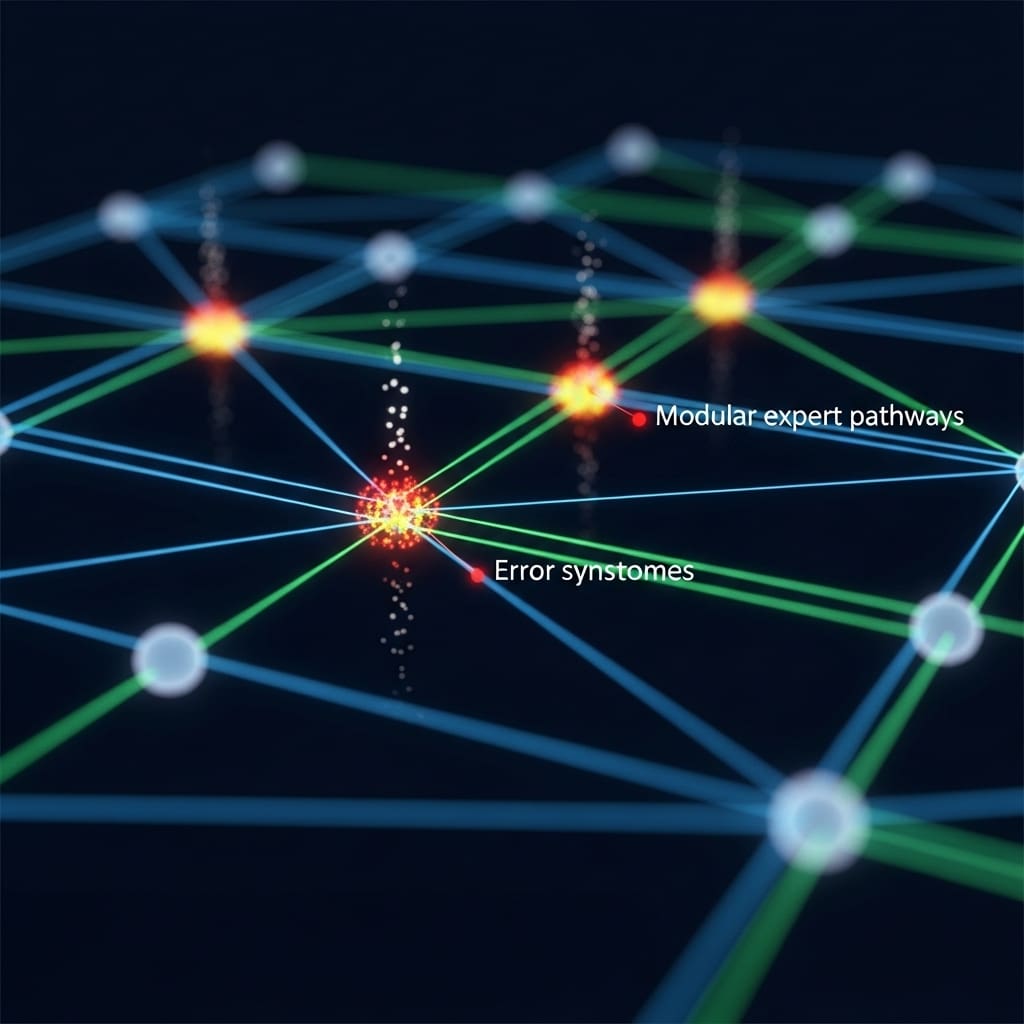
This work establishes a new paradigm for quantum decoding by drawing inspiration from vision models and their ability to exploit spatial inductive biases. The team implemented a vision transformer architecture, recognizing its potential to model both local and global information within the quantum code. Furthermore, they integrated a mixture of experts layer, a technique proven successful in large language models, to enhance representational capacity without sacrificing inference efficiency, a critical requirement for real-time decoding applications. The innovative SoftMoE component addresses challenges associated with standard MoE models, such as load balancing and routing discontinuities, by mapping tokens into aggregated slots, ensuring a more stable and efficient decoding process.
Experiments on the toric code conclusively demonstrate QuantumSMoE’s superior performance, showcasing its ability to achieve higher fidelity decoding compared to existing methods. The decoder’s design, incorporating plus-shaped embeddings and adaptive masking, allows it to effectively capture the geometric properties of the surface code and enforce spatial locality, leading to more accurate error pattern identification. This breakthrough opens exciting possibilities for building larger, more robust quantum. The team measured performance across a range of physical error rates and code distances, achieving superior results compared to methods like MWPM, MWPM-Corr, BP LSD, and the QECCT decoder.
This breakthrough delivers a substantial advancement in the ability to protect quantum information from physical noise by efficiently decoding error syndromes into accurate recovery operations. Researchers incorporated code structure into QuantumSMoE through plus-shaped embeddings and adaptive masking, enabling the model to capture local interactions and lattice connectivity within the quantum code. The decoder focuses only on pertinent neighboring regions, reducing computational demands and enhancing scalability. Furthermore, a novel auxiliary loss was implemented to optimise token-to-slot assignment within SoftMoE blocks, promoting more effective grouping of similar inputs and improving the decoder’s ability to classify complex errors.
Data shows this approach is among the first to successfully utilise a Mixture-of-Experts architecture to enhance machine learning based decoders for quantum error-correcting codes. Tests prove that QuantumSMoE’s architecture explicitly incorporates geometric and topological characteristics of the toric code, leading to more accurate decoding. The slot orthogonality loss encourages the SoftMoE module to assign similar patch inputs to the same subset of experts, refining the decoding process. Extensive numerical evaluations confirm that the proposed approach yields superior logical error rate reduction compared to classical baselines and existing machine learning models.
Specifically, the toric code served as a standard benchmark for controlled evaluation, allowing for precise measurement of performance gains. Measurements confirm that the integration of a Mixture-of-Experts layer, combined with the auxiliary loss, allows QuantumSMoE to accurately classify complicated errors at each decoding stage with only modest computational overhead. The work establishes a new paradigm for quantum error correction, demonstrating the power of vision transformers and Mixture-of-Experts in addressing the critical bottleneck of scalable, real-time decoding. This breakthrough has the potential to accelerate the development of fault-tolerant quantum computers by providing a more efficient and accurate method for protecting quantum information.
QuantumSMoE boosts error correction performance significantly
Scientists have developed QuantumSMoE, a novel decoder for quantum error correction that combines Vision Transformers with mixture-of-experts architectures. This framework leverages plus-shaped embeddings and adaptive masking to effectively capture the local connectivity inherent in topological stabilizer codes, such as the toric code. Experiments demonstrate that QuantumSMoE significantly reduces logical error rates compared to both established classical decoders and existing machine learning-based approaches under depolarizing noise. The key innovation lies in the decoder’s ability to isolate and emphasize critical syndrome information through a SoftMoE layer and slot orthogonality loss, simplifying the learning process for individual experts within the mixture-of-experts framework.
Each expert specialises in identifying a specific error pattern, allowing for efficient decoding of complex errors. The authors acknowledge a limitation in that their current work focuses on the toric code and depolarizing noise, and future research will explore extending this approach to higher-dimensional codes and more realistic noise models, including syndrome measurement and circuit noise. This work represents a substantial advance in the field of quantum error correction, potentially paving the way for more scalable and reliable quantum computation.
👉 More information
🗞 A Mixture of Experts Vision Transformer for High-Fidelity Surface Code Decoding
🧠 ArXiv: https://arxiv.org/abs/2601.12483


