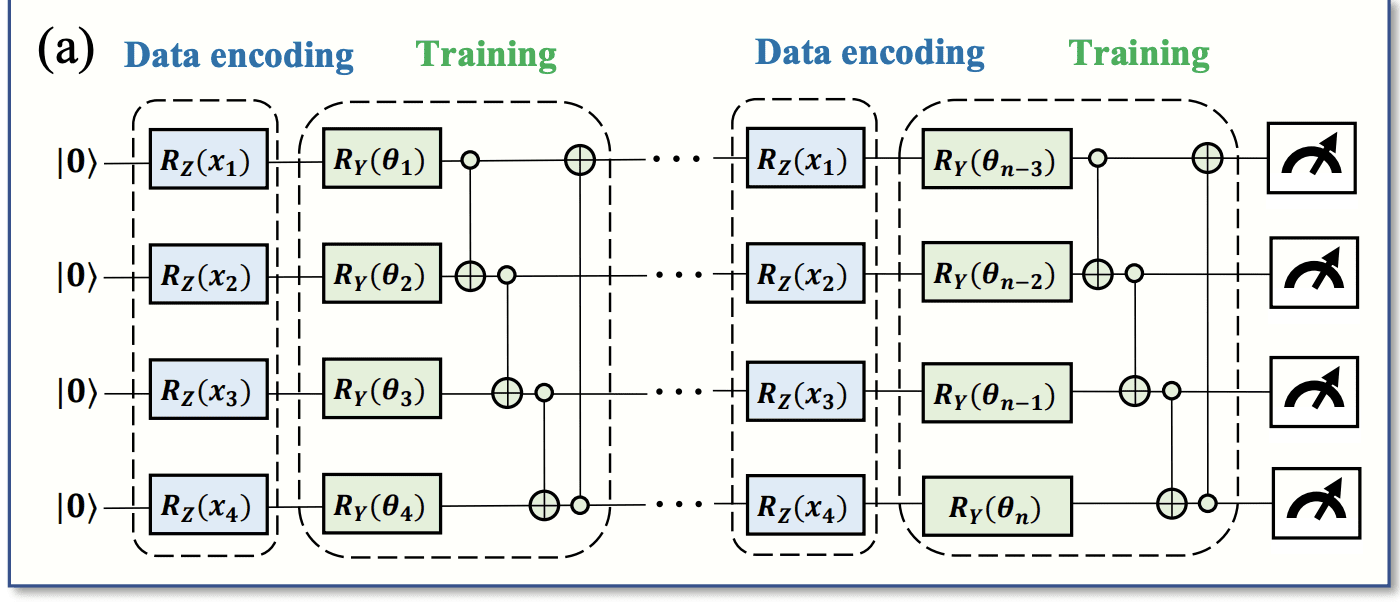
Pulse-based quantum machine learning represents a promising new approach to artificial intelligence, offering potential advantages in hardware efficiency. Researchers Han-Xiao Tao, Xin Wang, and Re-Bing Wu, all from Tsinghua University, investigate a critical challenge in this emerging field: how to build models that are both powerful enough to solve complex problems and easy enough to train. Their work addresses a key trade-off, demonstrating that maintaining trainability often comes at the cost of expressivity, and they identify a crucial condition relating the model’s initial state, measurement process, and underlying symmetry. This research establishes a fundamental framework for designing practical pulse-based quantum machine learning models, paving the way for algorithms that can balance computational power with the ability to learn effectively.
Studies suggest that pulse-based models, guided by dynamic symmetry, can be effectively trained thanks to a beneficial optimization landscape that avoids common training difficulties. However, inadequate design can compromise a model’s ability to represent complex data, limiting its usefulness. This research investigates the requirements for pulse-based quantum machine learning (QML) models to be both expressive and trainable, presenting a necessary condition relating the system’s initial state, the measurement process, and the underlying symmetry of the system, supported by numerical simulations. These findings establish a framework for designing practical pulse-based QML models that balance the ability to learn with the capacity to represent complex information.
Quantum Neural Network Expressivity and Variance Analysis
This work provides a detailed analysis of the expressivity and variance of four distinct quantum machine learning models. The analysis calculates the variance of the QNN output, a crucial metric for trainability, as a high variance indicates sensitivity to control parameter changes, which is desirable for optimization. The results validate theoretical predictions, providing empirical evidence to support understanding of the factors affecting QNN trainability, such as initial state choice and Lie algebra dimension, and can inform the design of better QNNs with improved expressivity and trainability.
Dynamic Symmetry Enables Trainable Quantum Models
Pulse-based quantum machine learning (QML) offers a promising path towards efficient hardware implementation of artificial intelligence. However, practical QML models must be both capable of representing complex functions and trainable, meaning their parameters can be adjusted to improve performance. Recent research has focused on achieving this balance, recognizing that models designed for expressivity can become difficult to train due to unfavorable characteristics in the optimization process. This work reveals a critical link between a pulse-based QML model’s design, its trainability, and its ultimate expressivity.
Researchers have demonstrated that dynamic symmetry, a principle governing the system’s evolution, can facilitate training by creating a more manageable optimization landscape. The analysis utilizes a mathematical tool borrowed from control theory to analyze how the pulse-based model responds to inputs and determine its capacity to represent complex functions. Experiments confirm these theoretical findings, demonstrating that pulse-based QML models with dynamic symmetry can achieve a favorable balance between trainability and expressivity, paving the way for the development of practical and powerful pulse-based QML models.
Expressivity and Trainability in Quantum Models
This work establishes a framework for designing practical pulse-based quantum machine learning (QML) models that balance expressivity and trainability. The research demonstrates that models leveraging dynamic symmetry can be effectively trained due to a beneficial optimization landscape, provided certain conditions relating to the system’s initial state, measurement observable, and underlying Lie algebra are met. The findings reveal a relationship between model expressivity and the choice of Hamiltonian structure, initial state, and observable, with smaller models sometimes outperforming larger ones when qubit numbers are limited. Simulations suggest that larger models will eventually become more expressive as qubit numbers increase, aligning with theoretical predictions. The authors acknowledge that satisfying the necessary condition for expressivity does not guarantee complete expressivity, particularly with constrained control pulses, and further investigation is needed. Additionally, the trade-off between model expressivity, trainability, and generalizability remains an important area for future research.
👉 More information
🗞 On the Design of Expressive and Trainable Pulse-based Quantum Machine Learning Models
🧠 ArXiv: https://arxiv.org/abs/2508.05559