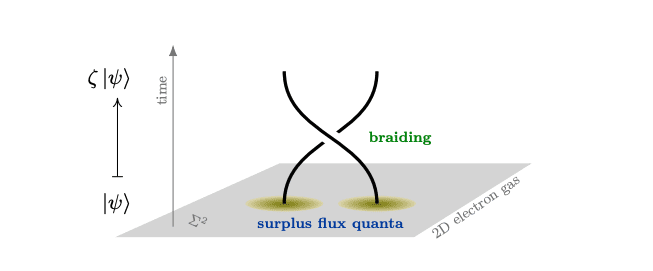
The pursuit of robust quantum computation necessitates the identification and control of exotic states of matter exhibiting topological order, where information is encoded not in local degrees of freedom but in the global properties of the system. Recent observations of fractional anomalous Hall (FQAH) states, characterised by fractionalised quantum Hall effects in the absence of an external magnetic field, present a promising avenue for realising such topological hardware. However, confirming the existence of the crucial anyonic excitations, quasiparticles obeying non-Abelian statistics essential for quantum computation, remains a significant challenge. Hisham Sati and Urs Schreiber, alongside colleagues at the Center for Quantum and Topological Systems at New York University Abu Dhabi, address this issue in their work, “Identifying Anyonic Topological Order in Fractional Quantum Anomalous Hall Systems”. Their research establishes a link between the fragile topology of these systems and the identification of anyons within momentum space, utilising a theorem from algebraic topology dating back to 1980, and providing a framework for understanding symmetry-protected topological order in FQAH systems through computations in equivariant cohomotopy.
Recent advances in topological quantum computation are driven by research establishing a definitive link between fragile band topology and the emergence of anyonic states, which are crucial for developing fault-tolerant quantum information processing. Investigations reveal that fractional quantum anomalous Hall (FQAH) systems host these exotic particles, which arise from monodromy – a multi-valuedness arising from traversing a closed loop in parameter space – within their delicate topological structure. This provides a theoretical framework for predicting and controlling their behaviour. Applying a theorem developed by Larmore and Thomas in 1980, scientists pinpoint FQAH anyons directly within momentum space, significantly constraining the possibilities for viable quantum states and offering a powerful tool for material screening and device design.
This research moves beyond material-specific investigations by establishing a general connection between fragile band topology and the existence of anyonic states. The findings demonstrate that these particles emerge from the inherent monodromy within the topological structure of these materials, offering a foundation for designing materials with tailored quantum properties. Scientists successfully reduce the complex problem of symmetry-protected topological order in FQAH systems to computations within equivariant cohomotopy, a sophisticated branch of mathematics concerned with functions respecting symmetry groups, and leverage established mathematical tools to predict and understand the behaviour of these systems with greater precision.
Investigations reveal that admissible braiding phases, which dictate how anyons exchange and interact, are constrained to be the 2C-th roots of unity, where C represents the Chern number, a topological invariant characterising the band structure. This finding significantly constrains the possible behaviours of these anyons, providing a framework for understanding the symmetry-protected topological order inherent in FQAH systems and enabling the development of materials with predictable quantum properties. The restriction to roots of unity is significant as it limits the range of possible quantum gate operations achievable with these anyons.
The study highlights the importance of monodromy in determining the topological properties of these materials, linking fragile topology to anyon behaviour and providing a theoretical foundation for predicting and controlling the properties of FQAH states. This approach moves beyond simply observing these states and towards a more predictive and controllable understanding of their underlying physics, opening avenues for designing materials with tailored quantum properties. Furthermore, the reliance on equivariant cohomotopy offers a powerful mathematical tool for analysing the complex interplay between symmetry and topology in these systems, allowing researchers to explore the full range of possible topological phases and their associated anyonic excitations.
Future work will focus on extending these theoretical findings to a wider range of materials exhibiting fragile topology. Detailed calculations of equivariant cohomotopy for specific material band structures are necessary to identify materials with tailored quantum properties. Scientists plan to investigate the robustness of these states against disorder and imperfections, and explore the possibility of manipulating these states using external fields, paving the way for the development of practical quantum devices. Researchers also aim to develop new theoretical tools for characterising and understanding the behaviour of these states, and explore the connection between these states and other exotic states of matter.
👉 More information
🗞 Identifying Anyonic Topological Order in Fractional Quantum Anomalous Hall Systems
🧠 DOI: https://doi.org/10.48550/arXiv.2507.00138