Researchers demonstrated a method for braiding Majorana zero modes—particles theorised to enable robust quantum computation—using a minimal three-mode system. By manipulating magnetic flux and utilising interference effects, they achieved tunable coupling between modes, facilitating both Clifford and non-Clifford gate operations for universal topological quantum computation.
The pursuit of robust quantum computation necessitates exploring physical systems inherently protected from environmental decoherence. One promising avenue lies in utilising quasiparticles known as Majorana zero modes (MZMs) – exotic excitations predicted to exist in certain superconducting materials – which exhibit non-Abelian braiding statistics. This property means that exchanging (braiding) MZMs alters the quantum state in a way that is topologically protected, forming the basis for fault-tolerant quantum gates. Researchers Zhen Chen (Peking University) and Yijia Wu and X. C. Xie (Fudan University) detail a novel interferometer design in their paper, “Three-Majorana Cotunneling Interferometer for Non-Abelian Braiding and Topological Quantum Gate Implementation”, proposing a minimal three-MZM system leveraging cotunneling – the transfer of electrons without their direct participation in a measurable current – to achieve controlled braiding and, crucially, demonstrate the potential for universal quantum computation beyond standard Clifford gates.
Tunable Majorana Braiding Advances Topological Quantum Computation
Researchers have detailed a new method for manipulating Majorana zero modes (MZMs) – quasiparticles considered promising for building topologically protected quantum computers. The innovation centres on controlling MZM braiding – the physical exchange of MZMs used to perform quantum computations – through cotunneling, the transfer of electrons across a potential barrier, within a minimal three-MZM system.
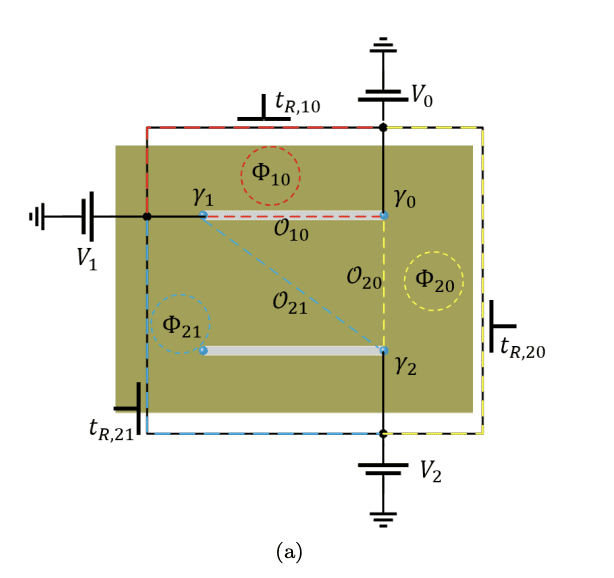
The team demonstrates that incorporating ‘reference arms’ into the system establishes a tunable coupling between the MZMs, responsive to external magnetic flux. This allows precise control over the interaction between the MZMs. Introducing a half-flux quantum alters the sign of this coupling, enabling an ‘echo-like’ protocol that effectively cancels out dynamic phases – unwanted distortions of quantum information – accumulating during the braiding process. Maintaining coherence, and thus minimising the impact of these dynamic phases, is a significant challenge in realising practical quantum computation.
The proposed setup represents a streamlined approach to MZM braiding, requiring only three MZMs and simplifying experimental complexity compared to previous designs. Simulations confirm that this system facilitates the implementation of Clifford gates – fundamental building blocks of quantum algorithms – through braiding operations. Importantly, the researchers demonstrate the potential to realise non-Clifford gates, such as the Hadamard gate, by manipulating geometric phases. This is crucial, as universal quantum computation requires the ability to perform non-Clifford operations, exceeding the capabilities of gate sets restricted to Clifford operations alone.
The theoretical framework underpinning this work is grounded in established principles of quantum mechanics and superconductivity. It provides a robust foundation for future experimental investigations. Further research should focus on detailed modelling of realistic device imperfections and their impact on braiding fidelity, investigating the robustness of the scheme against variations in MZM localisation and coupling strengths. Exploring alternative architectures incorporating additional reference arms or modified coupling schemes may yield further improvements in performance and scalability.
Researchers demonstrate a viable scheme for braiding Majorana zero modes (MZMs) utilising cotunneling processes within a minimal three-MZM system, establishing a tunable coupling between the MZMs via interference of cotunneling paths. Crucially, manipulation of magnetic flux and the reference arms allows precise control over both the strength and sign of this coupling, a key requirement for controlled braiding operations. The introduction of a half-flux quantum within the system reverses the coupling sign, enabling an echo-like protocol that effectively mitigates the accumulation of dynamic phases during braiding, a significant challenge in maintaining quantum coherence.
👉 More information
🗞 Three-Majorana Cotunneling Interferometer for Non-Abelian Braiding and Topological Quantum Gate Implementation
🧠 DOI: https://doi.org/10.48550/arXiv.2506.03553