

The behaviour of coupled oscillatory systems, prevalent in diverse natural phenomena from biochemical networks to arrays of electronic circuits, often exhibits complex dynamics. Recent research demonstrates that topological principles, typically associated with the robustness of quantum states, also apply to these classical systems, yielding unexpectedly stable oscillatory patterns. Specifically, scientists are discovering that carefully designed coupling arrangements can induce oscillations localised at the edges of a network, while interior units fall silent, creating a ‘frequency chimera’ state resistant to disturbances. This phenomenon, explored in a new study by Sayantan Nag Chowdhury and Hildegard Meyer-Ortmanns of Constructor University, alongside Meyer-Ortmanns’ affiliated work at the Complexity Science Hub, utilises concepts from condensed matter physics to achieve this stability. Their work, entitled ‘Topologically protected edge oscillations in nonlinear dynamical units’, details how the application of topological characteristics, specifically the Zak phase, reveals a bulk-boundary correspondence responsible for the resilience of these edge oscillations, even within a non-Hermitian framework.
Scientists demonstrate that principles of topology bolster the stability of oscillatory patterns within coupled oscillator networks, extending applications beyond quantum physics to encompass classical systems. Researchers successfully induce robust, localised oscillations at the edges of a two-dimensional grid while simultaneously driving units in the network’s interior to oscillation death, creating a state reminiscent of a frequency chimera, but exhibiting remarkable resilience to perturbations. This establishes a crucial link between momentum-space topology and the emergence of resilient patterns, moving beyond traditional applications of topological protection found in condensed matter physics, a field concerned with the physical properties of solid materials.
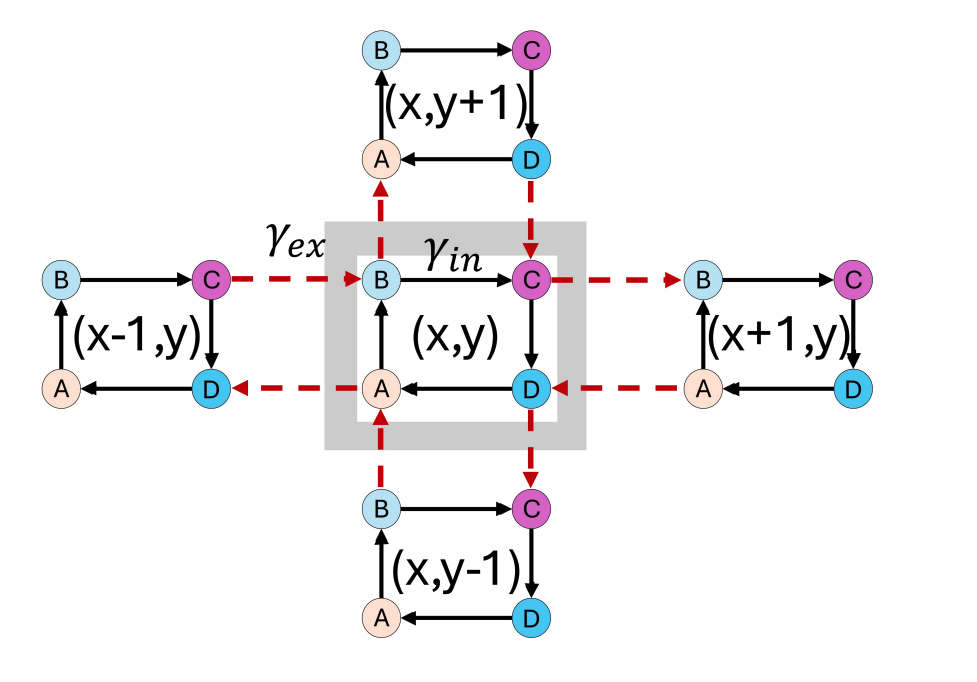
Researchers actively employ directed coupling between oscillators, alternating weak and strong connections to create a non-trivial topology in momentum space, which proves crucial for sustaining the observed edge oscillations. Topology, in this context, refers to the properties of a system that remain unchanged under continuous deformations, such as stretching or bending, and is not concerned with local details. The resulting oscillations withstand parameter variations, additive noise, and even structural defects within the network, showcasing the robustness of the topologically protected state. Researchers quantify this robustness by calculating the Zak phase, a topological invariant, a mathematical quantity that remains constant under continuous deformations and characterises the topological properties of the system. This reveals a bulk-boundary correspondence, meaning the behaviour at the edges of the network is directly linked to the topological properties of the entire system, solidifying the theoretical foundation of the research.
This study bridges concepts from nonlinear dynamics, the
This study bridges concepts from nonlinear dynamics, the study of systems where the output is not proportional to the input, and condensed matter physics, offering a new perspective on creating and stabilising complex patterns in classical oscillatory networks and providing a framework for designing resilient oscillatory systems. The findings have potential implications for understanding and controlling dynamics in diverse systems, including biochemical networks, where oscillations are fundamental to many processes, and sensor networks, where robust signal processing is essential.
Researchers demonstrate topological principles underpin robust dynamical states in coupled oscillator networks, specifically exhibiting edge-localised oscillations and oscillation death. The robustness of these edge oscillations stems from a bulk-boundary correspondence, even within a non-Hermitian Hamiltonian framework. A Hamiltonian, in physics, describes the total energy of a system, and a non-Hermitian Hamiltonian allows for energy gain or loss, extending the understanding of topological protection beyond conventional Hermitian systems, which assume energy conservation.
Scientists actively demonstrate control over the spatial distribution of oscillatory states by tuning system parameters, allowing precise manipulation of which regions of the grid oscillate and which enter oscillation death, offering potential for applications in pattern formation and control of complex dynamical systems.
Future research will explore the impact of varying network topologies and coupling strengths on the stability and robustness of these topologically protected states. Scientists plan to investigate the potential for extending these principles to higher-dimensional systems and more complex oscillatory networks, opening new avenues for controlling complex dynamical systems. They also aim to develop practical applications of these findings in areas such as neuromorphic computing, which seeks to mimic the structure and function of the brain, and sensor networks, leveraging the inherent robustness and energy efficiency of topologically protected states.
👉 More information🗞Topologically protected edge oscillations in nonlinear
🗞 Topologically protected edge oscillations in nonlinear dynamical units
🧠 DOI: https://doi.org/10.48550/arXiv.2506.18699


