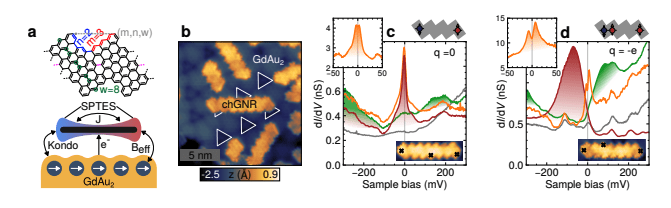
Researchers demonstrated control over the spin states of chiral nanoribbons grown directly on ferromagnetic surfaces. Low-temperature scanning tunnelling spectroscopy revealed three accessible spin configurations – singlet, triplet, and doublet – modulated by moiré patterns and exchange interactions. Atomic manipulation reversibly switches between these states, establishing a platform for controlling radicals on metallic substrates.
The precise manipulation of electron spin and charge represents a central challenge in condensed matter physics and a key requirement for future spintronic devices. Researchers are increasingly focused on exploiting topological states of matter – quantum states protected by their symmetry – to achieve robust and controllable electronic behaviour. A collaboration led by scientists at CIC nanoGUNE BRTA, alongside colleagues from the Centro Singular de Investigación en Química Biolóxica e Materiais Moleculares and the Universidade de Santiago de Compostela, has demonstrated reversible control over the spin and charge states within chiral graphene nanoribbons positioned directly on a two-dimensional ferromagnetic substrate. This work, detailed in their paper “Spin and Charge Control of Topological End States in Chiral Graphene Nanoribbons on a 2D Ferromagnet”, is authored by L. Edens, F. Romero Lara, T. Sai, K. Biswas, M. Vilas-Varela, F. Schulz, D. Peña, and J. I. Pascual. They report the ability to switch between distinct spin configurations – singlet, triplet, and doublet – through atomic manipulation, establishing a potential route towards localised radical control on metallic surfaces.
Stabilised Spin States in Topologically Non-trivial Nanoribbons on Ferromagnetic Substrates
The precise fabrication of nanostructures enables the creation of symmetry-protected topological boundary states, which can host localised spin moments with potential applications in spintronics and quantum computation. A significant challenge, however, is the quenching of these spin moments through charge transfer when deposited on conventional metallic substrates, resulting in closed-shell, spinless configurations. Here, we demonstrate that chiral nanoribbons, topologically non-trivial structures synthesised directly onto a ferromagnetic substrate, can maintain stable, tunable spin states.
Using low-temperature scanning tunnelling spectroscopy (STS), we observed that these nanoribbons exist in one of three distinct configurations: a charge-neutral diradical singlet or triplet, or a singly anionic doublet. The work function – the minimum energy required to remove an electron from a solid – and the exchange field arising from the ferromagnetic substrate are modulated by a moiré pattern. This pattern, resulting from the periodic arrangement of atoms in both the nanoribbon and substrate, creates a spatially varying potential landscape that dictates the electronic and magnetic properties of the nanostructure. Complementary measurements using Kelvin probe force microscopy and spin-flip spectroscopy corroborate this finding, providing a comprehensive understanding of the underlying mechanisms.
To fully elucidate this complex interplay, they developed an effective Hubbard dimer model. This simplified representation describes the electronic interactions within the nanoribbon, incorporating local electrostatic gating, electron-electron correlation, hybridisation between the nanoribbon and substrate, and the exchange field from the ferromagnet. Solving this model allowed us to map the complete phase diagram of accessible spin states, demonstrating how these parameters dictate the magnetic configuration.
The approach circumvents charge transfer issues by directly synthesising chiral nanoribbons on the ferromagnetic substrate, preserving the topological nature of the nanostructure. Low-temperature scanning tunnelling spectroscopy (STS) directly probes the electronic structure and spin configuration, revealing distinct spin states that depend on the applied gate voltage and magnetic field. Spin-flip spectroscopy further confirms the magnetic state, allowing direct probing of spin multiplicity and confirmation of localised spin moments. Analysis of the spin-resolved tunnelling spectra determines the energy splitting between singlet and triplet states, providing quantitative information about the exchange interaction strength, which is tunable via gate voltage and magnetic field.
The Hubbard dimer model accurately predicts the observed spin states and provides valuable insights into the underlying mechanisms. This model serves as a powerful tool for designing and optimising nanoscale devices based on chiral nanoribbons. The results establish a platform for local control of radicals adsorbed on metallic substrates, offering possibilities for spintronics and quantum computing. By utilising a ferromagnetic substrate and carefully controlling the electrostatic and magnetic environment, we can manipulate the spin configuration of chiral nanoribbons with unprecedented precision.
This work builds upon previous research into charge transfer on metallic substrates (Salaneck et al., 2002; Lazzaroni et al., 2002) and extends earlier studies of nanoscale magnetism (Kouwenhoven, 2006; Van der Zant, 2006; Jelínek, 2017). This establishes a platform for local control of radicals on metallic substrates, with potential applications in spintronics and quantum computing. We anticipate that this work will inspire further research in nanoscale magnetism and pave the way for novel spintronic devices with enhanced functionality.
👉 More information
🗞 Spin and Charge Control of Topological End States in Chiral Graphene Nanoribbons on a 2D Ferromagnet
🧠 DOI: https://doi.org/10.48550/arXiv.2505.23468