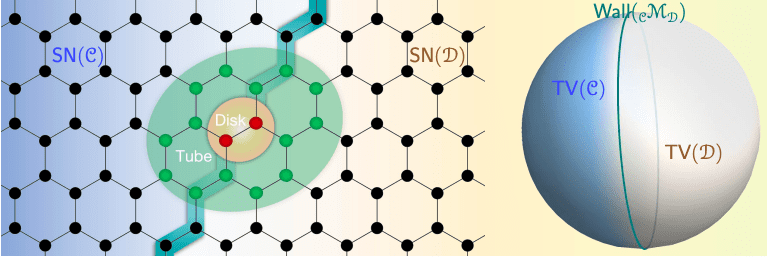
The behaviour of topological phases of matter, characterised by properties robust to local perturbations, continues to reveal unexpected mathematical structures. Recent work explores the interfaces, or domain walls, between these phases, utilising the framework of topological quantum field theory (TQFT). Specifically, researchers investigate how these boundaries support excitations and how their properties relate to the algebraic structures governing the bulk phases. Zhian Jia, Sheng Tan, and colleagues present a detailed analysis of these domain walls, constructing what they term ‘domain wall tube algebras’ to classify excitations localised on these interfaces. Their findings, detailed in the article “Weak Hopf tube algebra for domain walls between 2d gapped phases of Turaev-Viro TQFTs”, demonstrate a connection between these algebras and a related mathematical construct known as the Drinfeld double, offering new insights into the representation of topological defects and their interactions.
Topological phase boundaries exhibit intricate algebraic properties, revealing underlying structure, and physicists now construct a rigorous mathematical framework for understanding domain walls—interfaces between distinct topological phases of matter—within two-dimensional topological quantum field theories. These theories describe systems where physical properties are determined by the topology, or shape, of the underlying space, rather than local details. Researchers construct and analyse domain wall tube algebras, algebraic structures that classify the excitations localised on these interfaces, extending existing constructions to encompass more general multimodule categories. Multimodule categories are advanced mathematical tools used to describe anyonic systems, where particles exhibit exchange statistics differing from the familiar bosons and fermions.
Physicists establish a deep connection between bimodule and multimodule categories and the resulting domain wall algebras. They prove that functors—mappings between categories—between these bimodule categories embed naturally into the representation category of the domain wall tube algebra. This effectively classifies excitations on the domain wall through algebraic representations, allowing for a precise mathematical description of how these excitations interact and propagate. Crucially, researchers construct a Drinfeld double—a sophisticated algebraic object—from the weak Hopf boundary tube algebras using a skew-pairing, a mathematical operation that combines elements in a non-commutative way.
They prove a formal isomorphism—a structural equivalence—between the domain wall tube algebra and this Drinfeld double of boundary tube algebras, establishing a powerful duality. This duality provides new insights into the relationship between the domain wall itself and its boundary behaviour. They introduce the concept of an “n-tuple algebra” arising in the multimodule domain wall setting, expanding the mathematical toolkit for analysing these systems. Researchers extend the analysis to defects—imperfections or boundaries within the domain walls themselves.
They demonstrate that these defects are also characterised by representations of a “domain wall defect tube algebra”, allowing for a systematic and representation-theoretic treatment of even more complex interfacial phenomena. This systematic approach offers a powerful means of analysing and predicting the behaviour of complex topological systems, paving the way for potential applications in areas like topological quantum computation and the development of novel materials with exotic properties. Physicists rigorously investigate domain walls separating distinct topological phases of matter, specifically those described by Turaev-Viro topological field theories, a class of two-dimensional conformal field theories.
👉 More information
🗞 Weak Hopf tube algebra for domain walls between 2d gapped phases of Turaev-Viro TQFTs
🧠 DOI: https://doi.org/10.48550/arXiv.2507.01515