Diamond defects known as tin-vacancy centers are emerging as powerful building blocks for future photonic technologies, and a team led by Pablo Tieben of Leibniz University Hanover, Jan Rhensius of QZabre AG, and Takuya F. Segawa of ETH Zurich now demonstrates a significant advance in harnessing their potential. Researchers successfully extracts light with unprecedented efficiency from individual tin-vacancy centers embedded within specially crafted diamond structures, overcoming a major hurdle in the field. The team achieves this by incorporating the centers into diamond nanopillars featuring a unique multi-cone design, which dramatically enhances light emission and collection. This innovative approach yields a bright, stable source of single photons, confirmed by a strong antibunching signal and a remarkably high emission rate, paving the way for practical applications in quantum communication, sensing and advanced computing.
Diamond Spectroscopy Via Waveguide Enhancement
This study details the experimental techniques and data analysis used to investigate single negatively charged tin-vacancy (SnV−) centers within diamond. Researchers employed multi-cone diamond waveguides to significantly improve light collection and performed detailed spectroscopic measurements to characterize these centers. They also developed automated methods to efficiently identify and characterize individual SnV− centers, enhancing the signal for advanced photonic applications. The multi-cone diamond waveguides concentrate light emitted from the SnV− centers, increasing the signal available for analysis.
The fabrication of these waveguides, previously described, provides an optimized pathway for light collection. The team combined multiple wavelengths, ranging from 520 to 532 nanometers, using an acousto-optic filter, achieving increased output power compared to single-wavelength excitation. Emission spectra were carefully analyzed, accounting for the zero-phonon line, low-energy phonon modes, and higher-energy phonon modes. The fitted zero-phonon line exhibited a width of four nanometers, with a main peak displaying a full width at half maximum of 5. 6 nanometers. An automated cone selection algorithm efficiently identifies bright cones for measurement, utilizing a Gaussian filter and comparing pixel brightness to neighboring pixels.
Nanopillar Fabrication and SnV Center Creation
This research introduces a novel nanopillar platform designed to enhance photon extraction from tin-vacancy (SnV) centers in diamond, materials increasingly important for photonic technologies. Researchers fabricated diamond nanopillars incorporating a multi-cone structure and tapered sidewalls, creating an optimized geometry for photon emission and capture. To create the SnV centers, researchers employed ion implantation, carefully controlling the dose to encourage the formation of fluorescent defects within the diamond lattice. Following implantation, the team utilized advanced measurement techniques to identify and characterize SnV centers exhibiting strong fluorescence.
Precise alignment of the nanopillar structures with excitation and collection optics enabled the team to isolate and analyze the light emitted from single SnV centers. Measurements revealed a sharp emission peak, demonstrating the high quality of the SnV centers and the effectiveness of the nanopillar structure in confining and directing light. Crucially, the team observed antibunching in the second-order correlation function, confirming single-photon emission from the SnV centers. The emitter achieved a high saturation count rate, indicating a bright and stable single-photon source. These results establish the nanopillar platform as a promising architecture for realizing efficient and robust quantum light sources based on SnV centers in diamond.
High-Efficiency Photon Extraction From Diamond Nanopillars
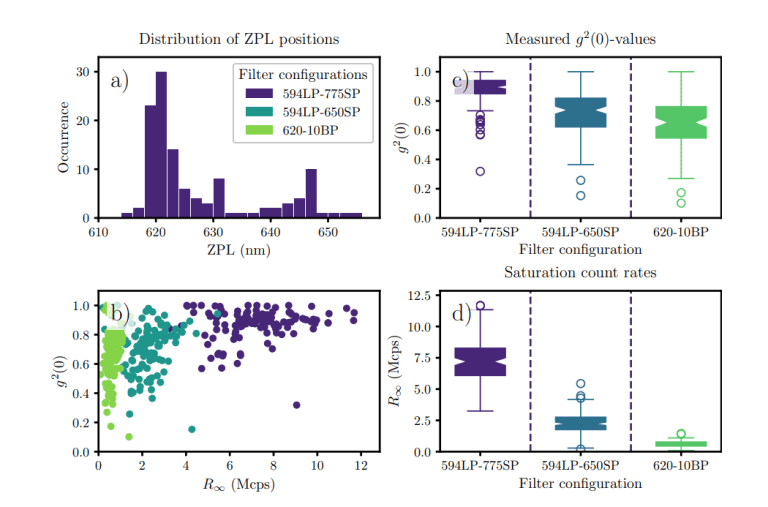
Scientists have achieved highly efficient photon extraction from a single tin-vacancy (SnV) center embedded within a diamond nanopillar, demonstrating a significant advance in quantum photonics. The team fabricated a unique structure, a diamond nanopillar with tapered sidewalls and a multi-cone design, to overcome the limitations of light extraction from diamond. Experiments revealed a sharp emission peak at a wavelength of 619 nanometers with a remarkably narrow full width at half maximum (FWHM) of only 6 nanometers, indicating a highly refined and controlled emission spectrum. This breakthrough delivers an extraordinarily high saturation count rate of approximately 9 million photons per second, a substantial improvement over typical rates observed in bulk diamond.
This enhanced emission rate is directly attributable to the nanopillar’s design, which efficiently captures and directs emitted photons. Further analysis using the second-order correlation function confirmed single-photon emission, with an antibunching dip well below 0. 5, demonstrating the quantum nature of the light source. Finite-difference time-domain simulations validated the experimental findings, revealing a photon extraction efficiency exceeding 70%. These simulations confirm that the nanopillar structure effectively channels light, minimizing losses and maximizing the number of photons collected. The combination of a narrow emission linewidth, a high saturation count rate, and confirmed single-photon emission establishes this nanopillar platform as a promising candidate for developing bright and stable quantum sources and sensors based on SnV centers in diamond. This work paves the way for practical applications in quantum technologies, including quantum computing, quantum communication, and high-resolution sensing.
Efficient Single Photon Sources via Nanopillars
Scientists have demonstrated a significant advance in the development of efficient single-photon sources using tin-vacancy (SnV) centers in diamond. They successfully incorporated SnV centers into a novel diamond nanopillar structure featuring tapered sidewalls and a multi-cone design, substantially enhancing photon extraction. The resulting devices exhibit a narrow emission spectrum, with a full width at half maximum of six nanometers centered around 619 nanometers, and achieve a high saturation count rate of approximately eleven million counts per second. Crucially, the team observed clear evidence of single-photon emission, confirmed by a second-order correlation function displaying a strong antibunching effect, falling well below a value of 0.
- These results establish the developed nanopillar platform as a promising architecture for creating bright and stable single-photon sources based on SnV centers. The authors acknowledge that the majority of the fabricated cones currently contain multiple SnV centers, indicated by second-order correlation values above 0. 5, but suggest that refinement of the implantation process could reliably yield devices with single emitters per cone. Future work will likely focus on optimizing the fabrication process to achieve this goal, paving the way for improved photon collection and enhanced performance in quantum technologies. This research represents a significant step towards realizing practical and efficient single-photon sources for a range of quantum applications.
🗞 Bright Single-Photon Emission from Individual Tin-Vacancy Centers in Multi-Cone Diamond Waveguides
🧠 ArXiv: https://arxiv.org/abs/2510.11285