Tin-vacancy centres in diamond represent a promising foundation for future quantum networks, and researchers are actively exploring ways to enhance their performance. Nina Codreanu, Tim Turan, and Daniel Bedialauneta Rodriguez, all from Delft University of Technology, alongside colleagues including Matteo Pasini, Lorenzo de Santis, and Maximilian Ruf, now report a significant advance in this field. The team demonstrates a level of coherent interaction between tin-vacancy centres and light trapped within specially designed photonic crystal cavities that exceeds a key threshold for practical applications. This achievement, involving detailed characterisation of hundreds of cavities, unlocks the potential for creating highly efficient and coherent light-matter interfaces, paving the way for more robust and scalable quantum networks. The results represent a crucial step towards realising the full potential of tin-vacancy centres as building blocks for future quantum technologies.
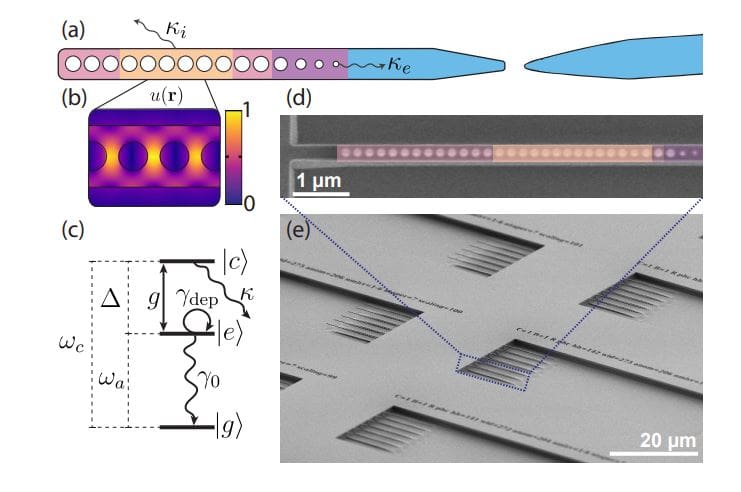
This work enhances this interaction by embedding the centers within photonic crystal cavities, nanoscale structures designed to confine light and accelerate photon collection. The team demonstrates above-unity coherent cooperativity, a key milestone indicating that the rate of light emission stimulated by the center exceeds the rate of light loss from the cavity, paving the way for deterministic photon sources and improved quantum network performance. The approach involves fabricating high-quality photonic crystal cavities in diamond membranes and then precisely positioning single tin-vacancy centers within the cavity using advanced nanofabrication and implantation techniques.
By carefully tuning the cavity parameters and optimizing the center’s optical properties, they maximize the strength of the light-matter interaction and observe a significant enhancement in the rate of spontaneous emission. This research demonstrates strong coupling between a single tin-vacancy center and a photonic crystal cavity, achieving a coherent cooperativity exceeding unity, and substantially increasing the efficiency of light collection. This achievement represents a crucial step towards realizing practical quantum repeaters and long-distance quantum communication networks, enabling the distribution of entanglement over extended distances with minimal loss.
Diamond Nanophotonics for Quantum Light Sources
This body of work explores the integration of diamond color centers, specifically tin-vacancy centers, with nanophotonic structures for quantum information processing and networking. Researchers focus on enhancing light-matter interaction, controlling photon emission, and creating scalable quantum systems. Photonic crystal cavities are a prominent structure used to confine light and enhance interaction with the diamond emitters, with the ultimate goal of building quantum networks requiring entangled photons and their transmission over long distances, necessitating quantum repeaters to overcome signal loss. A significant portion of the work involves developing techniques to create high-quality diamond materials, fabricate nanophotonic structures, and integrate the emitters into these structures, including focused ion beam milling, etching, and layer transfer techniques.
Research focuses on understanding the optical properties of tin-vacancy and silicon-vacancy centers, and techniques to create and control their density in diamond. Scientists are also using focused ion beam milling to create and isolate single emitters, and employing Purcell enhancement to increase the emission rate by placing emitters in high-finesse cavities. Researchers are designing and fabricating one-, two-, and three-dimensional photonic crystal cavities, as well as waveguides to direct light from the emitters. They are also fabricating free-standing diamond membranes for integration with nanophotonic structures and developing techniques to transfer diamond layers onto other substrates.
Cryogenic packaging techniques are being developed to maintain the performance of nanophotonic devices at low temperatures, and simulations are used to design and optimize nanophotonic structures. Scientists are achieving strong coupling between the emitters and the cavity modes, enhancing emission rates through cooperative interactions between multiple emitters, and creating entangled photons. They are developing sources of single photons with high purity and efficiency, and exploring quantum feedback to control the emitter and cavity properties. Research also focuses on designing and implementing quantum repeaters, distributing entanglement over long distances, and using wavelength multiplexing to increase the capacity of quantum communication channels.
Hybrid quantum systems are being investigated, integrating diamond emitters with other quantum systems such as superconducting qubits. Theoretical and computational work involves using quantum master equations to model the system, analyzing input and output properties, and using finite element modeling to simulate optical properties. Notable research includes work on one-way quantum repeaters, photon-mediated interactions between quantum emitters, and scalable focused ion beam creation of high-quality emitters. Early work on fabricating diamond nanostructures and controlling all degrees of freedom of optical coupling in hybrid quantum photonics is also prominent. This is a comprehensive and cutting-edge research program pushing the boundaries of quantum optics, nanophotonics, and materials science, with the goal of building practical quantum technologies.
Room Temperature Cavity Coupling of Tin Vacancies
This research demonstrates a significant advance in coupling tin-vacancy centers in diamond to photonic crystal cavities, achieving coherent cooperativity exceeding unity at room temperature. Scientists successfully fabricated free-standing photonic crystal cavities and characterized over three hundred structures, identifying devices with quality factors exceeding one thousand. Detailed examination of two cavity-coupled tin-vacancy emitters revealed Purcell-reduced lifetimes and cooperativities up to 0. 8, alongside strong modulation of cavity transmission. These findings establish a pathway towards utilizing cavity-coupled tin-vacancy centers as efficient and coherent light-matter interfaces, crucial for developing future quantum networks.
While the current work focuses on demonstrating these capabilities, the authors acknowledge limitations related to fabrication tolerances and the complexity of optimizing device performance. Future research directions include improving fabrication techniques to achieve even higher cooperativities and exploring the potential of these systems for applications such as high-rate entanglement distribution and the creation of multi-dimensional quantum states. The team notes that further refinement of the fabrication process could yield devices with near-unity external coupling factors while maintaining spin-selective excitation.
👉 More information
🗞 Above-Unity Coherent Cooperativity of Tin-Vacancy Centers in Diamond Photonic Crystal Cavities
🧠 ArXiv: https://arxiv.org/abs/2511.13375