
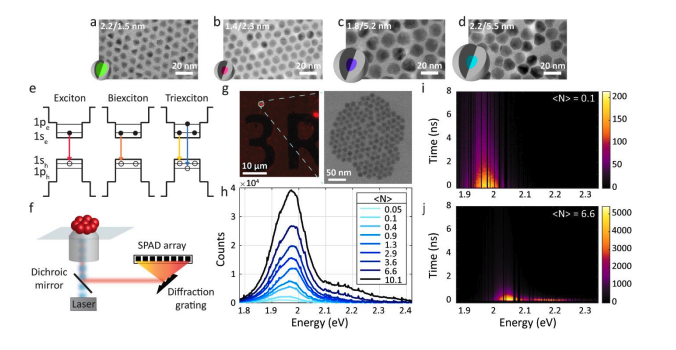
The behaviour of multiple excitons, bound pairs of electrons and holes, within semiconductor nanocrystals, known as quantum dots, is crucial for improving the efficiency of various optoelectronic devices. Einav Scharf, alongside colleagues at the Weizmann Institute of Science and others, now presents a novel method for studying these multiexcitons in groups of quantum dots, overcoming challenges associated with their rapid decay and complex interactions. The team employs a technique called time-gated heralded spectroscopy to precisely measure the binding energies of biexcitons and, for the first time, isolate and characterise the different pathways for triexciton formation. These measurements, performed on ensembles of CdSe/CdS quantum dots of varying sizes, reveal a shift from attractive to repulsive interactions between excitons and provide valuable insight into the lifetimes of these multiexciton states, ultimately paving the way for enhanced performance in applications such as lasers, light-emitting diodes, and photocatalytic systems.
Multiple Exciton Dynamics in Colloidal Quantum Dots
Researchers investigate the generation, recombination, and lifetimes of multiple excitons within colloidal quantum dots, primarily composed of cadmium selenide and cadmium sulfide. They employ advanced spectroscopic techniques, including time-gated spectroscopy and photon correlation measurements, to resolve these complex dynamics and understand how energy transfers between these nanoscale semiconductors when multiple electron-hole pairs are created. The research demonstrates that quantum dots efficiently generate multiple excitons upon excitation. The team identifies and characterizes different pathways by which excitons recombine, including single excitons, biexcitons (pairs of excitons), and triexcitons (triplets of excitons).
They specifically distinguish between different triexciton recombination pathways, finding one contributes to approximately 25% of the total emission, and determine the lifetimes of various exciton states. The size of the quantum dots plays a crucial role in determining their optical properties and recombination dynamics. Auger recombination, a process that limits multi-exciton generation efficiency, also plays a role. Photon correlation measurements help researchers study exciton interactions and determine the order of recombination, while time-gated spectroscopy selectively observes emission from different exciton states, tracking their evolution over time. This detailed investigation provides a comprehensive account of the experimental methods and data analysis techniques used to understand the complex dynamics of multi-excitons in colloidal quantum dots.
Ensemble Spectroscopy Reveals Multiexciton Dynamics
Researchers developed a novel spectroscopic technique, ensemble time-gated heralded spectroscopy, to investigate multiexcitons and overcome limitations in existing methods. This technique studies ensembles of quantum dots, providing stronger signals and reducing noise for more precise observation, unlike traditional approaches that struggle with the rapid decay of these states. It cleverly uses “heralded spectroscopy”, where detecting one photon signals a multiexciton state, and then “time-gated” detection to isolate the signal from background noise. By precisely timing photon detection, researchers pinpoint the characteristics of multiexcitons before they decay, revealing crucial information about their energy levels and lifetimes.
This approach effectively observes spectral shifts, subtle changes in emitted light, often too small to detect with conventional methods, especially within an ensemble of quantum dots. The research team applied this technique to cadmium selenide/cadmium sulfide core/shell quantum dots, carefully tuning the core and shell size to manipulate exciton interactions. Changing the dimensions induced a transition from attractive to repulsive interactions, influencing the energy of the multiexciton states and offering insights relevant to applications like lasing and light harvesting. Furthermore, the method successfully isolates the spectra of complex triexciton states and accurately measures their lifetimes, allowing researchers to distinguish between different triexciton pathways and opening new avenues for optimizing quantum dot performance in diverse optoelectronic devices and exploring fundamental many-body physics.
Multiexciton Dynamics Revealed in Quantum Dots
Researchers have developed a new method to study how multiple excitons behave within quantum dots, nanoscale semiconductors with unique optical properties. This technique, time-gated heralded spectroscopy, allows for the observation of these interactions within ensembles of quantum dots, overcoming limitations found when studying single particles. The method relies on precisely timing the detection of emitted photons to reveal the dynamics of these multiexciton states. The team’s experiments focused on cadmium selenide/cadmium sulfide quantum dots of varying sizes. By increasing the laser power used to excite the quantum dots, they observed shifts in the emitted light spectrum, indicating the formation of additional exciton states.
Crucially, the researchers were able to isolate and characterize biexcitons and triexcitons, distinguishing their spectral signatures and lifetimes, despite the challenges posed by rapid energy loss from interacting excitons. The results demonstrate a transition from attractive to repulsive interactions between excitons within the quantum dots, providing insights into the fundamental physics governing these nanoscale systems. The team achieved this by correlating the energy and arrival time of each photon, revealing the decay dynamics of different spectral features. This new method offers significant advantages over existing techniques, providing higher photon counts and lower noise levels, allowing for the observation of multiexciton characteristics difficult to resolve in single particle studies. The ability to rapidly analyze multiexciton properties is particularly valuable for designing quantum dots for advanced optoelectronic applications, including lasers, light-emitting devices, and light sources, where precise control over exciton interactions is crucial for performance.
Multiexciton Interactions in Quantum Dot Ensembles
This research introduces a new method for studying multiexcitons, interactions between multiple energy packets within quantum dots, using time-gated heralded spectroscopy. By applying this approach to small groups of quantum dots, researchers successfully measured the binding energies of biexcitons and distinguished between different triexciton emission pathways, measuring their lifetimes and overcoming previous challenges in isolating these signals. The key advancement lies in shifting from studying individual quantum dots to small ensembles, which significantly increases the number of detected photons and reduces noise. This allows for the observation of subtle multiexciton characteristics difficult to resolve when examining single dots. Future work could focus on applying this technique to a wider range of quantum dot designs, enabling a more comprehensive understanding of multiexciton properties and aiding the development of improved optoelectronic devices such as lasers, light-emitting diodes, and photocatalytic systems. This improved understanding of multiexciton behavior will be crucial for tailoring quantum dots.
👉 More information
🗞 Unraveling Size Dependent Bi- and Tri-exciton Characteristics in CdSe/CdS Core/Shell Quantum Dots via Ensemble Time Gated Heralded Spectroscopy
🧠 ArXiv: https://arxiv.org/abs/2508.05203