

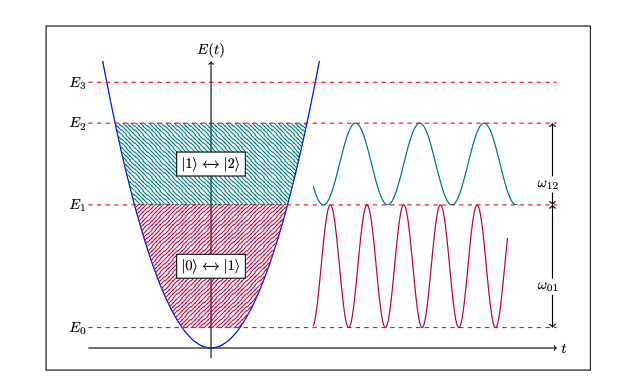
On April 21, 2025, researchers Yash Saxena, Sagnik Chatterjee, and Tharrmashastha Sapv published a study titled Realization of maximally-entangling two-qutrit gates using the Cross-Resonance scheme, advancing quantum computing by demonstrating high-fidelity entanglement across three levels in superconducting qutrit systems.
The research demonstrates a high-fidelity two-qutrit generalized controlled-R gate using superconducting transmon qutrits, extending existing quantum computing frameworks. Experimental simulations achieved a maximum extracted concurrence of 0.986, confirming entanglement across all three levels. Additionally, the team prepared a two-qutrit Bell state with a fidelity of 0.975, showcasing the potential for universal quantum computation with three-level systems. This advancement highlights the feasibility of leveraging qutrits for enhanced quantum processing capabilities.
Researchers have achieved a critical milestone by generating Greenberger-Horne-Zeilinger (GHZ) states using superconducting transmon qutrits. These states, which exist in three or more distinct states simultaneously, are highly sensitive to environmental noise and require precise control. The use of microwave pulses has enabled high-fidelity operations, minimizing errors and demonstrating the potential for complex entangled states essential for quantum algorithms and communication.
To manipulate qubit states with precision, advanced techniques such as optimized microwave pulses and selective darkening of degenerate transitions have been employed. These methods reduce unwanted environmental interactions, a major challenge in maintaining coherence. Cross-resonance gates have been refined to improve gate fidelity and reduce crosstalk, enabling entangling operations between qubits without direct coupling.
The successful demonstration of high-dimensional entanglement and improved gate operations suggests the potential for large-scale quantum processors capable of complex calculations. GHZ states open new possibilities for quantum communication and error correction, particularly in developing fault-tolerant systems that require robust methods for detecting and correcting errors.
While challenges remain, such as scaling up to thousands or millions of qubits, recent progress is encouraging. The ability to create high-dimensional entangled states and improved gate operations represents a significant step forward. As researchers refine techniques, further advancements are expected, bringing us closer to realizing quantum computing‘s full potential in solving optimization problems, simulating molecular systems, and enabling secure communication networks.
👉 More information
🗞 Realization of maximally-entangling two-qutrit gates using the Cross-Resonance scheme
🧠 DOI: https://doi.org/10.48550/arXiv.2504.15265


