

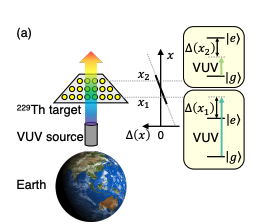
The subtle warping of spacetime, predicted by Einstein’s theory of general relativity, manifests as a gravitational redshift, a change in the frequency of light due to differences in gravitational potential. Wen-Te Liao from National Central University, Sven Ahrens from Shanghai Normal University, and colleagues theoretically investigate the potential to detect this effect with unprecedented precision using the unique properties of Thorium-229. Their work, detailed in the article ‘Gravitational photon echo’, explores the generation, control, and storage of a ‘gravitational photon echo’ – a phenomenon analogous to the well-established optical echo, but induced by gravitational frequency shifts. The researchers demonstrate how the exceptionally narrow linewidth and long coherence time of the Thorium-229 nuclear clock transition could enable the detection of minute altitude variations at the millimeter scale, paving the way for controllable gravitational measurements on Earth.
Thorium-229 (229Th) presents a compelling opportunity for future quantum technologies and precision measurement, prompting considerable research into its singular low-energy nuclear excited state. Investigations demonstrate the potential to exploit this state as a platform for quantum memories, extending these concepts to the manipulation of hard x-ray photon wave packets, which are photons with high energy and short wavelengths.
A central focus resides in achieving coherent control over the nuclear state of 229Th, employing techniques encompassing magnetic field manipulation, x-ray pulse shaping, and optical pumping methods. These capabilities facilitate the realisation of 229Th’s potential as a platform for quantum information storage and processing, building upon established gradient echo techniques – a method used to refocus nuclear spins – and adapting principles from quantum optics, the study of the quantum properties of light, to a nuclear system. The exceptionally narrow linewidth, a measure of the spectral width of the transition, and high quality factor of the 229Th clock transition are critical to these advancements, enabling long coherence times, the duration for which quantum information can be reliably stored.
Precision measurement benefits from research into the generation
Precision measurement benefits from research into the generation and storage of gravitationally induced photon echoes using the 229Th clock transition, potentially enabling the detection of subtle gravitational effects at small altitude variations. This relies on the principle that gravity affects the frequency of light, and by precisely measuring these shifts, minute changes in gravitational fields can be detected.
Advanced experimental techniques include the use of time-delayed magnetic control and x-ray free electron lasers to manipulate nuclear states, aiming to enhance spectral resolution and coherence. Researchers also develop methods for generating, manipulating, and analysing x-rays to probe the 229Th nucleus, actively pursuing spectral narrowing of x-ray pulses to improve the precision of spectroscopic measurements. Spectral narrowing reduces the uncertainty in the energy of the x-ray photons, leading to more accurate measurements.
Theoretical work underpins these experimental efforts, providing frameworks for understanding relativistic effects, those arising from Einstein’s theory of relativity, and the behaviour of electromagnetic fields in these systems. This convergence of atomic, nuclear, and x-ray physics bridges disciplines to unlock the potential of 229Th and advance fundamental understanding of quantum control and relativistic effects.
Researchers have successfully demonstrated nuclear quantum memory functionality and the storage and retrieval of single photons and, more recently, hard x-ray photon wave packets. This establishes a clear trajectory towards utilising the unique properties of Thorium-229 (229Th) for advancements in quantum technologies and precision measurement, demonstrating significant progress towards realising practical quantum technologies and precision measurement tools.


