Periodically poled lithium niobate crystals form the basis for advanced optical technologies, yet creating long, consistently poled areas within these materials has remained a significant hurdle to improved device efficiency. Now, Laura Bollmers, Noah Spiegelberg, Michael Rüsing, and colleagues at Paderborn University demonstrate a substantial advance in this field, achieving continuous periodic poling over an impressive 70mm length with a precision of 3 microns. This breakthrough overcomes previous limitations, routinely exceeding 10mm poling lengths, and importantly, maintains high poling quality across a wafer scale. By comparing continuous and segmented electrode designs, the team establishes a pathway towards fabricating highly efficient, narrow-bandwidth nonlinear optical devices requiring minimal power, representing a key step towards more sustainable and compact photonic technologies.
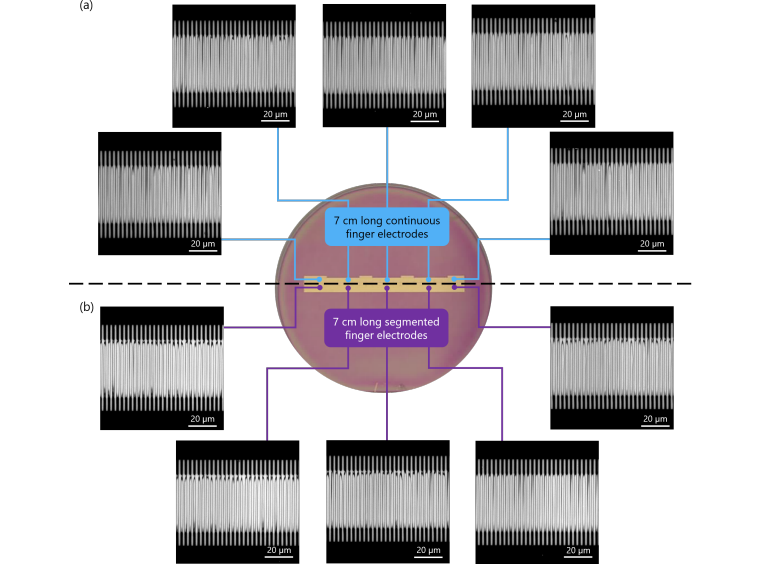
The performance of nonlinear materials improves with increasing size, yet fabricating long, continuously poled areas in thin-film lithium niobate (TFLN) remains challenging, with typical lengths rarely exceeding 10 millimeters. This research demonstrates significant progress in this field, achieving periodic poling of continuous areas 70 millimeters long with a 3-micron poling period and a near 50% duty cycle. The team compared two electrode design approaches to fabricate these extended, continuous poled areas, one using a single, continuous electrode and the other employing a segmented design with over 20 individual sections.
Polarization Microscopy Reveals Periodic Poling Domains
Scientists utilize a range of techniques to characterize and monitor periodic poling in thin-film lithium niobate. Second harmonic microscopy (SHM) is a dominant technique, with bright-field SHM revealing domains exhibiting a strong second harmonic generation signal and dark-field SHM enhancing contrast for visualizing domain boundaries. Polarization-resolved SHM provides information about the orientation of ferroelectric domains, while Čerenkov SHM is sensitive to phase transitions, allowing for contrast tuning. Confocal SHM delivers high-resolution 3D imaging of ferroelectric domains, and optical microscopy provides initial assessment of poling quality.
Nonlinear focal mapping analyzes the second harmonic generation signal from ferroelectric domain walls, and real-time optical monitoring observes changes in the second harmonic generation signal during the poling process, assessing domain formation and switching. In-situ second harmonic generation monitoring optimizes poling parameters during fabrication. X-ray diffraction confirms the crystalline structure and orientation of the TFLN, while piezoresponse force microscopy maps the piezoelectric response, revealing domain boundaries and polarization direction. These techniques collectively assess poling performance, including quasi-phase matching spectral imperfections, duty cycle errors, leakage current, and second harmonic generation efficiency.
Understanding contrast mechanisms and utilizing 3D imaging are crucial for accurate interpretation. Real-time monitoring optimizes the poling process, and minimizing duty cycle errors maximizes nonlinear conversion efficiency. Characterizing domain walls is important for controlling device performance. This comprehensive suite of techniques provides detailed insights into the structure and quality of periodically poled thin-film lithium niobate.
Extended 70mm Poling in Thin-Film Lithium Niobate
Scientists have achieved a significant breakthrough in the fabrication of periodically poled thin-film lithium niobate, a material crucial for highly efficient light sources and frequency converters. The team successfully demonstrated periodic poling across continuous areas of 70 millimeters in length, with a 3-micron poling period and a near 50% duty cycle, representing a substantial advancement over previously achievable lengths typically limited to 10 millimeters. This achievement unlocks the potential for wafer-scale fabrication of nonlinear optical devices. The research involved a comparison of two distinct electrode design approaches to create these extended poled areas.
One method utilized a single, continuous 70-millimeter electrode, enabling poling across the entire length with a single application of electric field. The second approach employed a segmented design, consisting of over 20 individual sections meticulously aligned to form the 70-millimeter region, allowing for individual optimization of the poling process and minimizing variations in the duty cycle. Detailed analysis confirmed that both methods yielded consistent poling quality comparable to results obtained with shorter devices. Measurements demonstrate the successful fabrication of wafer-scale periodic poling exceeding typical chiplet sizes without any degradation in poling quality.
This breakthrough is vital for several advanced applications in nonlinear optics, specifically enabling the creation of frequency conversion devices with dramatically increased efficiency and scalability. The ability to fabricate these ultra-long periodically poled regions also reduces the requirement for high pump power, minimizing thermal effects, photorefraction, and noise, thus enhancing device stability and enabling operation at previously inaccessible ultra-low power levels. This work represents a key step towards realizing highly efficient, narrow-bandwidth, and low-pump power nonlinear optical devices for a wide range of applications.
Extended Poling Achieved in Thin-Film Lithium Niobate
This research demonstrates a significant advance in the fabrication of periodically poled thin-film lithium niobate, achieving continuous poling over a length of 70 millimeters. This represents a substantial improvement over previous limitations, where continuously poled areas rarely exceeded 10 millimeters, and opens new possibilities for highly efficient nonlinear optical devices. The team successfully compared two electrode design approaches, a continuous electrode for rapid fabrication and a segmented electrode allowing for individual optimization of the poling process. Results indicate that both fabrication methods maintain poling quality comparable to shorter devices, confirming the scalability of this technique without compromising performance.
The ability to create these extended periodically poled structures is particularly important because the efficiency of nonlinear devices increases significantly with the interaction length, benefiting applications like high-power frequency comb generation. Furthermore, the segmented approach offers the potential for minimizing duty cycle errors, which is crucial for high-performance quantum frequency converters demanding low spectral noise. The authors acknowledge that while the current demonstration extends to 70 millimeters, the technique is readily scalable to even longer lengths simply by increasing the number of segments used in the fabrication process. Future work could focus on further optimizing the poling pulse for each segment, potentially enhancing poling quality for demanding quantum optical applications. This achievement represents a key step towards realizing scalable nonlinear and quantum photonic devices, bridging the gap between laboratory prototypes and practical, large-scale implementations.
🗞 Optimizing Ultra-Long Continuous Wafer-Scale Periodic Poling in Thin-Film Lithium Niobate
🧠 ArXiv: https://arxiv.org/abs/2509.22342