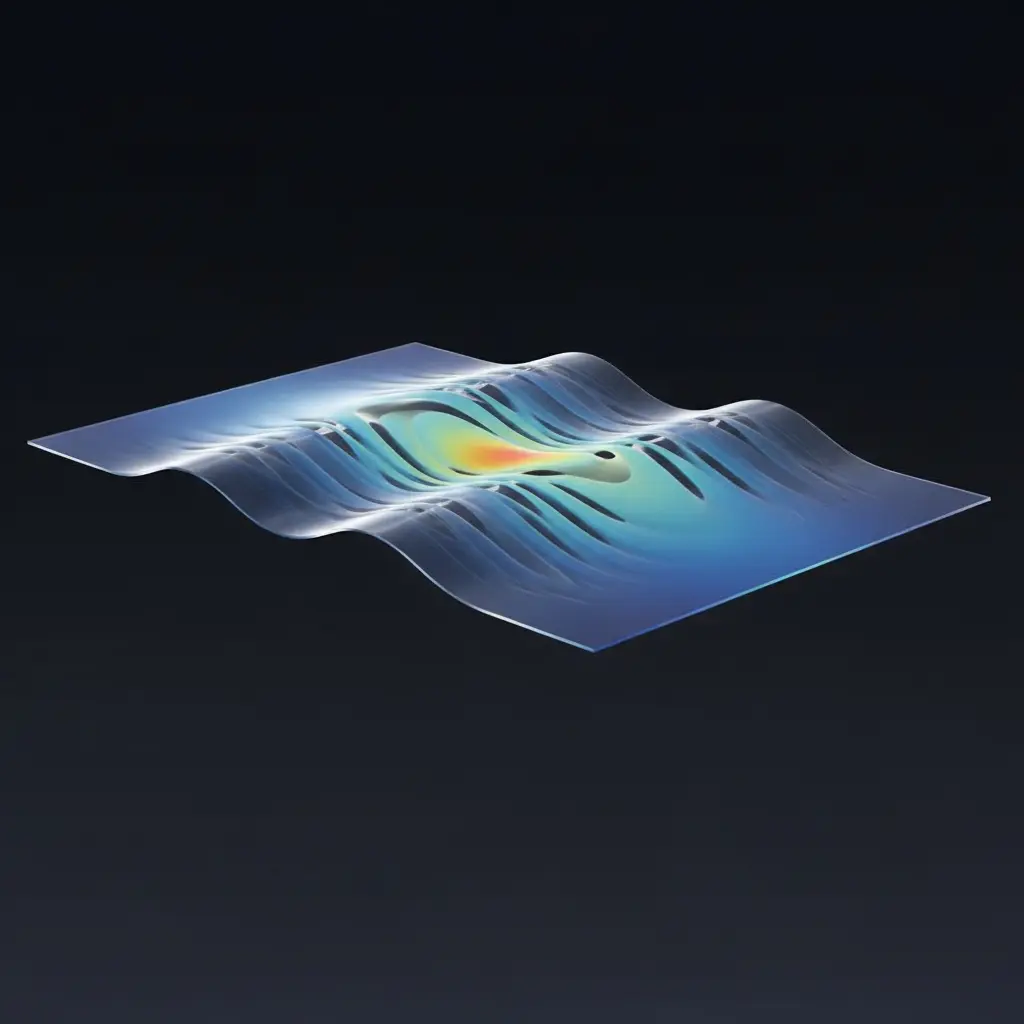
The development of nanoscale electromechanical systems (NEMS) relies on materials possessing both high strength and ease of manufacture, a combination often difficult to achieve. Hagen Gress, Cody L. Ritt, and Inal Shomakhov, alongside colleagues from Boston University, University of Colorado Boulder, and Massachusetts Institute of Technology, have now created the first nanomechanical resonators from a two-dimensional polyaramid material, dubbed 2DPA-1. These resonators, reaching thicknesses of just 8 nanometres, are fabricated by transferring the material onto specifically designed microchips. This research demonstrates a clear pathway towards creating robust, lightweight, and easily processed polymeric NEMS, offering significant potential for advancements in sensing and other nanoscale technologies. Characterising the resonators’ behaviour under varying conditions provides crucial insights into the material’s mechanical properties and its interaction with surrounding environments.
2DPA-1 Nanoresonator Fabrication and Characterisation
Scientists have successfully fabricated the first nanomechanical resonators from a two-dimensional polyaramid, designated 2DPA-1, achieving thicknesses as small as 8nm. This breakthrough establishes a pathway towards molecular-scale polymeric Nanoelectromechanical Systems (NEMS) possessing high mechanical strength, low density, and ease of synthetic processing. The research team transferred nanofilms of 2DPA-1 onto silicon chips containing arrays of circular microwells, then meticulously characterised the thermal resonances of these newly created resonators under varying conditions. This innovative approach allows for the precise measurement of material properties at the nanoscale, opening new avenues for device miniaturisation and performance enhancement.
The fabrication process involved transferring 2DPA-1 films onto substrates with pre-etched microwells, creating suspended membrane resonators. Detailed analysis of the resonators’ eigenfrequencies, both in the absence and presence of residual gas, provided critical insights into the material’s behaviour. When no gas was present, the observed frequencies aligned with theoretical predictions based on tensioned plate theory, enabling the determination of the Young’s modulus and tension within the 2DPA-1 nanofilms. This precise characterisation demonstrates the potential of 2DPA-1 as a viable material for advanced NEMS applications.
Experiments reveal that the introduction of gas modifies the mechanical resonances due to the resulting bulging, adhesion, and slack within the 2DPA-1 membranes. This phenomenon allowed scientists to model the behaviour of partially adhered membranes and estimate the adhesion energy between the polymer and the substrate. Scanning electron microscopy and atomic force microscopy were employed to visualise the membrane structures and confirm the impact of pressure on their deformation, providing a comprehensive understanding of the system’s mechanics. The team successfully demonstrated intact and ruptured membranes with radii of 4.25μm and thicknesses of 35nm. This work represents a significant advancement in NEMS technology, bridging the gap between conventional polymers and two-dimensional crystalline nanomaterials0.2DPA-1 combines the advantageous properties of both material classes, offering tunability through organic chemistry and the potential for high sensitivity and selectivity in future devices. The ability to fabricate and characterise these molecular-scale resonators unlocks possibilities for a wide range of applications, including advanced sensors, actuators, and energy harvesting systems, paving the way for a new generation of nanoscale technologies.
2DPA-1 Nanoresonator Fabrication and Mechanical Characterisation
Researchers pioneered a novel fabrication technique to create nanomechanical resonators from two-dimensional polyaramid, 2DPA-1, achieving thicknesses as small as 8nm. The study involved transferring nanofilms of 2DPA-1 onto silicon chips containing pre-etched circular microwells, forming the basis of these molecular-scale devices. Subsequent characterization focused on the thermal resonances of these resonators under varying conditions, employing a tensioned plate theory to determine the Young’s modulus and tension within the 2DPA-1 nanofilms when no residual gas was present. This approach enabled precise measurement of material properties at the nanoscale.
When gases were introduced into the microwells, the 2DPA-1 nanofilms exhibited bulging, altering the mechanical resonances due to adhesion and slack. Scientists developed a model to account for these effects, describing the membrane’s behaviour from a flat, adhered state to a bulged and partially delaminated configuration. The model utilizes dimensionless parameters to describe tension and deflection, allowing calculation of resonance frequencies under these altered conditions. Experiments involved applying nitrogen pressure up to 200 kPa for several days to induce re-adhesion, and monitoring the resulting changes in resonance.
Data analysis involved minimizing error between experimental and theoretical frequencies to determine Young’s modulus (E) and tension (S) values, using parametric sweeps and the first four eigenmodes. The team measured E = 11.2 ±8.8 GPa, aligning with nanoindentation measurements of 12.7±3.8 GPa, and observed a linear increase in the dissipation constant with frequency, suggesting frequency-independent Q factors. Analysis of Q factors as a function of film thickness revealed that thicker polymer devices tended to exhibit lower Q values, though further investigation is required to confirm this trend. Table I details the radius, thickness, Young’s modulus, tension, and non-dimensional tension parameter for each resonator measured, providing a comprehensive dataset for material characterization.
2DPA-1 Nanoresonators Exhibit Predicted Thermal Behaviour
Scientists achieved a significant breakthrough in nanomechanical systems by fabricating resonators from two-dimensional polyaramide, 2DPA-1, with thicknesses as small as 8 nanometers. These molecular-scale devices were created by transferring nanofilms of 2DPA-1 onto chips containing arrays of circular microwells, enabling detailed characterization of their thermal resonances under varying conditions. Experiments revealed that, in a vacuum of approximately 10−7 Torr (10−5 Pascals), the eigenfrequencies of these resonators align with predictions from tensioned plate theory, allowing for the determination of the Young’s modulus and tension within the 2DPA-1 nanofilms. The team measured the Brownian motion, or thermal displacement fluctuations, of nearly flat membranes in vacuum, detecting thermal resonances for the first few eigenmodes.
Power spectral density analysis of displacement fluctuations for a 4.25μm radius, 35nm thick membrane revealed distinct peaks corresponding to the first four eigenmodes, with noticeable splitting in nominally degenerate modes due to slight deviations from ideal circular geometry. Fitting these peaks with Lorentzian curves allowed precise determination of the resonance frequencies, fmn, and quality factors, Qmn, for each mode. Analysis of these frequencies using established equations for circular plate vibrations under tension enabled the extraction of material properties. Results demonstrate an average Young’s modulus of 11.2 ±8.8 GPa for the 2DPA-1 material, consistent with previous nanoindentation measurements.
The study also quantified the tension within the membranes, revealing a strong correlation between the measured eigenfrequencies and theoretical calculations. Measurements confirm a linear relationship between the dissipation constant, fmn Qmn, and frequency, suggesting frequency-independent quality factors. Furthermore, data shows a trend towards lower quality factors in thicker polymer devices, with Qmn plotted as a function of 2DPA-1 thickness ranging from 8 to 65nm. The fabrication and characterization of these 2DPA-1 nanomechanical resonators deliver a convincing pathway towards molecular-scale polymeric NEMS possessing high mechanical strength, low density, and synthetic processability. Detailed data, including all measured fmn and Qmn values, are available in supplementary tables, providing a comprehensive dataset for future research and development in this emerging field. The breakthrough opens possibilities for advanced sensors, actuators, and other nanoscale devices leveraging the unique properties of 2DPA-1.
2DPA-1 Nanoresonators Reveal Mechanical Properties
Researchers have successfully fabricated nanomechanical resonators from a two-dimensional polyaramid, designated 2DPA-1, achieving thicknesses of just 8 nanometres. These devices were created by transferring the 2DPA-1 material onto microfabricated structures and subsequently characterizing their thermal resonance properties under varying conditions. Analysis of these resonances allowed for the extraction of key material properties, including Young’s modulus and tension within the 2DPA-1 nanofilms, demonstrating a viable route towards polymeric nanoelectromechanical systems. The study demonstrates that 2DPA-1 exhibits adhesion characteristics comparable to other two-dimensional materials like graphene and molybdenum disulphide, though with a significantly lower Young’s modulus.
The team developed nanomechanical resonance models accounting for factors such as slack and adhesion to accurately describe the behaviour of these resonators, highlighting the unique equilibrium characteristics of polymeric membranes compared to crystalline 2D materials. While acknowledging the continuum approach used simplifies the molecular structure, the authors suggest further investigation is needed to fully understand how 2DPA-1’s properties align with those of conventional one-dimensional polymers or other two-dimensional crystalline materials. Future work could explore the potential of 2DPA-1 in diverse applications leveraging its combination of mechanical strength, low density, and ease of fabrication.
🗞 Molecularly Thin Polyaramid Nanomechanical Resonators
🧠 ArXiv: https://arxiv.org/abs/2601.10633