

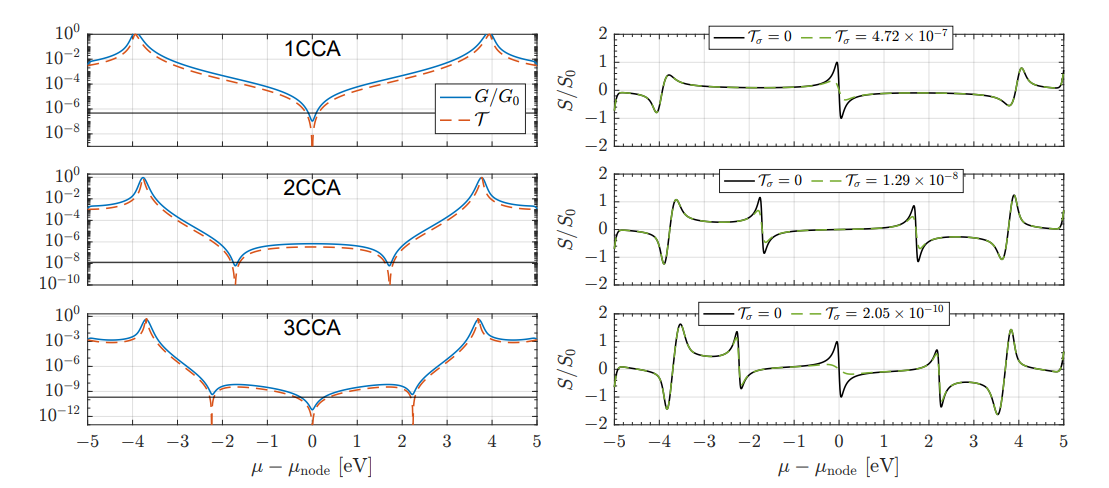
Thermoelectric materials, which convert heat into electricity and vice versa, hold promise for waste heat recovery and solid-state refrigeration, but achieving high efficiency remains a significant challenge. Justin P Bergfield, from Illinois State University, and colleagues demonstrate a novel approach to boosting the performance of these materials by focusing on the design of molecular junctions. Their research reveals that connecting multiple ‘repeat units’ in a specific series-connected architecture, utilising cross-conjugated molecules, dramatically enhances the ability of the material to generate power from temperature differences. The team’s theoretical work shows this enhancement stems from a unique ‘split-node’ spectrum, exceeding the efficiency of other established methods, and opens exciting possibilities for creating scalable, high-performance thermoelectric materials based on molecular interference. This achievement highlights a new pathway towards more efficient energy conversion and represents a significant step forward in the field of thermoelectricity.
Quantum Transport, Interference, and Thermoelectric Effects
Scientists are investigating electron movement through single molecules connected to metallic electrodes, crucial for developing molecular-scale electronics. A central focus is quantum interference, where electron waves reinforce or cancel each other, impacting electrical flow. Researchers study transmission channel distribution to understand these effects and how they influence conductance. The team also examines environmental factors causing loss of quantum coherence, known as dephasing, and how this affects interference and conductance, identifying limitations in existing models. Furthermore, the research explores how these molecular junctions can generate or manipulate heat and electricity, focusing on the Seebeck coefficient, a measure of thermoelectric power.
The team performs advanced quantum mechanical calculations, building upon Density Functional Theory with enhancements for accuracy, including accounting for weak interactions and employing efficient computational algorithms. They utilize Non-Equilibrium Green’s Function formalism to calculate electron movement, modeling junctions with molecules connected to gold electrodes, carefully considering connection geometry. Detailed computational parameters are optimized for reliable results, and various dephasing models are tested and compared to accurately represent system behavior. This research confirms that quantum interference significantly influences the conductance of molecular junctions.
The study demonstrates that commonly used dephasing models can fail when dephasing is strong or the molecule has specific electronic structures, pinpointing conditions where these models become inaccurate. Importantly, the research shows that quantum interference can enhance thermoelectric effects, potentially leading to more efficient energy conversion. The distribution of transmission eigenvalues provides insights into electron travel, and the way the molecule connects to the electrodes significantly impacts its transport properties. The role of cross-conjugation, a specific molecular structure, is also investigated to understand its influence on electron flow.
Scientists are studying various molecular structures, including alkane dithiols and cross-conjugated molecules, to understand how structure affects transport. This research pushes the boundaries of understanding quantum transport at the molecular scale, with implications for developing molecular electronics, creating more efficient thermoelectric materials for energy harvesting and cooling, and gaining a deeper understanding of fundamental quantum phenomena. The work also contributes to improving computational methods used to simulate quantum transport.
Many-Body Theory Models Molecular Junction Transport
Scientists investigated the thermoelectric properties of single-molecule junctions built from acyclic, cross-conjugated molecules, resembling dendralene and iso-poly(diacetylene). To accurately model electron transport, the team employed many-body transport theory, a sophisticated approach accounting for complex interactions between electrons within the molecule. This method equally treats both Coulomb blockade and coherent tunneling, ensuring a precise description of electron flow under various conditions. The study pioneered a non-perturbative quantum transport framework, enabling accurate modeling of both sequential and cotunneling regimes.
To overcome computational challenges posed by strongly correlated electron systems, scientists implemented the Lanczos method, a powerful technique for evaluating Green’s functions. This approach avoids directly calculating a massive matrix by iteratively projecting into a smaller space, significantly reducing memory demands and accelerating calculations. The Lanczos recursion generates a continued-fraction expansion of the Green’s function, allowing correlation functions to be evaluated without needing to know the full spectrum of the molecule. This two-stage Lanczos procedure proved scalable to larger molecules, reaching systems with up to 16 orbitals.
The molecular Hamiltonian, central to the calculations, was derived from first principles using a renormalization procedure. This process incorporates the effects of off-resonant degrees of freedom, such as the sigma system and image charges, into effective onsite energies and coupling terms. The resulting Hamiltonian, expressed in a basis of localized orbitals, includes terms for onsite potentials, transfer integrals, and Coulomb interactions between electrons. To accurately parameterize the model, scientists optimized the Hamiltonian against experimental observables, including ionization energy, electron affinity, and low-lying excitations of benzene, ensuring the model faithfully reproduces known physical behavior.
This yielded values of 9. 69 eV for onsite repulsion, transfer integrals ranging from 2. 2 to 3. 0 eV, and a quadrupole moment of -0. 65 eŲ, providing a physically motivated alternative to traditional models. The electrodes were modeled with a dielectric constant of 1. 56, completing the detailed description of the system.
Enhanced Thermopower via Split-Node Spectrum Broadening
Scientists investigated the thermoelectric properties of single-molecule junctions built from acyclic, cross-conjugated molecules, including dendralene analogues and iso-poly(diacetylene) motifs, connected in series. Using many-body transport theory, the team demonstrated that increasing the number of repeat units in these molecules does not alter the fundamental energy gap, but instead creates a split-node spectrum. This spectrum exhibits cumulative broadening that dramatically enhances the thermopower, a measure of voltage generated by a temperature difference. The research reveals this enhancement can exceed that achieved through other quantum interference mechanisms, such as the formation of a supernode, suggesting new avenues for designing scalable quantum-interference-based materials.
The study focused on molecules containing N node-possessing subunits connected in series, where a node represents a point of destructive interference in electron transmission. Researchers showed that as the number of these subunits increases, the spectrum splits into N distinct nodes rather than coalescing into a single supernode. This split-node regime mimics a higher-order response, effectively providing many of the thermoelectric advantages previously associated with supernodes. The team’s calculations demonstrate that the cumulative broadening of these split nodes significantly boosts the thermopower, offering a pathway to enhanced energy conversion.
Further analysis evaluated the scaling of the electronic figure of merit, ZT, and maximum thermodynamic efficiency. The work highlights that the split-node architecture provides a robust mechanism for enhancing thermoelectric response, even as molecular length increases. Specifically, the research demonstrates that the nodal density grows with molecular length, leading to a cumulative effect on the thermopower. These findings underscore the potential of split-node-based materials to realize quantum-enhanced thermoelectric response, offering a promising direction for developing more efficient energy harvesting technologies. The team employed a many-body quantum transport theory to examine charge and heat transport through these molecular junctions, utilizing alkynyl-extended dendralene molecules and iso-poly(diacetylene) analogues as minimal interferometers.
Split-Node Architectures Enhance Thermopower Scaling
This research demonstrates that molecular junctions incorporating repeating, node-possessing units exhibit a split-node spectrum, where each unit contributes to interference, and the overall charging energy is determined by the length of the repeating unit. The team’s many-body calculations reveal that increasing the number of these repeating units enhances thermopower by increasing nodal density within the transport window, leading to improved thermodynamic quantities. This scaling sharpens the energy derivative of transmission and.
🗞 Thermoelectric Enhancement of Series-Connected Cross-Conjugated Molecular Junctions
🧠 ArXiv: https://arxiv.org/abs/2510.07694


