

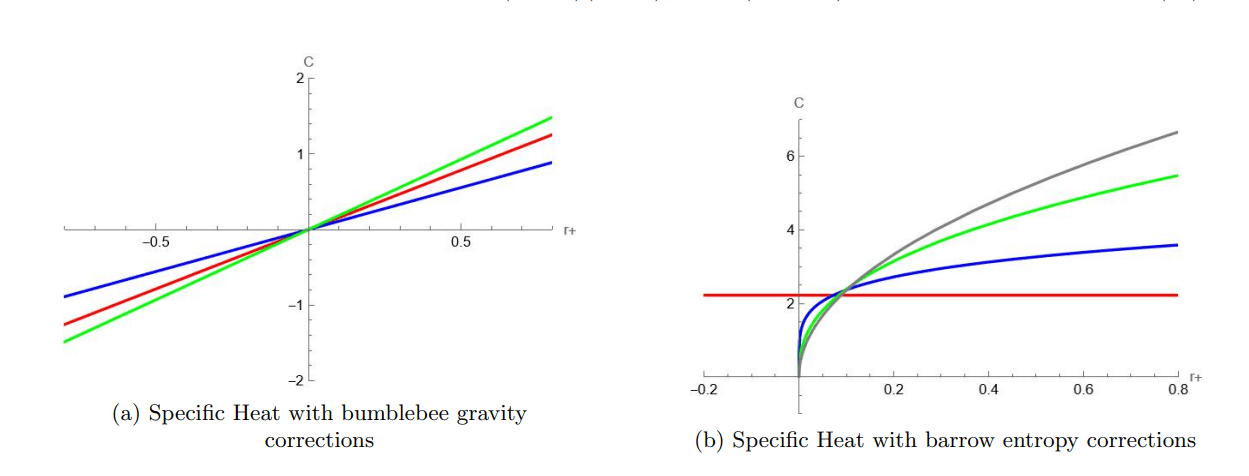
The behaviour of black holes challenges our understanding of gravity, and recent research explores how fundamental principles might change under extreme conditions. H. Kaur and Prince A. Ganai, from the National Institute of Technology, Srinagar, alongside their colleagues, investigate the thermodynamics of black holes in a specific theoretical framework combining Einstein’s gravity with ‘bumblebee’ gravity, a theory allowing for violations of fundamental symmetry principles, and incorporating a modified understanding of entropy known as Barrow entropy. This work examines how these combined effects alter the temperature, free energy, and stability of black holes, specifically focusing on lower-dimensional black holes known as BTZ black holes, by modelling them within a confined, heated space. The results reveal that the interplay between symmetry violation, modified entropy, and boundary conditions significantly impacts the behaviour of these black holes, offering new insights into the nature of gravity and the implications of extending established physical laws.
The research focuses on how Barrow entropy, a modification of standard entropy incorporating quantum gravity effects, alters the black hole’s temperature, entropy, and free energies. The team also examines black hole stability by calculating specific heat and determining conditions for phase transitions, revealing how Barrow entropy influences thermal stability. Furthermore, the study considers cavity modification, introducing a minimal length scale and altering the black hole’s horizon structure, impacting its thermodynamic properties and stability.
The research connects black hole thermodynamics with non-extensive Barrow entropy, which parametrises quantum-gravitational corrections to the standard Bekenstein-Hawking area law. Scientists introduce the York cavity formalism, placing the black hole in a finite, isothermal cavity to establish a well-defined canonical ensemble. This approach yields corrected temperature, free energy, and stability conditions for the BTZ black hole, demonstrating the interplay between Lorentz-violating effects, Barrow entropy corrections, and boundary conditions within the cavity. The results indicate that the combined impact of bumblebee dynamics and Barrow entropy significantly alters the phase structure and equilibrium.
Three-Dimensional Black Hole Entropy Calculations
This research comprehensively explores black hole thermodynamics, focusing on modifications to standard gravity and entropy calculations. Scientists investigate three-dimensional black holes, specifically the Bañados-Teitelboim-Zanelli (BTZ) black hole, a simpler model than four-dimensional black holes, facilitating theoretical analysis. The research explores modified gravity theories, including Bumblebee gravity, which breaks Lorentz symmetry, and f(T) gravity. A key focus is on entropy corrections, achieved through Barrow entropy, which proposes a modified entropy formula based on fractal geometry, and other generalized entropy frameworks. Scientists employ York’s cavity formalism to rigorously study black hole thermodynamics.
Black Hole Thermodynamics, Lorentz Violation, Barrow Entropy
This research investigates the thermodynamics of black holes within a framework combining Einstein-Bumblebee gravity, Barrow entropy, and York’s cavity formalism. Scientists analysed how corrections to black hole entropy, arising from Barrow entropy and Lorentz symmetry breaking inherent in the bumblebee gravity model, influence the black hole’s thermal behaviour. The team employed York’s cavity formalism, placing the black hole within a finite, thermally regulated cavity, to establish a well-defined canonical ensemble and accurately calculate thermodynamic quantities. The results demonstrate that the combined effects of Lorentz symmetry breaking, Barrow entropy corrections, and the cavity boundary conditions significantly alter the phase structure, equilibrium configurations, and thermal stability of these black holes.
Specifically, the study reveals modified thermodynamic relations and stability conditions dictated by the interplay between Lorentz symmetry breaking and quantum fractalization of the black hole horizon. While the research focuses on theoretical calculations within this specific model, it provides insight into quantum gravity in lower-dimensional spacetime and universal features of black hole thermodynamics. The authors acknowledge that the model relies on specific assumptions regarding the bumblebee gravity potential and Barrow entropy corrections, which may not fully capture the complexity of real-world black holes. Future research directions include exploring the implications of different potential forms and investigating the potential observational signatures of these effects in astrophysical systems. This work establishes a foundation for further investigation into the interplay between quantum gravity, Lorentz symmetry, and black hole thermodynamics.
👉 More information
🗞 Thermodynamics of BTZ Black Holes in Bumblebee Gravity with Barrow Entropy with Cavity-Modification
🧠 ArXiv: https://arxiv.org/abs/2509.22129

