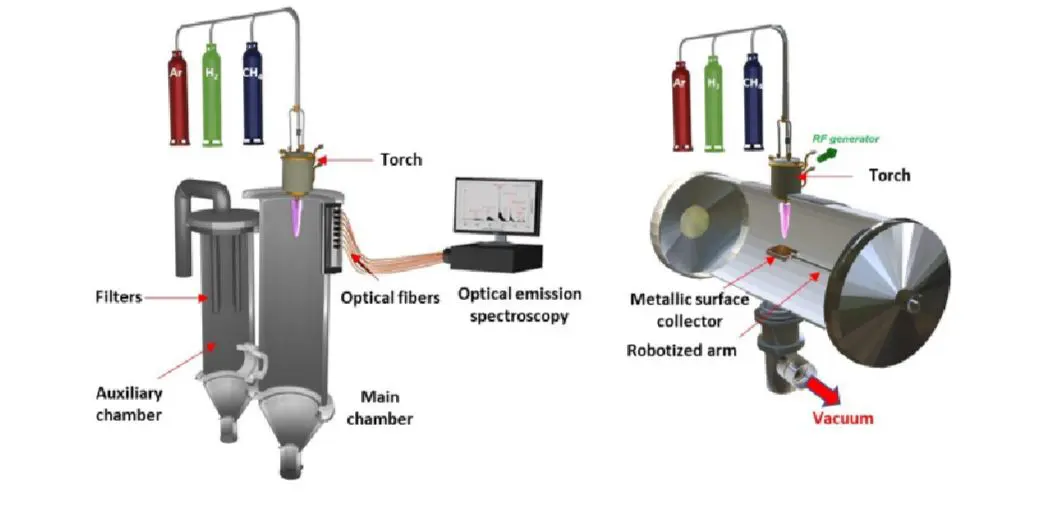
Controlling the synthesis of carbon nanostructures remains a significant challenge in materials science, yet recent work by Taki Aissou, Jerome Menneveux, and Fanny Casteignau, all from Université de Sherbrooke’s Institut Interdisciplinaire d’Innovation Technologique, alongside Nadi Braidy and Jocelyn Veilleux, establishes a crucial link between the conditions of thermal plasma synthesis and the resulting nanostructure morphology. The team demonstrates that precise control over process parameters, such as gas flow rates and pressure, directly influences plasma characteristics like temperature and the density of key carbon-containing molecules. This research reveals how manipulating these factors favours the growth of specific nanostructures, ranging from low-density carbon nanohorns to denser graphitic nanocapsules and nanoflakes, offering a pathway to tailor material properties at the nanoscale. By mapping temperature and carbon density within the plasma jet, the scientists achieve unprecedented insight into the mechanisms governing nanostructure formation, paving the way for advanced materials design.
Carbon Nanomaterial Synthesis and Growth Mechanisms
This collection of research papers comprehensively explores the synthesis, characterization, and growth mechanisms of carbon nanomaterials, including graphene, carbon nanotubes, carbon nanohorns, and soot precursors. The studies consistently demonstrate that precise control over synthesis parameters is crucial for tailoring the properties of these materials. Researchers investigated various synthesis methods, with a strong emphasis on thermal plasma techniques, alongside chemical vapour deposition and arc discharge. Understanding the nucleation and growth processes of these materials is a central theme throughout the research, with a focus on controlling the aggregation of nanoparticles and achieving desired particle size distributions. The research highlights the importance of understanding the connection between soot formation and the creation of carbon nanomaterials, suggesting that insights into soot mechanisms can aid in nanomaterial synthesis. Theoretical models, such as kinetic nucleation theory and molecular dynamics simulations, complement experimental studies, providing deeper insights into the underlying growth mechanisms.
Plasma Synthesis Links Parameters to Nanostructure Morphology
Adopting Plasma Methods for Enhanced Nanostructure Synthesis
Scientists pioneered a novel approach to carbon nanostructure synthesis using thermal plasma, establishing a direct correlation between process parameters, plasma characteristics, and the resulting product morphology. The study employed a radiofrequency plasma torch to decompose hydrocarbon gas precursors, offering advantages in productivity, energy efficiency, and operational simplicity. To directly observe the plasma environment during synthesis, the team harnessed in situ optical emission spectroscopy, mapping the distribution of both temperature and dicarbon molecule (C2) density within the plasma jet. Experiments revealed that low-density nanostructures, such as carbon nanohorns, are favoured at high temperatures and dilute C2 local densities, while denser nanostructures, like onion-like polyhedral graphitic nanocapsules, form at lower temperatures and higher C2 densities. The carbon density was precisely controlled by adjusting the flow rate and pressure, significantly influencing nanostructure morphology, with transitions observed from nanoflakes to graphitic nanocapsules as either parameter increased. This detailed mapping of plasma characteristics and their influence on nanostructure formation represents a significant advancement in controlling the synthesis of advanced carbon materials.
Plasma Conditions Control Nanostructure Morphology
Precisely Correlating Plasma Parameters with Nanomaterial Morphology
This research demonstrates a precise correlation between plasma conditions and the morphology of carbon nanostructures, achieving controlled synthesis of graphene nanoflakes, carbon nanohorns, and graphitic nanocapsules. The team meticulously mapped temperature and dicarbon density distributions within the plasma jet using in situ optical emission spectroscopy, establishing a direct link between these parameters and nanostructure formation. By manipulating carbon precursor type and pressure, scientists achieved a transition in nanostructure morphology, evolving from graphene nanoflakes to graphitic nanocapsules as either parameter increased. Increasing the hydrogen to carbon ratio from 1 to 8 induced a morphological transition from carbon nanohorns to graphene nanoflakes, with improvements in crystallinity confirmed by Raman spectroscopy. These measurements demonstrate a significant reduction in defects and an enhancement in the quality of the graphene nanoflakes produced. The team characterized the resulting materials using transmission electron microscopy and Raman spectroscopy, quantifying the impact of each parameter on nanostructure morphology and crystalline quality.
Plasma Control Dictates Carbon Nanostructure Morphology
Demonstrating Versatile Synthesis of Carbon Nanostructures
This research successfully demonstrates the production of diverse carbon nanostructures, including graphene nanoflakes, carbon nanohorns, and graphitic nanocapsules, using a thermal plasma process. By combining detailed materials characterization with in situ optical emission spectroscopy, scientists have established clear relationships between process parameters, plasma characteristics, and the resulting nanostructure morphology. The findings reveal that controlling the local concentration of C2 radicals, achieved through adjustments to gas flow rate, pressure, and the hydrogen-to-carbon ratio, is critical for directing nanostructure growth. High C2 densities favour the formation of compact structures like graphitic nanocapsules, while lower densities promote the development of less dense structures such as graphene nanoflakes and carbon nanohorns. The study also highlights the importance of temperature gradients within the plasma jet, with crystal growth occurring within a specific zone located 50 to 100mm from the torch nozzle, exceeding 3,500 K. This work advances the field by demonstrating precise control over nanostructure morphology through manipulation of plasma conditions, paving the way for tailored materials with specific properties.
🗞 Controlling Carbon Nanostructure Synthesis in Thermal Plasma Jet: Correlation of Process Parameters, Plasma Characteristics, and Product Morphology
🧠 ArXiv: https://arxiv.org/abs/2512.04880