

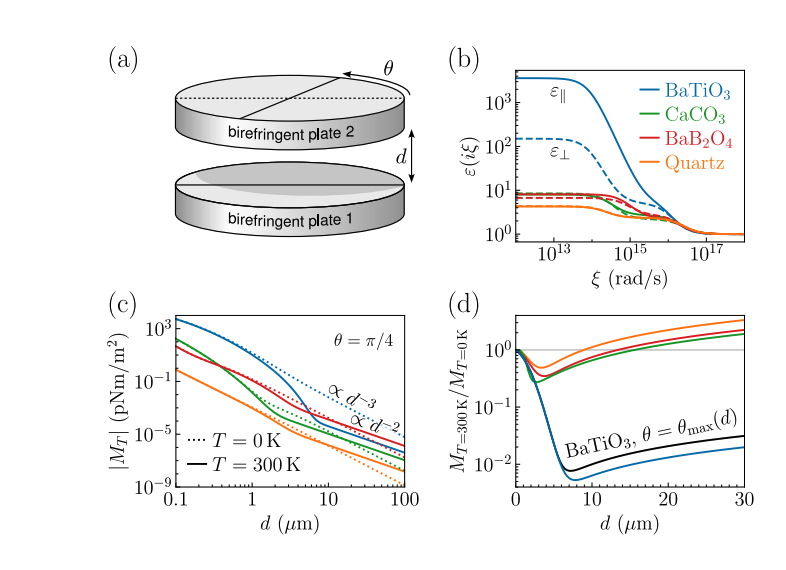
Research demonstrates thermal fluctuations substantially reduce Casimir torque between birefringent plates, sometimes by up to two orders of magnitude. Temperature alters the torque’s angular dependence, enabling control of its magnitude and direction in dissimilar plate systems, and offering the potential for nanoscale sensor and device development. Birefringence refers to the property of a material having a refractive index that depends on the polarisation and propagation direction of light.
The subtle interplay between quantum fluctuations and thermal energy dictates behaviour at the nanoscale, manifesting as forces between closely spaced objects. This phenomenon, known as the Casimir effect, typically describes attractive forces but can also generate rotational forces, termed Casimir torque, when materials exhibit optical anisotropy, meaning they interact differently with light depending on its polarisation. Benjamin Spreng, from the University of California, Davis, and Jeremy N. Munday, along with their colleagues, investigate the influence of temperature on this torque between birefringent plates – materials with differing refractive indices depending on the direction of light polarisation. Their research, detailed in the article ‘Thermal Effects in the Casimir Torque between Birefringent Plates’, reveals that thermal fluctuations substantially reduce the magnitude of the torque and, crucially, alter its angular dependence, offering potential for temperature-controlled manipulation of nanoscale rotational forces.
Recent investigations reveal a substantial influence of thermal fluctuations on the Casimir torque when acting between birefringent plates, demonstrating reductions of up to two orders of magnitude in torque strength for materials exhibiting high birefringence. Birefringence, the property where a material’s refractive index varies with the polarisation of light, fundamentally alters the interaction beyond the simpler, isotropic cases, and establishes a crucial role for temperature in modifying the angular dependence of the torque.
The typically observed sinusoidal behaviour of the Casimir
The typically observed sinusoidal behaviour of the Casimir torque deviates with increasing temperature, signifying a complex interplay between quantum and thermal contributions and challenging simplified models. This deviation arises because thermal fluctuations introduce additional modes that interfere with the quantum vacuum fluctuations responsible for the original torque. The resulting torque is, therefore, a superposition of these quantum and thermal effects, leading to a more complex angular dependence.
Researchers observe a distance-dependent reversal in the torque’s direction when utilising dissimilar birefringent plates, offering a mechanism for precise control over both the magnitude and sign of the rotational force through temperature manipulation. This control arises from the differing responses of each material to thermal fluctuations at varying separations, resulting in a gradient in the thermal contribution to the overall torque.
Rigorous comparison of experimental results with theoretical predictions refines understanding of the Casimir-Lifshitz torque, a more comprehensive model that accounts for material properties and geometry. The Casimir-Lifshitz force generalises the original Casimir effect to include the effects of dielectric materials and considers the full frequency spectrum of electromagnetic fluctuations. This comparison validates the theoretical framework and highlights the importance of accurately modelling thermal contributions to the torque.
Beyond fundamental understanding, the observed phenomena offer a framework for the development of novel nanoscale sensors and devices. Precise control of the Casimir torque, facilitated by temperature tuning, presents opportunities for creating actuators, rotational switches, and sensitive torque sensors. The ability to manipulate the torque through temperature control provides an additional degree of freedom for device engineering, potentially leading to innovative sensors, actuators, and methods for assembling nanostructures.
The interplay between quantum fluctuations and thermal effects
The interplay between quantum fluctuations and thermal effects provides a rich landscape for future exploration. Further research will focus on exploring the potential for utilising these effects in practical device applications, and investigating the behaviour of more complex geometries and material combinations. Theoretical modelling will continue to refine predictions and guide experimental investigations, particularly concerning the impact of material imperfections and surface roughness on the observed phenomena.
These findings demonstrate that the Casimir torque is not merely a static quantum effect but a dynamic phenomenon sensitive to environmental conditions, specifically temperature and material characteristics. The implications extend beyond fundamental physics, opening doors for innovative device designs, including highly sensitive rotational sensors, nanoscale actuators, and novel methods for controlling the alignment of micro and nanoscale components.
🗞 Thermal Effects in the Casimir Torque between Birefringent Plates
🧠 DOI: https://doi.org/10.48550/arXiv.2507.02184


