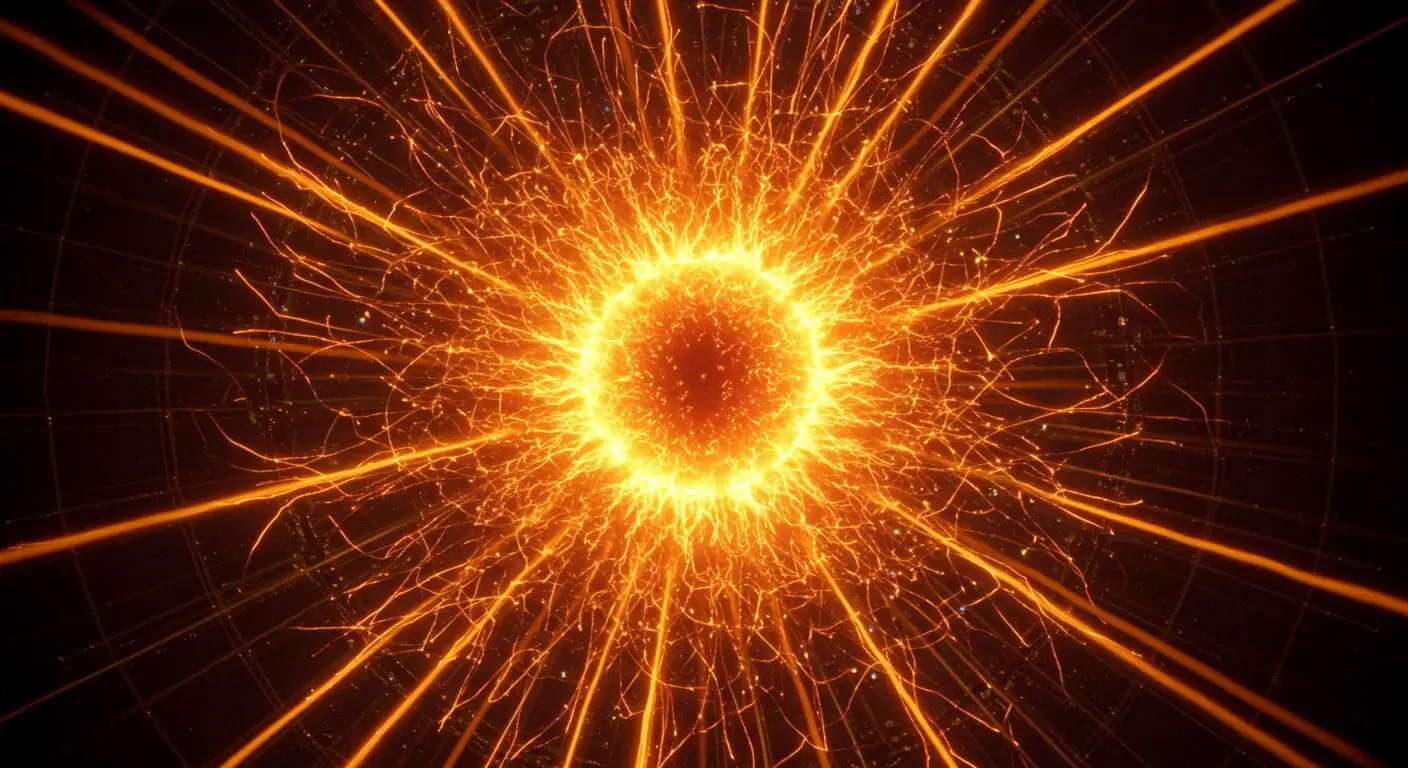
The Higgs boson, often called the “God particle,” is a fundamental particle associated with the Higgs field, which plays a crucial role in giving other particles mass. Proposed by Peter Higgs and others in 1964, its discovery was a monumental achievement in physics, completing the Standard Model that describes the basic building blocks of matter and their interactions. The quest for the Higgs boson led to the construction of the Large Hadron Collider (LHC), a particle accelerator designed to recreate conditions similar to those just after the Big Bang by colliding protons at extremely high energies.
The discovery of the Higgs boson was announced in 2012 by teams working on the ATLAS and CMS detectors at CERN. These experiments analyzed vast datasets from LHC collisions, providing evidence for a particle consistent with the Higgs boson’s predicted properties. This confirmation validated decades of theoretical work and marked a significant milestone in experimental physics, completing the Standard Model and addressing one of the most fundamental questions about why particles have mass.
Despite this breakthrough, many questions remain unanswered. The discovery of the Higgs boson has highlighted the limitations of the Standard Model, as it does not explain phenomena like dark matter or provide insights into the universe’s structure beyond what is currently understood. Future research directions aim to explore physics beyond the Standard Model, investigating whether the Higgs boson exhibits behaviors that deviate from predictions, which could point to new phenomena such as supersymmetry or extra dimensions. Ongoing experiments at the LHC and other facilities continue to deepen our understanding of fundamental physics, seeking to unravel the universe’s deepest secrets and address unanswered questions about its structure and origins.
The Standard Model’s Missing Pieces
The Higgs boson, often popularly referred to as the “God Particle,” is a fundamental particle in the Standard Model of physics. Its discovery was pivotal because it explained how particles acquire mass through the Higgs field, a mechanism essential for the structure of matter. This particle’s existence was theorized to fill a critical gap in understanding the universe’s basic components.
The Higgs mechanism involves a field that permeates all space, interacting with particles to give them mass. Without this mechanism, particles like electrons would not have mass, leading to a universe fundamentally different from our own. The term “God Particle” originated from a book by Leon Lederman but is misleading as the Higgs does not explain all cosmic phenomena.
The search for the Higgs boson involved extensive experiments at CERN’s Large Hadron Collider (LHC) and Fermilab’s Tevatron. These accelerators smashed protons together, creating high-energy conditions to produce particles, including the Higgs, which decayed into detectable forms like photons or leptons.
The discovery was announced in 2012 after analyzing data from these experiments. Observations of specific decay channels matched theoretical predictions, confirming the Higgs boson’s existence. This achievement was a milestone for particle physics, validating the Standard Model and opening avenues for exploring beyond it.
The implications of this discovery extend to future research, potentially informing theories like supersymmetry or dark matter. While the Higgs fills a significant gap in the Standard Model, questions remain about the universe’s deeper structure, driving continued exploration in high-energy physics.
Constructing The LHC: Engineering Marvels
The term “God particle” was popularized by physicist Leon Lederman in his book The God Particle: If the Universe Is the Answer, What Is the Question?, though it is not a term favored by physicists themselves due to its theological connotations.
The search for the Higgs boson culminated at the Large Hadron Collider (LHC), an engineering marvel located near Geneva, Switzerland. The LHC, constructed over two decades and operational since 2010, accelerates protons to unprecedented energies in a 27-kilometer-long ring of superconducting magnets. This accelerator represents one of humanity’s most ambitious scientific endeavors, involving thousands of scientists and engineers from around the globe.
The discovery of the Higgs boson was announced on July 4, 2012, by teams working at the ATLAS and CMS detectors, which are among the largest scientific instruments ever built. These detectors were designed to observe the debris of proton-proton collisions, searching for evidence of the Higgs boson’s brief existence. The discovery confirmed the theoretical framework proposed in the 1960s by Peter Higgs and others, solidifying our understanding of the electroweak interaction.
The engineering challenges of constructing the LHC were immense. The accelerator required precise alignment of its magnets to within millimeters, despite being buried over 100 meters underground. Also, maintaining these magnets’ superconducting state necessitated cooling them to temperatures colder than outer space, using liquid helium. These technical feats underscored the ingenuity and collaboration required for such a project.
The discovery of the Higgs boson has profound implications for our understanding of the universe. It validates the Standard Model and opens avenues for exploring physics beyond it, such as dark matter and supersymmetry. The LHC continues to operate, providing physicists with data that may lead to further breakthroughs in particle physics.
The International Race For Discovery
The quest for the Higgs boson was marked by intense international competition, primarily between CERN’s Large Hadron Collider (LHC) project and Fermilab’s Tevatron collider. Both facilities were engaged in high-energy particle collisions to detect the elusive particle. The LHC near Geneva, Switzerland, was designed with higher energy capabilities than the Tevatron, giving it a significant advantage in the race.
The discovery of the Higgs boson was announced on July 4, 2012, by CERN. Physicists observed a new particle at a mass of approximately 125 gigaelectronvolts (GeV) with a statistical significance of five sigma, which is the threshold for confirming a discovery in particle physics. This confirmation came after analyzing data from proton-proton collisions in the LHC.
The implications of this discovery are profound. It validates the Standard Model by confirming the existence of the Higgs field, which gives mass to elementary particles. However, it also raises new questions about the nature of the universe, such as the existence of dark matter and supersymmetry, areas that remain unexplored and continue to drive further research.
The search for the Higgs boson exemplifies international scientific collaboration. Thousands of scientists from over 100 countries contributed to the LHC project, showcasing how global cooperation can achieve monumental discoveries in physics.
From Academic Skepticism To Nobel Recognition
The search for the Higgs boson, often referred to as the “God particle,” began with a theoretical framework proposed by Peter Higgs in 1964. Higgs suggested that an invisible field, now known as the Higgs field, permeates the universe and gives particles their mass through interactions. This hypothesis was initially met with scepticism but gained traction as it filled a critical gap in the Standard Model of particle physics. The theoretical underpinnings were further developed by other physicists, including François Englert and Robert Brout, who independently proposed a similar mechanism around the same time.
The experimental quest to confirm the existence of the Higgs boson required unprecedented technological advancements. Particle accelerators like the Large Hadron Collider (LHC) at CERN were designed to recreate conditions similar to those just after the Big Bang, allowing physicists to observe high-energy collisions and search for evidence of the Higgs boson. The discovery was announced in 2012 by teams working on the ATLAS and CMS detectors, which observed a particle consistent with the Higgs boson’s predicted properties. This achievement marked a milestone in experimental physics, validating decades of theoretical work.
Discovering the Higgs boson has profound implications. It confirmed the Standard Model and opened new avenues for understanding fundamental forces and the early universe. The Higgs field explains why some particles have mass while others do not, addressing one of physics’s most significant unanswered questions. Furthermore, the discovery has implications for cosmology, as the properties of the Higgs boson could influence the stability of the universe and the nature of dark matter.
Despite its monumental significance, the discovery of the Higgs boson also highlighted the limitations of the Standard Model. Physicists continue to explore whether the Higgs boson exhibits behaviors that deviate from predictions, which could point to new physics beyond the current framework. Ongoing experiments at the LHC and other facilities aim to uncover these mysteries, potentially leading to breakthroughs in understanding phenomena such as supersymmetry or extra dimensions.
The 2013 Nobel Prize in Physics awarded to Peter Higgs, François Englert, and Robert Brout underscored the importance of their contributions. This accolade also reflected the collaborative nature of modern physics, where theoretical insights and experimental ingenuity converge to advance scientific knowledge. The story of the Higgs boson serves as a testament to human curiosity and the power of systematic inquiry in unravelling the universe’s deepest secrets.