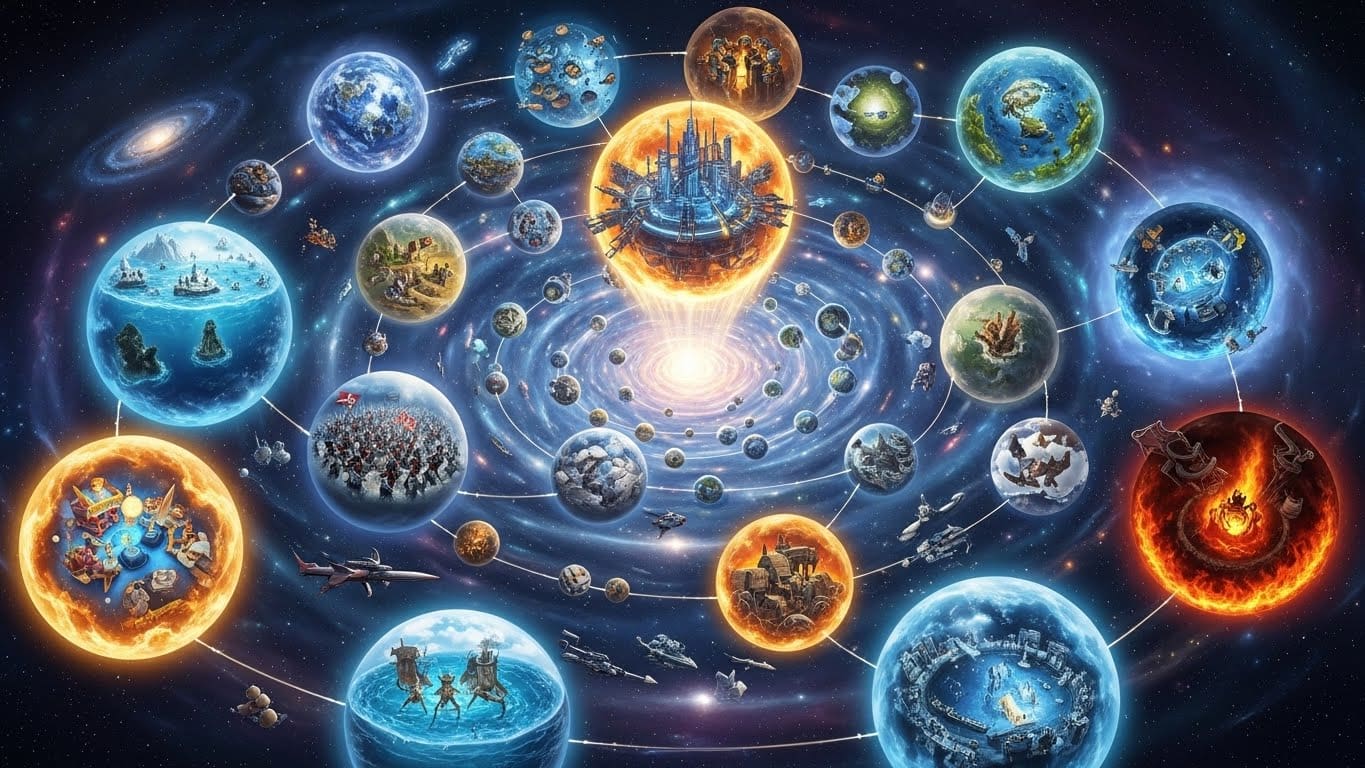
The Many-Worlds Interpretation (MWI) of quantum mechanics has long been a subject of debate among physicists and philosophers. First proposed by Hugh Everett III in 1957, MWI posits that every quantum event spawns parallel universes, each representing a distinct outcome of a quantum process. Unlike the Copenhagen Interpretation, which relies on wavefunction collapse, MWI eliminates the need for an observer-induced transition to classicality. Instead, it suggests that all possible outcomes of quantum measurements coexist in a branching multiverse. Recent advancements in quantum computing, cosmology, and experimental physics have reignited interest in MWI, prompting researchers to take it more seriously as a viable framework for understanding reality.
The growing case for MWI is driven by its ability to resolve paradoxes like Schrödinger’s cat and the quantum measurement problem without invoking ad hoc mechanisms. By treating the universe as a single, evolving wavefunction, MWI avoids the conceptual inconsistencies of wavefunction collapse. Moreover, its mathematical elegance and compatibility with quantum field theory make it an attractive alternative to other interpretations. As quantum technologies advance, the implications of MWI for fields like quantum computing, cosmology, and artificial intelligence are becoming increasingly relevant. This article explores the principles, mechanisms, challenges, and future of MWI, highlighting why it is now gaining traction in both theoretical and applied sciences.
The Fundamental Principles Behind Many-Worlds Interpretation
At its core, MWI is rooted in the mathematics of quantum mechanics. The theory asserts that the universe’s wavefunction evolves deterministically according to the Schrödinger equation, without any collapse. Every quantum event—such as a particle’s spin measurement or photon absorption—results in a branching of the wavefunction into non-communicating “worlds.” For example, if a quantum system exists in a superposition of states, each state corresponds to a separate branch of the wavefunction. Observers in each branch perceive only their own outcome, unaware of the others.
This interpretation eliminates the need for an external observer to “collapse” the wavefunction, a concept that has long been criticized for its subjectivity. Instead, MWI treats the observer as part of the quantum system, with their consciousness also branching into parallel versions. The theory’s foundation lies in the linear nature of quantum mechanics, which allows superpositions to persist indefinitely. By avoiding the collapse postulate, MWI provides a unified description of quantum and classical phenomena, though it raises profound philosophical questions about identity and the nature of reality.
The many-worlds interpretation of quantum mechanics proposes that all possible outcomes of quantum measurements are physically realized in separate, non-communicating branches of the universe. This interpretation eliminates the need for wavefunction collapse by treating the universe as a single, evolving wavefunction.
— Encyclopedia Britannica
How Quantum Branching Works in Practice
Quantum branching occurs when a quantum system interacts with its environment, leading to decoherence. Decoherence is the process by which quantum superpositions lose their coherence due to entanglement with external systems. In MWI, this entanglement results in the separation of the wavefunction into distinct branches, each corresponding to a classical outcome. For instance, when a particle’s spin is measured, the measuring device and observer become entangled with the particle, creating two branches: one where the spin is up and another where it is down.
The branching mechanism is governed by the Schrödinger equation, ensuring that all branches evolve independently. While each branch appears classical to its observers, the entire wavefunction remains a single, coherent entity. The number of branches grows exponentially with every quantum event, leading to an astronomically vast multiverse. However, because branches do not interact, their existence is inferred rather than directly observable. This non-interaction is a key feature of MWI, distinguishing it from other multiverse theories in cosmology.
The Preferred Basis Problem and Decoherence
One of the primary challenges for MWI is the “preferred basis problem”: how does the wavefunction branch into specific, classical-like states rather than arbitrary superpositions? Decoherence provides a partial solution by identifying the basis in which macroscopic systems naturally evolve. Due to interactions with the environment, quantum systems tend to decohere into states that correspond to classical outcomes, such as position or momentum. This process selects a preferred basis, making the branching structure of the wavefunction compatible with our classical experience.
However, decoherence does not fully resolve the issue. While it explains why certain branches become dominant, it does not eliminate the existence of other superpositions. Critics argue that MWI still requires an additional criterion to define the branching structure. Proponents counter that the preferred basis emerges naturally from the system-environment interaction, making the interpretation self-consistent. This debate underscores the ongoing refinement of MWI as a framework for quantum theory.
The Role of Decoherence in MWI
Decoherence is central to MWI’s ability to reconcile quantum mechanics with classical observations. By suppressing interference between branches, decoherence ensures that each world behaves classically, even though the underlying wavefunction remains quantum. This process occurs rapidly for macroscopic systems, explaining why we do not perceive quantum superpositions in everyday life. For example, a cat in a box with a radioactive atom appears either alive or dead because the system decoheres into two distinct branches, each corresponding to a classical state.
Despite its explanatory power, decoherence does not account for the subjective experience of a single outcome. MWI addresses this by asserting that each observer’s consciousness is confined to a single branch, unaware of the others. This leads to the “problem of probability”—how can a theory with infinite branches assign meaningful probabilities to outcomes? Some researchers propose that probability in MWI arises from the relative weights of branches, determined by the Born rule, though this remains a topic of debate.
Comparing MWI vs Copenhagen Interpretation
The Copenhagen Interpretation, formulated in the 1920s, posits that quantum systems remain in superposition until measured, at which point the wavefunction collapses into a definite state. This collapse is inherently probabilistic and relies on an external observer, a concept that has been criticized for its lack of physical mechanism. In contrast, MWI replaces the collapse postulate with a deterministic evolution of the wavefunction, treating measurement as an interaction that entangles the system with the environment.
The key difference lies in their treatment of observers. Copenhagen assigns a privileged role to measurement, while MWI treats observers as quantum entities subject to the same laws as other systems. This makes MWI more consistent with the mathematical formalism of quantum mechanics but introduces philosophical challenges, such as the nature of consciousness in a branching universe. Advocates argue that MWI’s lack of ad hoc assumptions makes it a more elegant and scientifically rigorous framework.
Current Research and Validation Efforts
Recent advances in quantum information science have provided new tools to explore MWI. Experiments in quantum computing and simulation aim to test predictions of the theory indirectly. For example, quantum error correction relies on principles compatible with MWI, as it assumes that quantum information is preserved across branches. Additionally, researchers are investigating whether quantum gravity theories, such as loop quantum gravity, can accommodate a multiverse structure.
Simulations of quantum systems using supercomputers are also shedding light on the dynamics of branching. While direct empirical validation remains elusive, the absence of contradictions with existing experiments strengthens MWI’s credibility. Theoretical physicists are working to refine the preferred basis problem and develop testable predictions, such as the statistical distribution of outcomes in highly entangled systems. These efforts highlight MWI’s growing role in shaping the future of quantum theory.
Key Researchers and Institutions
Prominent figures in the development and advocacy of MWI include David Deutsch, who connected the theory to quantum computing, and Max Tegmark, who explores its implications for cosmology. Institutions like the Perimeter Institute for Theoretical Physics and the University of California, Santa Barbara, are at the forefront of MWI research. Collaborative projects between physicists and philosophers are also addressing the theory’s philosophical ramifications, such as the nature of identity in a branching universe.
Funding from organizations like the National Science Foundation and private foundations has enabled experiments in quantum information and cosmology that indirectly test MWI. These efforts are fostering interdisciplinary dialogue, bringing together experts in quantum mechanics, computer science, and philosophy to refine the theory’s foundations.
Applications in Quantum Computing
MWI has significant implications for quantum computing, particularly in the design of quantum algorithms. The theory suggests that quantum computers perform computations across parallel branches, enabling exponential speedups for certain problems. For instance, Shor’s algorithm for factoring large numbers relies on quantum superposition, a feature naturally explained by MWI.
Moreover, MWI informs error correction strategies in quantum computing. By treating decoherence as a natural process of branching, researchers can model errors as transitions between branches, leading to more robust error correction codes. The theory also inspires new approaches to quantum simulation, where parallel universes are used to model complex systems. As quantum hardware advances, MWI’s role in guiding algorithmic development and hardware design will likely expand.
Implications for Cosmology and Multiverse Theories
MWI intersects with cosmological theories of the multiverse, such as eternal inflation, which posits that new universes are constantly being created in a vast cosmic landscape. While these theories arise from different physical principles, they both suggest an infinite number of parallel realities. The convergence of MWI and cosmological multiverse models raises intriguing questions about the nature of existence and the possibility of testing these ideas through observational cosmology.
For example, some researchers propose that quantum fluctuations in the early universe could leave imprints detectable in the cosmic microwave background, providing indirect evidence for a multiverse. While these ideas remain speculative, they highlight the potential for MWI to inform our understanding of the universe’s large-scale structure and evolution.
The Industrial Revolution, spanning the late 18th to 19th centuries, transformed economies and societies through technological innovations like the steam engine and mechanized textile production. This period marked a shift from agrarian economies to industrialized mass production, reshaping labor, urbanization, and global trade.
— Encyclopedia Britannica
Challenges in Empirical Testing
Despite its theoretical appeal, MWI faces significant challenges in empirical validation. The non-interactive nature of branches makes direct observation impossible, forcing researchers to rely on indirect evidence. Critics argue that the theory’s lack of falsifiability undermines its scientific rigor. However, proponents counter that many foundational theories, such as general relativity, were initially untestable but later confirmed through experiments.
Ongoing efforts to develop testable predictions include analyzing statistical anomalies in quantum systems and searching for deviations from the Born rule. Advances in quantum gravity and cosmology may also provide indirect evidence by linking MWI to observable phenomena like cosmic inflation. Until such tests are developed, MWI will remain a compelling but unproven framework.
The Path Forward: Near-Term Developments
The next decade may see significant progress in testing MWI through quantum information experiments and cosmological observations. Quantum computers with thousands of qubits could simulate branching processes with unprecedented accuracy, offering insights into decoherence dynamics. Additionally, experiments in quantum gravity may reveal whether spacetime itself exhibits multiversal properties.
Collaborative efforts between physicists and philosophers will also refine the theory’s conceptual foundations. For example, addressing the problem of probability in MWI could lead to new interpretations of the Born rule. These developments will determine whether MWI transitions from a philosophical curiosity to a cornerstone of quantum theory.
Long-Term Vision and Philosophical Impact
In the long term, MWI could revolutionize our understanding of reality, consciousness, and the nature of time. If validated, it would imply that every decision and event spawns an infinite number of parallel lives, challenging traditional notions of identity and free will. The theory’s implications for artificial intelligence are equally profound, as it raises questions about whether AI systems could experience branching consciousness.
Ultimately, MWI represents a paradigm shift in how we perceive the universe. By embracing the multiverse as a physical reality, it could unify quantum mechanics with cosmology and reshape humanity’s place in the cosmos. While empirical validation remains a distant goal, the growing scientific and philosophical discourse around MWI ensures its continued relevance in the quest to understand the fundamental nature of existence.