The search for exotic particles continues to expand our understanding of the strong force, and recent research focuses on tetraquarks , particles composed of four quarks. Gang Yang from Zhejiang Normal University, Jialun Ping from Nanjing Normal University, and Jorge Segovia from Universidad Pablo de Olavide, and their colleagues, systematically investigate the potential existence of particularly heavy tetraquarks containing three heavy quarks, specifically those with quark compositions and. This work is significant because it predicts the properties of these elusive particles, identifying potential resonant states within specific mass ranges , between GeV for the system and GeV for the system , and offering insights into their internal structure. The team’s detailed analysis, which considers various configurations and decay channels, suggests these tetraquarks are generally compact, though a few exhibit looser binding, and highlights the importance of specific structural components in their formation.
Investigations into triply heavy tetraquark systems, containing quark compositions ̄bc ̄qc and ̄cb ̄qb where q represents up, down, or strange quarks, are undertaken using a constituent quark model. These systems are characterised by various spin-parity quantum numbers, JP = 0+, 1+, and 2+, and isospin values of I = 0, 1/2, and 1. Determining whether bound or resonant states exist within these four-quark systems involves solving the Schrödinger equation, a process achieved through a high-precision Gaussian Expansion Method, enhanced by the Complex Scaling Method. A comprehensive analysis of S-wave tetraquark systems is also performed, considering configurations including meson-meson, diquark-antidiquark, and K-type arrangements, alongside all possible colour structures. This detailed analysis aims to identify and characterise several narrow resonant states within these complex systems.
Heavy Tetraquark Resonance Predictions from Theory
This research explores the possibility of forming stable or resonant tetraquark states, which are exotic particles composed of four quarks, unlike the more familiar mesons and baryons. Mesons consist of a quark-antiquark pair, while baryons comprise three quarks; tetraquarks, therefore, represent a more complex form of hadronic matter. The study focuses on tetraquarks containing bottom (b) and charm (c) quarks, as these heavier quarks experience a stronger colour interaction mediated by gluons, leading to enhanced binding energies and more pronounced effects in theoretical calculations. The increased mass also simplifies predictions by reducing the contribution of quantum mechanical effects like quark pair creation, which become significant for lighter quark systems. The research team predicts the properties of these tetraquark states using a theoretical framework, providing valuable information for experimental physicists searching for these elusive particles. The predictions cover a range of possible quantum numbers and internal structures, suggesting a rich spectrum of potential tetraquark states.
The team calculates several key properties for each predicted resonance, including its mass, width, size, and magnetic moment. Mass indicates the energy required to create the particle, while width relates to its stability; a narrower width suggests a longer-lived state, potentially observable in experiments. Size represents the spatial extent of the tetraquark, and the magnetic moment describes how strongly it interacts with magnetic fields, providing insights into its internal structure and quark configuration. The predictions are organised based on the specific quark content of the tetraquark, distinguishing between systems containing ̄bc ̄qc and ̄cb ̄qb combinations. This allows researchers to understand how different quark arrangements influence the properties of the resulting tetraquark state, and to differentiate between various possible tetraquark configurations. The constituent quark model employed assumes that quarks are confined within hadrons and interact via a potential that incorporates both colour interactions and kinetic energy. The Gaussian Expansion Method provides a flexible and accurate way to solve the Schrödinger equation for these complex systems, while the Complex Scaling Method allows for the identification of resonant states by analytically extending the potential. By providing detailed theoretical predictions, this research guides experimental efforts to identify and characterise these exotic particles, furthering our understanding of the strong force and the fundamental building blocks of matter.
Methodological Considerations and Theoretical Framework
The theoretical framework underpinning this study relies heavily on Quantum Chromodynamics (QCD), the established theory of the strong force. However, solving QCD equations analytically for multi-quark systems proves intractable, necessitating the use of approximations and effective models. The constituent quark model, therefore, represents a pragmatic approach, treating quarks as fundamental constituents with effective masses and interactions. These effective interactions incorporate the complexities of QCD, such as gluon exchange and sea quark contributions, in a simplified manner. The Schrödinger equation, a cornerstone of quantum mechanics, is then employed to describe the bound state problem, seeking solutions that correspond to stable or resonant tetraquark states. The choice of potential is crucial; the team utilises a potential that incorporates both a confining term, ensuring that quarks remain bound, and a short-range attractive term, representing the residual strong force between quarks.
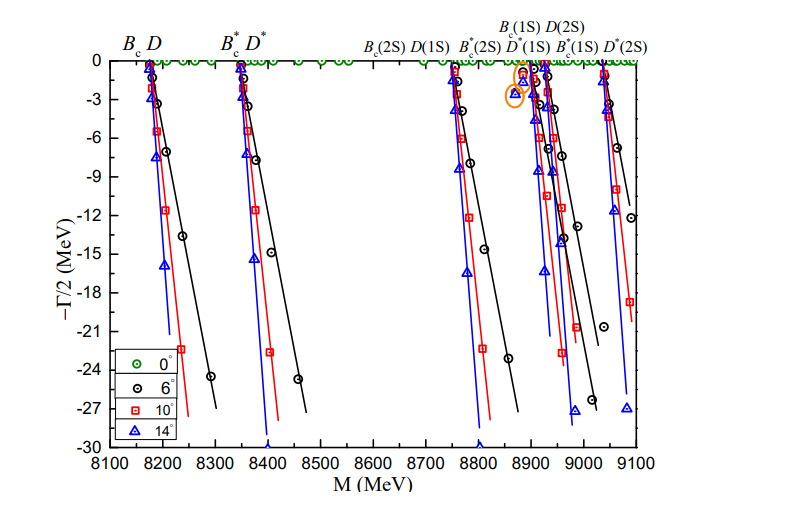
The Gaussian Expansion Method (GEM) represents a numerical technique for solving the Schrödinger equation in non-relativistic quantum mechanics. GEM expands the wave function as a sum of Gaussian functions, offering advantages in terms of accuracy and efficiency, particularly for systems with complex potentials. The Complex Scaling Method (CSM) is then implemented to determine the energy and width of resonant states. CSM involves rotating the coordinate system in the complex plane, effectively transforming bound states into resonances with finite lifetimes. By analysing the poles of the S-matrix in the complex energy plane, the team can extract the mass and width of each resonant state. The analysis considers all possible colour configurations, ensuring that the predicted states are physically realistic and satisfy the requirements of colour confinement. This rigorous approach, combining a sophisticated theoretical framework with advanced numerical techniques, provides a robust foundation for predicting the properties of triply heavy tetraquark states and guiding future experimental searches.
Implications and Future Research
The prediction of stable or resonant tetraquark states carries significant implications for our understanding of the strong force and the nature of hadronic matter. Discovering these exotic particles would validate the theoretical predictions derived from QCD and provide insights into the mechanisms governing quark confinement. Furthermore, the study of tetraquark properties, such as their mass, width, and decay modes, could reveal subtle details about the interactions between quarks and gluons. These insights could, in turn, refine our understanding of the quark-gluon plasma, a state of matter believed to have existed shortly after the Big Bang. The experimental verification of these predictions requires high-luminosity colliders, such as the Large Hadron Collider (LHC) at CERN, capable of producing and detecting these short-lived particles.
Future research directions include extending the analysis to include lighter quark combinations, such as those involving up, down, and strange quarks. This would require more sophisticated theoretical models and computational resources, as the effects of quark pair creation and relativistic corrections become more significant. Investigating the decay modes of these tetraquark states is also crucial, as they provide valuable information about the underlying quark structure and interactions. Furthermore, exploring the possibility of pentaquark and hexaquark states, composed of five and six quarks respectively, could reveal even more complex forms of hadronic matter. The ongoing interplay between theoretical predictions and experimental searches promises to unlock new insights into the fundamental building blocks of matter and the forces that govern their interactions, pushing the boundaries of our knowledge in particle physics.
🗞 Triply heavy tetraquarks and in a constituent quark model
🧠 DOI: https://doi.org/10.48550/arXiv.2507.13728