

The ability to control magnetism using electrical signals represents a major goal in materials science, and recent research demonstrates a novel approach using stacked layers of graphene. Daniel Brandon, Tixuan Tan, and Yiwen Ai, alongside colleagues at various institutions, now reveal how manipulating the arrangement of these layers achieves nonvolatile magnetic switching. The team demonstrates that applying an electrical gate voltage induces a structural change in four-layer graphene, causing it to slide between different stacking configurations. This sliding transforms the material’s magnetic state, switching it between paramagnetism and ferromagnetism, and importantly, maintains this state even when the voltage is removed, opening up possibilities for new data storage technologies and a deeper understanding of unconventional physics at the boundaries between different material structures.
Graphene Multilayers, Stacking, and Electronic Properties
This research comprehensively investigates graphene multilayer systems, their electronic properties, and emerging phenomena like ferroelectricity and superconductivity. The focus lies on how stacking order dramatically alters the electronic band structure, creating unique properties. Moiré patterns, arising from slight misalignments between layers, also create new superlattice structures with altered electronic behaviour. Trigonal warping and Berry’s phase are important concepts related to the band structure of these multilayer systems. A major theme is the emergence of ferroelectric behaviour in graphene multilayers through interlayer sliding, a novel mechanism for inducing ferroelectricity.
The research explores the potential for using this ferroelectricity in memory devices. Investigations also suggest the possibility of inducing superconductivity in graphene multilayers, potentially through mechanisms related to domain wall fluctuations or other novel interactions. The research further explores the emergence of topological states and valley transport, particularly at domain walls, and investigates changes in the electronic band structure and their effects on transport properties. Theoretical calculations of electronic structure and properties rely on Density Functional Theory. Atomic Force Microscopy fabricates graphene nanoribbons and characterizes surface properties, while Scanning Tunneling Microscopy images electronic structure and local density of states. Transport measurements characterize electrical conductivity, and X-ray Diffraction determines stacking order and crystal structure. This research pushes the boundaries of graphene materials science by exploring how stacking and interlayer interactions create new functionalities, with potential implications for memory devices, nanoelectronics, superconducting devices, and domain wall electronics.
Graphene Switching Between Quantum Phases Demonstrated
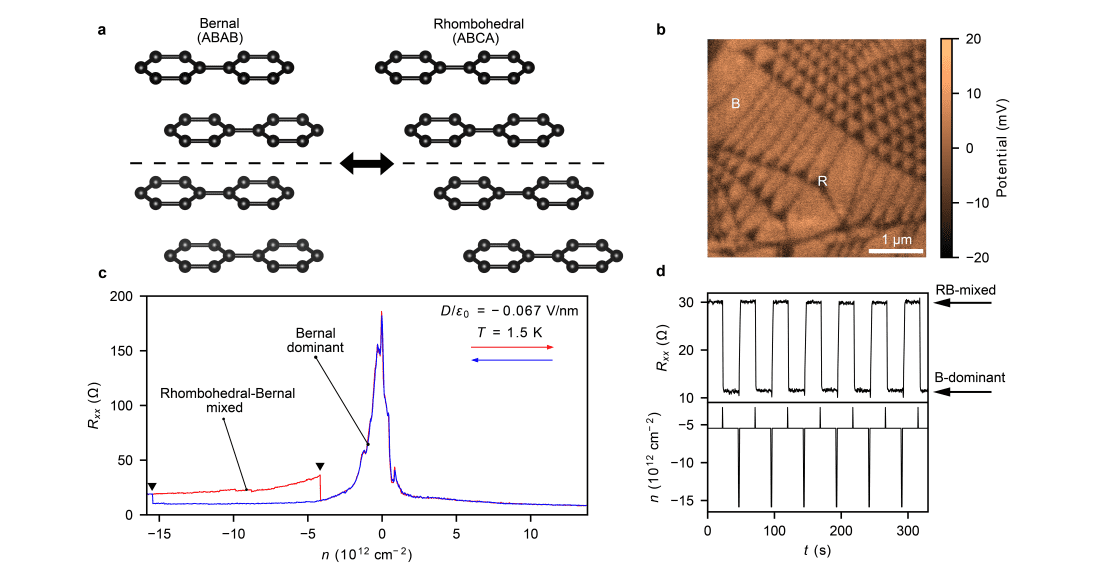
Scientists have demonstrated a gate-voltage-induced structural phase transition in tetralayer graphene, achieving nonvolatile switching between distinct quantum phases. The research focuses on manipulating the stacking order, Bernal and rhombohedral, through interlayer sliding, a phenomenon termed “slidetronics. ” Experiments reveal an abrupt jump in longitudinal resistance when the graphene is doped, indicating a transition between a mixed rhombohedral-Bernal state and a Bernal-dominant state. This change in resistance persists, demonstrating clear hysteretic behaviour. The team assembled marginally-twisted double bilayer graphene, creating mixed domains of both rhombohedral and Bernal stacking.
Kelvin probe force microscopy measurements show a surface potential difference between rhombohedral and Bernal graphene, consistent with previous reports. This structural arrangement is critical, as the switching between states is driven by the motion of pre-existing domain walls within the material, requiring significantly less voltage than would be needed to induce a transition in a uniformly stacked material. Further analysis reveals that the doped region consists of spatially mixed rhombohedral and Bernal domains, while the region with higher carrier density appears predominantly Bernal. The absence of clear quantum oscillations in the mixed-domain region suggests a superposition of oscillations originating from both stacking configurations, while their presence in the Bernal-dominant region confirms its structural identity. This breakthrough delivers a method for on-demand control of quantum phases through gate-induced interlayer sliding, paving the way for novel electronic devices and exploration of unconventional physics at stacking domain boundaries.
Graphene Switching Between Magnetic and Structural States
This research demonstrates a gate-voltage-controlled structural transition between Bernal and rhombohedral stacking in tetralayer graphene, achieving a first-order structural change through interlayer sliding. Transport measurements reveal bistable switching behaviour, allowing the material to alternate between a Bernal-dominant state and a mixed rhombohedral-Bernal state. This structural transition is accompanied by nonvolatile switching between paramagnetic and ferromagnetic states, alongside the observation of the anomalous Hall effect. The team discovered that the sign of the anomalous Hall effect reverses with opposite displacement fields, suggesting its origin lies in domain boundaries between the Bernal and rhombohedral regions.
Further analysis indicates the anomalous Hall effect arises from two components: a negative contribution from the rhombohedral graphene itself and a separate contribution originating from the domain boundaries. While the negative anomalous Hall effect is attributed to the quarter-metal phase within the rhombohedral regions, disentangling the contributions from both sources requires further investigation. This achievement establishes a new method for controlling quantum phases of matter in two-dimensional systems, offering a pathway towards rapid, energy-efficient switching and potential applications in magnetic memory and reconfigurable circuits. The approach may also be applicable to other exotic phases, such as chiral superconductivity, and extend to other 2D materials with metastable stacking orders, while simultaneously establishing domain boundaries as platforms for exploring emergent physics.
👉 More information
🗞 Nonvolatile Switching of Magnetism via Gate-Induced Sliding in Tetralayer Graphene
🧠 ArXiv: https://arxiv.org/abs/2510.00220


