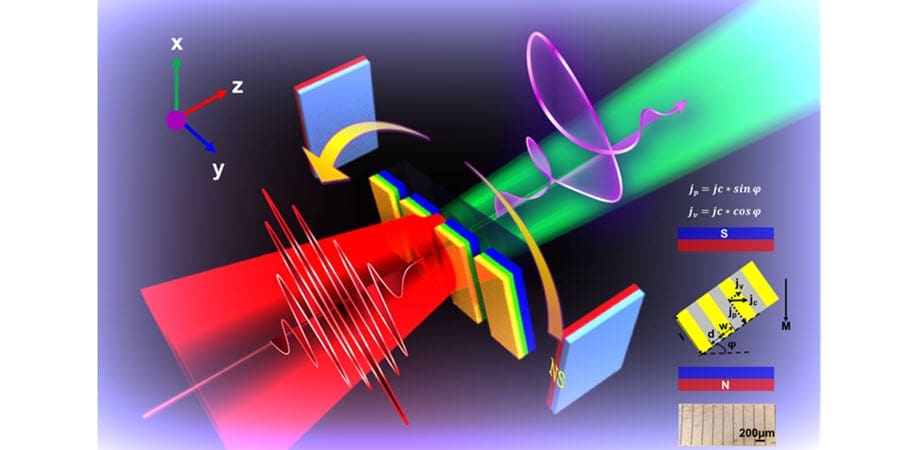
Researchers from Beihang University in China have developed a spintronic terahertz (THz) emitter with a microscale stripe pattern that enables direct polarization control during THz wave generation. This innovation addresses the limitations of traditional THz sources, which rely on bulky external components for polarization tuning. The new emitter integrates polarization modulation directly into its design, using thin-film layers of tungsten, cobalt-iron-boron, and platinum to generate a built-in electric field that influences the amplitude and phase of emitted THz waves.
Adjusting stripe patterns and orientations gives the device precise control over linear, elliptical, and circular polarization states across a broad frequency range (0.74–1.66 THz). This advancement promises to enhance wireless communication by enabling polarization multiplexing for higher data rates and improve biomedical imaging for more accurate biomolecule detection while also advancing research in quantum optics and precision sensing.
Terahertz Waves: Potential in Wireless and Biomedical Technology
Terahertz (THz) waves, situated between microwaves and infrared light in the electromagnetic spectrum, hold significant potential for wireless communication and biomedical imaging. Their ability to penetrate nonmetallic materials without causing damage makes them ideal for security scanning and medical diagnostics applications.
However, controlling the polarization of THz waves has been a challenge. Traditional methods rely on bulky external components like wave plates or metamaterials, which are inefficient and limited in frequency range. This limitation hinders their integration into compact devices, crucial for practical applications.
Recent advancements by researchers at Beihang University have introduced a spintronic emitter that addresses these challenges. This innovative device incorporates polarization control directly into its design through microscale stripe patterns. When exposed to ultrafast laser pulses, the emitter generates a spin current converted into electrical charge via the inverse spin Hall effect. The stripe pattern modulates charge distribution, creating an electric field that influences THz wave properties.
Testing with varying stripe aspect ratios demonstrated enhanced polarization control. Larger ratios produced stronger electric fields, enabling precise modulation of THz waves. This capability allows efficient switching between polarization states, such as linear and circular, by rotating the emitter or adjusting stripe angles.
The implications for wireless communication are substantial, with potential for doubling data rates through polarization multiplexing. In biomedical imaging, this technology could enable earlier disease detection by accurately sensing biomolecules. Additionally, enhanced measurement sensitivity in quantum optics and precision sensing opens new research avenues.
Looking ahead, refining frequency-selective control will further unlock the capabilities of THz wave control. This advancement brings scalable devices closer to reality, promising transformative impacts across various fields.
Challenges in Polarization Control of Terahertz Waves
Controlling the polarization of terahertz (THz) waves has been a significant challenge due to the limitations of traditional methods. These methods often rely on bulky external components such as wave plates or metamaterials, which are not only inefficient but also limited in frequency range. This restricts their integration into compact devices, making them less practical for real-world applications.
Spintronic Emitters and Microscale Stripe Patterns
Recent advancements by researchers at Beihang University have introduced a novel solution to these challenges: a spintronic emitter that incorporates polarization control directly into its design through microscale stripe patterns. When exposed to ultrafast laser pulses, the emitter generates a spin current that is converted into electrical charge via the inverse spin Hall effect. The stripe pattern modulates charge distribution, creating an electric field that influences THz wave properties.
Testing with varying stripe aspect ratios has demonstrated enhanced polarization control. Larger ratios produce stronger electric fields, enabling precise modulation of THz waves. This capability allows efficient switching between polarization states, such as linear and circular, by rotating the emitter or adjusting stripe angles.
Experimental Validation
The research conducted at Beihang University involved testing with varying stripe aspect ratios to observe their influence on electric field strength and polarization control. Experimental results confirmed that larger stripe aspect ratios produce stronger electric fields, enhancing modulation capabilities. This finding is critical for optimizing the performance of THz wave devices in practical applications such as wireless communication and biomedical imaging.
Implications and Future Directions
The spintronic emitter’s ability to control terahertz (THz) wave polarization through microscale stripe patterns has significant implications for wireless communication. By enabling efficient modulation of THz waves, this technology can enhance data transmission rates. The precise control over polarization states allows for polarization multiplexing, which could potentially double data rates in wireless networks.
In biomedical imaging, the improved polarization control offers enhanced capabilities for sensing biomolecules. This advancement could lead to more accurate and earlier detection of diseases by enabling better resolution and sensitivity in imaging systems. Additionally, the technology’s ability to modulate THz waves with high precision opens new possibilities for applications in quantum optics and precision sensing.
Looking ahead, further refinement of frequency-selective control will be essential to fully realize the potential of THz wave technology. This research brings scalable devices closer to reality, promising transformative impacts across various fields.
More information
External Link: Click Here For More