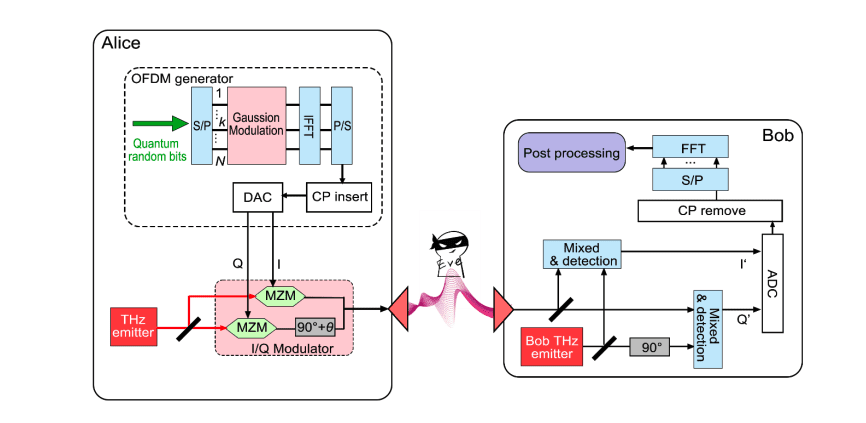
The increasing demand for secure communication necessitates exploration beyond conventional cryptographic methods, particularly in light of anticipated advances in quantum computing. Researchers are now investigating quantum key distribution (QKD), a technique that leverages the laws of quantum mechanics to ensure secure key exchange. A team led by Mingqi Zhang and Kaveh Delfanazari, both from the James Watt School of Engineering at the University of Glasgow, details a novel approach to continuous-variable QKD (CVQKD) in their article, “Orthogonal Frequency Division Multiplexing Continuous Variable Terahertz Quantum Key Distribution.” Their work focuses on utilising the terahertz (THz) band, a region of the electromagnetic spectrum offering potentially high bandwidth, and employing orthogonal frequency-division multiplexing (OFDM), a signal modulation technique commonly used in wireless communication, to enhance data throughput and mitigate signal degradation. The study presents a detailed analysis of this system’s performance, considering atmospheric effects and noise in both terrestrial and inter-satellite communication scenarios, and assesses the feasibility of implementation using emerging on-chip terahertz sources based on superconducting Josephson junctions.
Terahertz quantum key distribution (QKD) presents a viable route towards secure, high-throughput communication, and recent research details a continuous-variable QKD (CVQKD) protocol operating within the terahertz (THz) band. This protocol achieves a simulated secret key rate of approximately 72 bits per channel use under ideal conditions, utilising orthogonal frequency-division multiplexing (OFDM) to enhance spectral efficiency and counteract channel dispersion and atmospheric attenuation. A comprehensive security analysis, conducted under collective Gaussian attacks, confirms the protocol’s resilience against potential eavesdropping strategies, establishing a robust foundation for secure data transmission.
Researchers designed the CVQKD protocol to address the specific challenges of THz communication, incorporating features to optimise performance and security. The protocol employs OFDM, a method of encoding digital data across multiple frequency bands, to divide the THz signal into multiple subcarriers, mitigating the effects of multipath fading – where signals arrive via multiple paths – and intersymbol interference, enhancing data transmission reliability in challenging environments. Furthermore, the protocol utilises advanced modulation schemes and error correction codes to improve the key rate and communication range, contributing to a more efficient and secure communication system. The security analysis confirms the protocol’s ability to withstand sophisticated eavesdropping attempts, ensuring data confidentiality.
The study identifies atmospheric absorption as a primary limitation for terrestrial THz links, restricting practical communication distances to approximately 4.5 metres in open-air scenarios. This limitation arises from the strong absorption of THz radiation by water vapour and other atmospheric constituents. However, simulations reveal significantly extended ranges for inter-satellite links, exceeding 100 kilometres, due to minimal propagation losses in space, highlighting the potential of space-based THz communication for long-distance secure data transmission. Optimisation of modulation variance proves crucial in mitigating intermodulation noise – unwanted signals created by the mixing of different frequencies – enabling a trade-off between communication range and key rate.
Researchers plan to investigate miniaturisation and power efficiency of the THz sources, essential for enabling widespread deployment of compact, high-capacity CVQKD systems. They also intend to explore advanced materials and fabrication techniques to improve the performance and reliability of the THz sources, and integration of the CVQKD system with existing communication networks, facilitating seamless deployment of secure THz communication systems.
The development of THz CVQKD represents a significant step forward in secure communication, offering a promising solution to the growing threat of cyberattacks and data breaches. By leveraging the unique properties of THz radiation and advanced signal processing techniques, researchers have created a system that is both secure and efficient, with the potential to revolutionise how we communicate and protect our data. Ongoing research and development efforts will continue to refine and improve the technology, paving the way for widespread adoption and a more secure future.
Future work should focus on experimentally validating the simulated performance of the CVQKD protocol and the on-chip THz sources. Investigating advanced signal processing techniques to further mitigate the effects of atmospheric turbulence and intermodulation noise represents a key area for improvement, and exploring alternative modulation schemes and error correction codes could enhance both the key rate and the communication range.
👉 More information
🗞 Orthogonal Frequency Division Multiplexing Continuous Variable Terahertz Quantum Key Distribution
🧠 DOI: https://doi.org/10.48550/arXiv.2506.22985