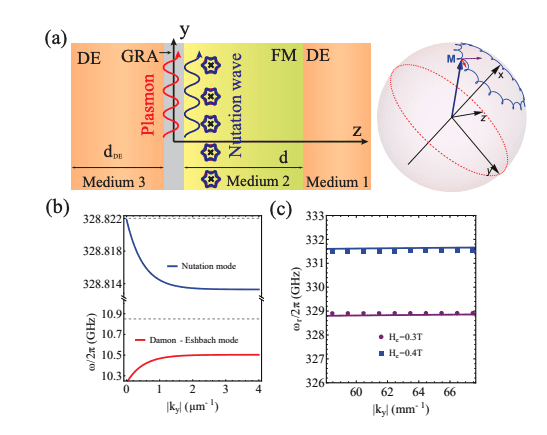
The behaviour of magnetism in materials often assumes frictionless movement. Still, recent evidence suggests this isn’t always the case, with some magnetic materials exhibiting an inertial effect similar to mass in motion. Researchers, including H. Y. Yuan from the Institute for Advanced Study in Physics at Zhejiang University, now demonstrate that this ‘spin inertia’ creates unique wave patterns at terahertz frequencies, and crucially, these waves interact with surface plasmons in two-dimensional materials. By carefully analysing how these combined waves reflect light, the team proposes a new method for measuring the strength of spin inertia in magnetic materials, offering a universally applicable technique to explore this fundamental property and deepen our understanding of magnetism itself. This advancement promises to unlock further investigation into the origins and extent of spin inertia across a wide range of magnetic systems.
Spin waves, also known as magnons, exhibit a wobbling motion called nutation at terahertz frequencies and can interact with surface plasmons in two-dimensional materials like graphene. Researchers have discovered that by exciting these hybrid spin wave-plasmon modes and analysing how light reflects from a structure combining a magnetic material with graphene, they can accurately determine the strength of spin inertia within the magnetic material. This approach is broadly applicable to various magnetic insulators and promises to advance our understanding of spin inertia and its underlying mechanisms.
Graphene Plasmons Couple to Ferromagnetic Nutation
This research investigates the interplay between inertial spin dynamics, specifically nutation, in magnetic materials and surface plasmons in graphene. The team explores how these phenomena couple and could be used in future spintronic and plasmonic devices. The study focuses on the effects of including inertia in spin dynamics, leading to nutation, a precession-like motion of the magnetisation, crucial at terahertz frequencies. Surface plasmons are collective oscillations of electrons at the interface between a metal like graphene and a dielectric material. The research demonstrates that the coupling arises from the overlap of the magnetic field associated with nutation and the electric field associated with surface plasmons.
The team derived a dispersion relation describing the propagation of coupled modes, showing how material properties and coupling strength affect their frequency and wavelength. The coupling can be tuned by altering material properties, such as graphene’s electronic characteristics or the magnetic layer’s thickness, and by applying an external magnetic field. Including inertial effects significantly enhances the interaction between spin waves and plasmons at terahertz frequencies. This coupling could enable the creation of terahertz detectors and emitters with improved efficiency, spin-wave plasmon converters, tunable plasmonic devices controlled by magnetic state, and high-frequency spintronic devices. This work bridges the gap between spintronics and plasmonics, opening new possibilities for advanced devices, and provides a deeper understanding of spin wave and plasmon interactions, potentially leading to discoveries in materials science and physics.
Nutation Spin Waves Couple to Surface Plasmons
Recent research reveals that spins within certain materials exhibit inertial effects, resisting changes to their motion, a departure from traditional spin dynamics understanding. This inertial behaviour manifests as nutation, a wobbling motion superimposed on spin precession, occurring at terahertz frequencies. The discovery of nutation spin waves opens new avenues for exploring fundamental magnetic properties and potentially revolutionising data processing technologies. Researchers have now shown that these high-frequency nutation spin waves can interact with surface plasmons, collective oscillations of electrons, in materials like graphene.
By carefully designing a structure combining a magnetic insulator with a layer of graphene, the team observed that nutation waves effectively “drag” the excitation of surface plasmons. This coupling is robust because the terahertz frequency of the nutation waves aligns well with the natural frequency of plasmons in graphene, leading to a measurable change in how the structure reflects light. This interaction provides a novel method for quantifying the strength of spin inertia within magnetic materials. By precisely measuring the dip in the reflected light spectrum caused by plasmon excitation, researchers can accurately determine the characteristics of the nutation motion. Importantly, this technique is broadly applicable to a wide range of magnetic insulators, offering a versatile tool for future investigations. The ability to both observe and quantify spin inertia represents a significant step forward in understanding magnetic behaviour. It could pave the way for innovative applications in nanophotonics and ultrafast spintronics, potentially leading to faster and more efficient data processing technologies.
Nutation Timescales Measured Via Spin Wave Coupling
This research demonstrates that terahertz nutation spin waves, a consequence of spin inertia, can interact with surface plasmons in a graphene-ferromagnet structure. This interaction alters the electromagnetic energy within the system, creating a measurable dip in the reflected spectrum, and importantly, provides a method for quantifying the timescale of this nutation. The findings suggest a pathway for identifying inertial dynamics across a broad range of magnetic materials and could facilitate the study of ultrafast spin wave-plasmon excitations. The team’s approach offers a universal technique applicable to both magnetic insulators and, with some considerations, potentially to magnetic metals and antiferromagnetic systems.
While the current work focuses on materials exhibiting nutation timescales of around 0.1 picoseconds or greater, the principles extend to materials with faster dynamics, although the interaction with surface plasmons becomes weaker at higher frequencies. This research provides a valuable tool for investigating the fundamental properties of spin inertia and its impact on magnetic materials.
👉 More information
🗞 Using surface plasmons to detect spin inertia
🧠 ArXiv: https://arxiv.org/abs/2508.01627