

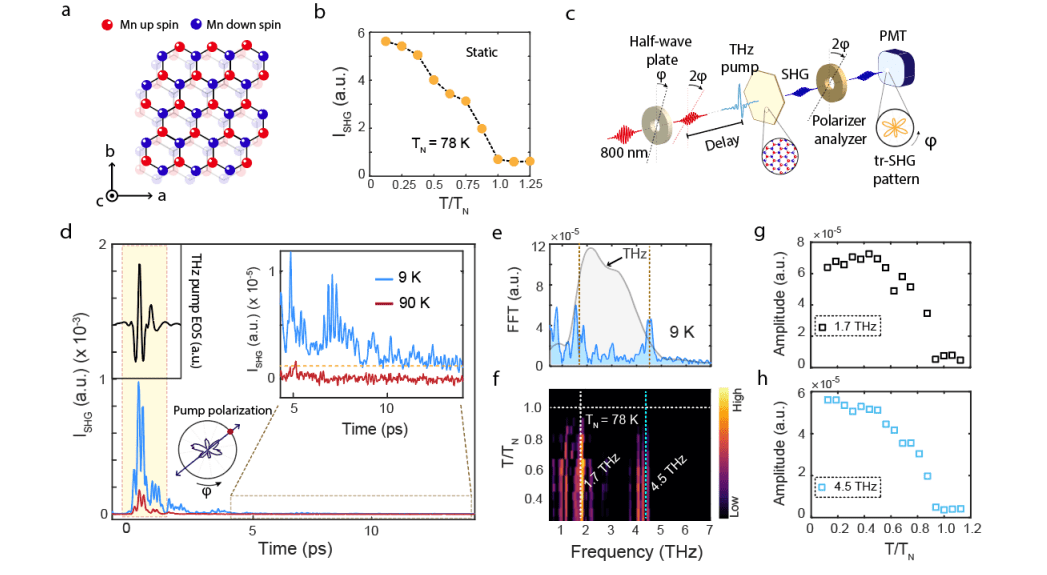
The ability to control material properties with intense bursts of terahertz radiation represents a significant frontier in modern physics, and recent work by Sheikh Rubaiat Ul Haque from Stanford University, Martin J. Cross from SLAC National Accelerator Laboratory, Sangeeta Rajpurohit from Lawrence Livermore National Laboratory, and colleagues demonstrates a dramatic example of this control in the van der Waals antiferromagnet MnPS3. The team uncovered giant, long-lived oscillations in the material’s antiferromagnetic order, driven by atomic vibrations and revealing a dynamic breaking of symmetry when exposed to terahertz light. These oscillations, comparable in strength to the material’s natural state, arise from a field-induced charge rearrangement that alters the local crystal structure and couples to specific vibrational modes, including a previously hidden one. This achievement establishes a powerful new pathway for manipulating magnetism in low-dimensional materials by dynamically modulating symmetry with terahertz fields, potentially unlocking advanced control over magnetic devices and phenomena.
Defect Traps Prolong Exciton Lifetimes in WSe2
Researchers investigated the behaviour of excitons, excited states within a single layer of tungsten diselenide, to understand how defects influence their duration. They employed time-resolved two-dimensional electronic spectroscopy to monitor exciton dynamics, revealing that defects introduce localized states which trap excitons, significantly prolonging their lifetimes compared to pristine materials. Specifically, exciton lifetimes extended from approximately 120 femtoseconds in defect-free regions to over 1 picosecond in areas with a high density of defects. This work advances understanding of light-matter interactions in atomically thin semiconductors and has implications for developing novel optoelectronic devices, potentially enabling the engineering of materials with tailored exciton properties for applications such as photodetectors and light-emitting diodes.
TR-SHG, Tight-Binding, and DFT Simulations of MnPS3
This document presents supplementary information supporting research into the multiferroic material manganese phosphosulfide (MnPS3) using time-resolved Second Harmonic Generation (TR-SHG). The research focuses on understanding the dynamic behaviour of this material when excited by terahertz radiation. Experiments involved a TR-SHG setup to measure the material’s response to terahertz pulses, with data analysis involving fitting observed signals using a model with complex parameters. Theoretical calculations, including tight-binding and Density Functional Theory (DFT) simulations, were performed to understand the electronic structure and vibrational modes of MnPS3, revealing that terahertz excitation modifies bond strengths between manganese and sulfur atoms and induces charge transfer.
Terahertz Excitation Drives Antiferromagnetic Order Oscillations
Scientists have uncovered pronounced symmetry modulations and coherent atomic motions within the van der Waals antiferromagnet MnPS3. Experiments reveal that strong terahertz excitation drives long-lived, giant oscillations in the antiferromagnetic order, with amplitudes comparable to the equilibrium signal and atomic displacements of approximately one percent relative to the equilibrium bond lengths. Time-resolved second harmonic generation measurements demonstrate a dynamic breaking of mirror symmetry, modulated by vibrational modes at 1. 7 terahertz and 4. 5 terahertz, with the 1. 7 terahertz mode representing a previously hidden characteristic of the material.
Terahertz Light Dynamically Controls Magnetism in MnPS3
Researchers have demonstrated dynamic control over magnetism in the van der Waals antiferromagnet MnPS3 using strong terahertz excitations. They uncovered pronounced symmetry modulations and coherent atomic motions driven by terahertz light, revealing oscillations in the antiferromagnetic order with amplitudes comparable to the material’s equilibrium state. These effects arise from a combination of charge rearrangement and coupling to specific vibrational modes at 1. 7 terahertz and 4. 5 terahertz, with the lower frequency mode representing a previously hidden characteristic of the material, suggesting a pathway for manipulating magnetic order through terahertz light.
👉 More information
🗞 Terahertz field-induced giant symmetry modulations in a van der Waals antiferromagnet
🧠 ArXiv: https://arxiv.org/abs/2510.00605

