

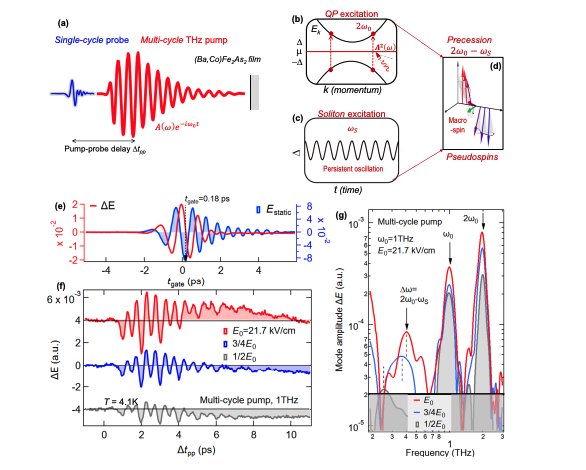
Maintaining coherence presents a significant hurdle in the development of advanced superconducting technologies, but researchers are now demonstrating a pathway towards overcoming this limitation. M. Mootz, C. Vaswani, and C. Huang, all from Ames National Laboratory, alongside colleagues including K. J. Lee from the University of Wisconsin-Madison, report the observation of superconducting solitons, stable wave packets that resist disruption, in a specially engineered iron-based superconductor. This breakthrough, achieved by driving the material with intense pulses of terahertz light, reveals a state where synchronized oscillations of the superconducting order parameter create a robust form of coherence, akin to superradiance. The findings establish a new method for controlling superconductivity with low-energy terahertz fields, potentially paving the way for faster, more energy-efficient devices and long-lasting quantum memories based on enhanced macroscopic coherence.
Terahertz Pulses Generate Superconducting Solitons and Phases
This research details the observation and control of novel quantum phenomena in iron-based superconductors using terahertz (THz) light. The core findings revolve around the generation of soliton-like excitations and the emergence of metastable quantum phases driven by THz illumination. Researchers utilize THz pulses to induce non-equilibrium dynamics, exploring previously inaccessible quantum states and collective modes. They observe solitons, localized, stable waves linked to the breaking and reformation of Cooper pairs, the fundamental carriers of superconductivity, which are dynamic, propagating excitations.
By carefully controlling THz pulse parameters, researchers induce metastable quantum phases exhibiting unique properties, including altered superconducting order parameters and novel collective modes. The THz excitation strongly couples to the Higgs mode, allowing manipulation of symmetry-breaking processes. The study demonstrates control over the quantum coherence of induced states, enabling manipulation of soliton dynamics and stabilization of metastable phases. The experimental observations are supported by theoretical models describing the dynamics of Cooper pairs and the emergence of solitons in strong THz fields.
The theory explains the observed frequency dependence of soliton generation and the stability of the phases. This research opens avenues for controlling superconductivity using THz light, potentially leading to novel quantum devices and materials with tailored properties. Future research will focus on exploring the potential of THz-driven solitons for quantum information processing and realizing exotic quantum phases of matter.
Terahertz Pulses Create Novel Soliton State
Researchers have demonstrated the creation and control of a unique state of matter within an iron-based superconductor, driven by intense pulses of terahertz radiation. This newly observed state, exhibiting properties distinct from conventional superconductivity, opens avenues for advanced technological applications. The team induced this state by applying carefully tuned terahertz waves to a thin film of the superconducting material, observing synchronized oscillations within the material’s electronic structure. This is achieved by driving the material with terahertz radiation, inducing a coherent population inversion and synchronizing electron movement, resembling Dicke superradiance.
The resulting state is characterized by the emergence of new spectral features at very low energies, providing evidence of soliton formation. These low-energy oscillations intensify when the driving frequency resonates with the material’s superconducting gap, demonstrating a strong interplay between the radiation and the material’s intrinsic properties. The strength of this effect is directly related to the intensity of the terahertz radiation, allowing for the creation of a stable, oscillating state that persists even after the initial pulse. Compared to conventional superconductors, this new state exhibits a unique spectral signature, with the emergence of distinct sidebands at frequencies significantly lower than those typically observed. These sidebands serve as a fingerprint of the soliton state, suggesting that strong interactions between electronic bands within the material facilitate its formation.
Terahertz Solitons Emerge During Laser Pulse
This research demonstrates the realization of a laser-driven superconducting soliton state in an iron-based superconductor using intense terahertz radiation. Unlike previously observed solitons which emerge gradually, this soliton state forms during the laser pulse itself, enabled by the material’s strong interband coupling. The emergence of this state is marked by a distinct subharmonic sideband in the terahertz spectrum, indicating synchronized oscillations of the material’s pseudo-spins, analogous to Dicke superradiance. The findings establish a new pathway for engineering long-lived quantum coherence and nonlinearities at terahertz speeds, with potential applications in quantum control, memory, and sensing technologies. Future research could focus on exploring this approach in different superconducting materials and investigating the potential for manipulating these soliton states for practical quantum devices.
🗞 Observation of Superconducting Solitons by Terahertz-Light-Driven Persistent Pseudo-Spin Coherence
🧠 ArXiv: https://arxiv.org/abs/2507.22383


