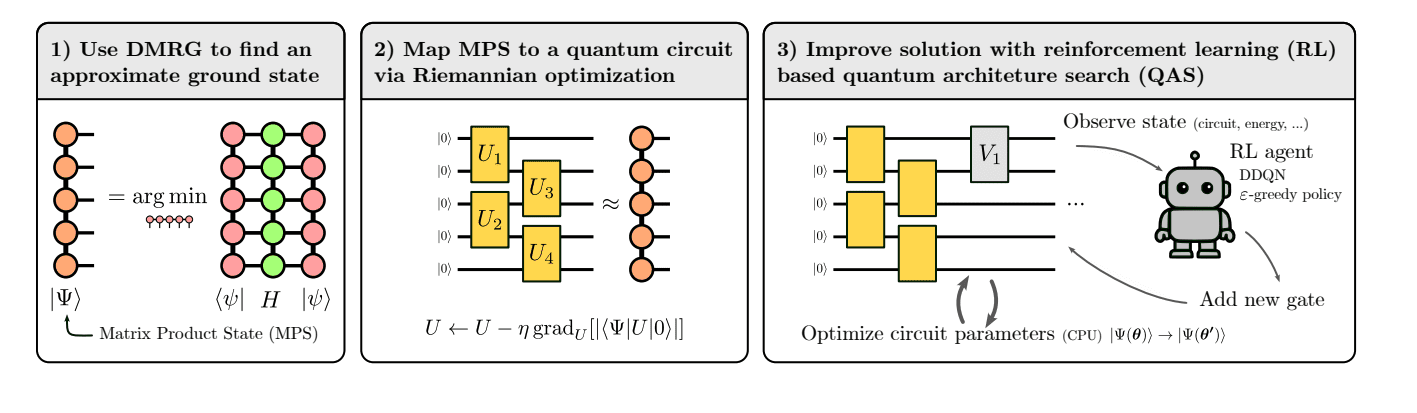
Variational algorithms face challenges in designing circuits for noisy hardware, while RL-based quantum architecture search (QAS) struggles with scalability. TensorRL-QAS combines tensor networks with reinforcement learning to address these issues by narrowing the search space using matrix product state approximations. Tested on chemistry problems up to 12 qubits, it reduces CNOT count and circuit depth by 10-fold, function evaluations by 100-fold, and accelerates training, achieving higher success probabilities for 10-qubit systems. Robustness is demonstrated in noiseless and noisy simulations, with results for up to 8 qubits.
Designing efficient quantum circuits that meet hardware constraints while solving complex problems is a key challenge in quantum computing. Reinforcement learning (RL) has been used for automated circuit design through quantum architecture search (QAS), but its scalability is limited as qubit numbers and circuit complexity increase. Akash Kundu from the QTF Centre of Excellence at the University of Helsinki, Finland, along with Stefano Mangini from both the QTF Centre and Algorithmiq, have developed TensorRL-QAS to overcome these limitations. This framework combines tensor network methods with RL, improving scalability and efficiency in quantum circuit discovery.
TensorRL-QAS enhances quantum circuit design for practical applications.
The field of quantum computing faces significant challenges due to the limitations of current NISQ (Noisy Intermediate-Scale Quantum) hardware. These devices are constrained by limited qubit counts, restricted connectivity, and high noise levels, which hinder the execution of complex quantum circuits. As a result, achieving practical quantum advantage remains elusive, with many foundational algorithms not yet feasible on existing technology.
Variational Quantum Algorithms (VQAs) have emerged as a promising approach to leverage NISQ devices effectively. These algorithms optimize parameters of Parameterized Quantum Circuits (PQCs) to minimize specific cost functions, often related to the expectation value of a Hamiltonian. However, the choice of ansatz for PQCs is crucial and often constrained by hardware limitations or problem-specific insights, leading to circuits that may be either too shallow or too deep, thus affecting scalability.
To address these challenges, Quantum Architecture Search (QAS) has been introduced as a method to automate the discovery of optimal PQC structures. Utilizing techniques like reinforcement learning (RL), QAS aims to tailor circuit architectures to both specific problems and hardware constraints. Despite its potential, RL-based QAS faces significant scalability issues, particularly with increasing qubit counts, circuit depth, and noise levels.
TensorRL-QAS offers a novel solution by integrating tensor network methods with RL for circuit design. This framework warm-starts the architecture search using matrix product state approximations of target solutions, effectively narrowing the search space to physically meaningful circuits. Tested on chemistry problems involving up to 12 qubits, TensorRL-QAS demonstrates improved performance, including reduced CNOT counts and circuit depth while maintaining chemical accuracy.
The advancements in TensorRL-QAS highlight its potential as a scalable and efficient protocol for circuit discovery on near-term quantum hardware. By addressing the limitations of traditional QAS methods, TensorRL-QAS provides a robust and versatile approach, demonstrating success both in noiseless simulations and noisy scenarios, with simulations achieving up to 8 qubits. These improvements establish TensorRL-QAS as a promising candidate for advancing practical quantum computing applications.
Combining tensor networks with reinforcement learning for circuit design.
The development of efficient quantum algorithms is crucial for leveraging the potential of near-term quantum hardware. Variational algorithms, while promising, face challenges in designing circuits that solve problems effectively while adhering to device constraints. TensorRL-QAS emerges as a novel framework addressing these issues by combining tensor network methods with reinforcement learning (RL), offering a scalable solution.
TensorRL-QAS innovates by integrating matrix product state approximations into the architecture search process. This warm-start approach provides an initial approximation of the target solution, effectively narrowing the search space to physically meaningful circuits. By doing so, it accelerates convergence towards the desired solution, demonstrating a significant improvement over traditional methods.
The framework’s performance is evaluated across three methods: TensorRL (fixed), TensorRL (trainable), and StructureRL. TensorRL (fixed) stands out for its efficiency, particularly in larger systems, with faster convergence times and lower time to minimum error compared to the other methods. This efficiency is attributed to its fixed structure, which maintains performance as the number of qubits increases, making it highly suitable for scalable applications.
Practical implications highlight TensorRL-QAS’s effectiveness, achieving a 10-fold reduction in CNOT counts and circuit depth while maintaining chemical accuracy. Additionally, it reduces function evaluations by up to 100-fold, significantly lowering computational resource requirements. The framework also demonstrates robustness, performing well in both noiseless and noisy environments, with simulations successfully conducted on up to 8-qubit systems.
In summary, TensorRL-QAS represents a significant advancement in quantum circuit discovery, offering scalable solutions that enhance efficiency and reduce resource demands. Its innovative approach positions it as a promising tool for near-term quantum computing applications.
TensorRL-QAS enhances quantum circuit optimization using reinforcement learning and tensor networks, outperforming traditional techniques.
TensorRL-QAS is an innovative framework that integrates reinforcement learning (RL) with tensor networks to optimize quantum circuit design. By leveraging matrix product states (MPS), a type of tensor network, TensorRL-QAS narrows the search space for physically meaningful circuits, thereby accelerating convergence to optimal solutions. This approach effectively addresses the scalability challenges faced by traditional RL-based quantum architecture search methods.
The framework demonstrates significant performance improvements over existing techniques such as StructureRL. For instance, it achieves faster training times, reducing the duration from 5.88 hours to over 48 hours for a 5-qubit system. TensorRL-QAS efficiently scales from smaller systems (5 qubits) to larger ones (20 qubits), maintaining relatively low circuit depths and gate counts. This scalability is crucial for practical applications on near-term quantum hardware.
Key findings reveal that the number of gates increases linearly with more qubits, reflecting the necessity for additional entangling operations. However, the circuit depth remains constant at 27 across most systems, indicating an optimized architecture that allows parallel execution of gates. Additionally, higher bond dimensions (e.g., χ=3) reduce CNOT gate counts but increase single-qubit rotations, highlighting a trade-off between entangling operations and state encoding efficiency.
TensorRL-QAS has been successfully tested on several chemistry problems involving up to 12 qubits, achieving a 10-fold reduction in CNOT count and circuit depth compared to baseline methods. It maintains or surpasses chemical accuracy while significantly reducing function evaluations by up to 100-fold. The framework’s robustness is further demonstrated in both noiseless and noisy scenarios, with simulations conducted on an AMD Rome CPU and Nvidia A100 GPU. These advancements establish TensorRL-QAS as a promising candidate for scalable and efficient circuit discovery protocols on near-term quantum hardware.
TensorRL (fixed) emerges as the most efficient method for training quantum circuits.
The study evaluates three methods—TensorRL (fixed), TensorRL (trainable), and StructureRL—for training quantum circuits using reinforcement learning. Key findings reveal that TensorRL (fixed) consistently achieves the quickest time to minimum error and shortest total training time across all qubit systems, making it highly efficient. In contrast, while TensorRL (trainable) offers greater flexibility, it requires significantly more computational resources and time, highlighting a trade-off between adaptability and efficiency. StructureRL demonstrates poor scalability, with consistently longer training times across all qubit numbers, suggesting it may not be suitable for larger systems.
The practicality of these methods depends on the specific application’s requirements, balancing speed, accuracy, and resource availability. TensorRL (fixed) is recommended for its efficiency in achieving quick results with minimal training time, while the trainable version may be considered when flexibility is crucial despite longer training periods.
These findings advance our understanding of quantum circuit design and address scalability challenges in reinforcement learning-based quantum architecture search methods. The success probabilities achieved for 10-qubit systems and reductions in resource requirements compared to baseline approaches underscore TensorRL-QAS’s potential as a scalable and efficient protocol for near-term quantum hardware.
Future work could explore hybrid approaches that combine the efficiency of fixed methods with the flexibility of trainable components, potentially improving adaptability without sacrificing performance. Additionally, extending these methods to handle larger qubit systems and diverse noise models could further enhance their practicality. Investigating how prior information about target solutions influences the search process may also lead to more efficient and scalable quantum circuit design protocols.
👉 More information
🗞 TensorRL-QAS: Reinforcement learning with tensor networks for scalable quantum architecture search
🧠 DOI: https://doi.org/10.48550/arXiv.2505.09371