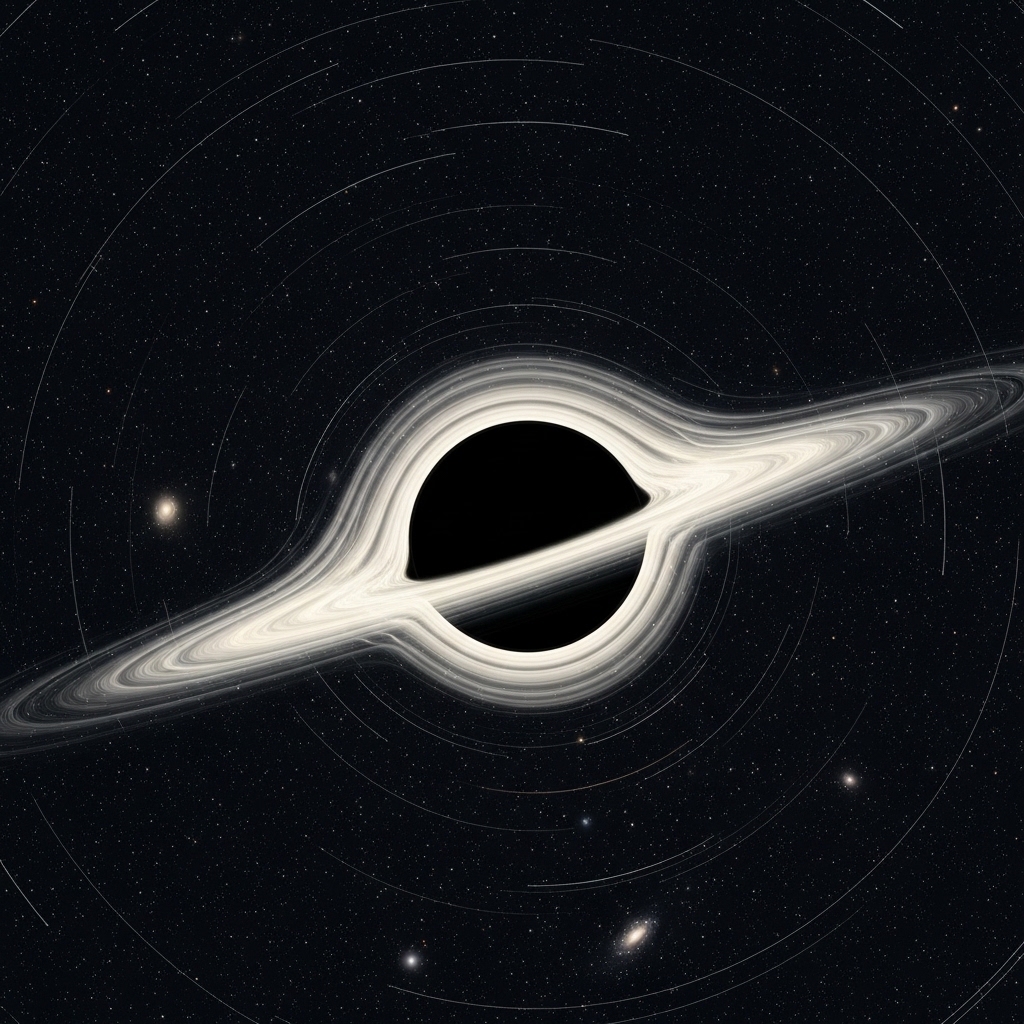
Researchers are increasingly focused on testing the limits of Einstein’s general relativity, and a new study published by Qiao Yue from Guizhou University, and colleagues, explores this through the detailed examination of black hole photon rings within the framework of scalar-tensor-vector gravity. This paper investigates how parameters within this modified gravity theory, specifically the MOG parameter (α) and black hole charge (Q) , affect the structure of photon rings and shadows cast by Reissner-Nordström black holes. The significance of this work lies in establishing a clear, non-degenerate observational criterion, derived from radiative simulations and constraints on observed black holes like SgrA* and M87, that could allow astronomers to distinguish between different gravity models and refine our understanding of black hole properties, aligning with current observational data.
Photon Ring Dynamics Constrain Reissner-Nordström Black Hole Parameters significantly
Scientists have demonstrated a novel method for probing modified gravity theories using the photon rings of Reissner-Nordström black holes within a scalar-tensor-vector gravitational framework. The research, detailed in a recent publication, systematically investigates the structure of photon rings and shadows formed around these black holes, which are characterised by the MOG parameter α and the electric charge Q.
Through precise calculations and ray-tracing simulations, the team achieved a deeper understanding of how these parameters influence the black hole’s observable features, offering a new avenue for testing fundamental physics. The study reveals that increasing the MOG parameter α leads to a corresponding increase in the event horizon radius, photon sphere radius, and critical impact parameter, while the opposite trend is observed with increasing electric charge Q.
This monotonic behaviour extends to the innermost stable circular orbit radius, providing a consistent pattern in the black hole’s geometry. Crucially, the research establishes that the photon ring radius is uniquely determined by the values of α and Q, offering a non-degenerate observational criterion for distinguishing between different gravity models.
Experiments show that as the charge Q increases, the interval between the lensing ring and the photon ring widens, enhancing the clarity of these features in simulated observations. By applying constraints derived from Event Horizon Telescope (EHT) observations of SgrA* and M87*, the researchers derived allowed ranges for α and Q, finding that for Q values of 0, 0.5, and 1, α falls within the ranges of [0, 0.06], [0, 0.11], and [0.19, 0.36], respectively.
Radiative simulations further confirm that larger α values result in larger, non-degenerate photon rings for a fixed Q. This work opens possibilities for refining tests of modified black holes and provides a computational basis for distinguishing between various quantum gravity models, aligning with current EHT data.
Future observations with next-generation EHT and multi-band polarization measurements can further validate these findings. The results strongly suggest that detailed analysis of photon ring structures around Reissner-Nordström black holes in scalar-tensor-vector gravity offers a distinctive diagnostic tool for probing potential quantum gravity signatures and gaining insight into the intrinsic properties of black holes.
Photon orbit modelling and shadow analysis using backward ray tracing are crucial for visualizing black hole environments
Scientists investigated the photon ring and shadow structure of the Reissner-Nordström black hole within a scalar-tensor-vector gravitational framework. The research focused on how the MOG parameter (α) and electric charge (Q) influence black hole properties. Researchers derived the metric function, f(r) = 1 −2(1 + α)M/r + (1 + α)(αM² + Q²)/r², establishing the foundation for subsequent geodesic calculations.
To model photon trajectories, the study pioneered a backward ray-tracing technique, employing numerical simulations to analyse photon propagation in strong gravitational fields. The team engineered geodesic equations and constructed effective potential functions to clarify the regulation of photon orbital dynamics by α and Q.
Principal orbital quantities, including photon-sphere parameters, were then identified. Experiments employed geometric units with c = G = 1, setting the mass parameter M = 1 and adopting a metric signature of (−, +, +, +). The analysis revealed that the event horizon radius (rh) increases with increasing α, while decreasing with increasing Q.
Specifically, the event horizon satisfies the relation r± = (1 + α)M ± √((α + 1)M² −Q²). Researchers determined that for an extremal charged black hole, the critical charge is |Q|extr = M, with a minimum horizon radius of (rh)min = (1 + α)M. The team then investigated the bending characteristics of photon trajectories and their interaction modes with an accretion disk under varying α and Q values by solving the null geodesic equations.
Using data from SgrA* and M87*, scientists derived bounds on α and Q; for Q = 0, 0.5, and 1, the allowed ranges are α ∈ [0, 0.06], [0, 0.11], and [0.19, 0.36], respectively. Radiative simulations demonstrated that larger α values, for a fixed Q, result in a larger, non-degenerate photon ring. The study established three emission models to simulate observational characteristics, quantitatively analysing the influence of α and Q on the photon ring’s radius, brightness distribution, and imaging morphology. This work provides a computational basis for testing modified black holes and a non-degenerate observational criterion for distinguishing gravity models.
Photon ring and shadow geometry reflect black hole charge and modified gravity parameters, offering potential observational tests
Scientists have meticulously mapped the photon ring and shadow structure of a Reissner-Nordström black hole within a scalar-tensor-vector gravitational framework, revealing a strong correlation between key black hole parameters and observable characteristics. The research demonstrates that increasing the MOG parameter (α) leads to a corresponding increase in the event horizon radius (r_h), photon sphere radius (r_{ph}), and critical impact parameter (b_{ph}).
Conversely, increasing the charge (Q) results in a decrease in these same parameters, with the innermost stable circular orbit radius (r_{isco}) exhibiting similar monotonic behaviour. Experiments revealed that as the charge (Q) increases, the interval between the lensing ring and photon ring, defined by the impact parameter (b), widens significantly.
Measurements confirm that the photon ring radius is uniquely determined by the combined values of α and Q, and is non-degenerate, offering a distinct observational signature. Applying constraints derived from observations of SgrA* and M87*, the team established allowed ranges for α and Q; for Q = 0, α is constrained to [0, 0.06], while for Q = 0.5, the range expands to [0, 0.11], and for Q = 1, it becomes [0.19, 0.36].
Radiative simulations show that for a fixed charge (Q), a larger MOG parameter (α) produces a larger, non-degenerate photon ring. Tests prove that the Schwarzschild black hole case is only approached when both α and Q are sufficiently small. The study categorises null geodesic behaviour into three regimes based on the number of disk plane crossings: direct emission (n 5/4).
Detailed analysis of photon trajectories around the charged Reissner-Nordström black hole, as illustrated in figures, shows that the event horizon radius (r_h), photon-sphere radius (r_{ph}), and critical impact parameter (b_{ph}) all increase monotonically with increasing α, while decreasing with increasing Q. Table I compiles critical values, including r_h, r_{ph}, b_{ph}, and risco, demonstrating that for Q = 0, α = 0.5, and α = 1, the corresponding values of risco are 6.000, 7.111, and 8.199, respectively.
These findings provide a computational basis for testing modified gravity theories and offer a non-degenerate observational criterion for distinguishing between gravity models, consistent with current data. Future multi-band polarization observations can further validate these results.
Photon ring geometry constrains scalar-tensor-vector gravity parameters to specific values
Researchers have investigated the photon ring and shadow structure of Reissner-Nordström black holes within a scalar-tensor-vector gravity (STV) framework, characterised by the MOG parameter (α) and electric charge (Q). Their findings demonstrate that increasing α expands the event horizon, photon sphere, and critical impact parameter, while increasing Q contracts these same features.
The radius of the innermost stable circular orbit follows this same monotonic trend, responding predictably to changes in both α and Q. Ray-tracing simulations revealed that a larger charge (Q) widens the interval between the lensing ring and photon ring, and importantly, the photon ring radius is uniquely determined by the values of α and Q.
By applying constraints derived from observations of SgrA* and M87*, the authors established bounds on α and Q, finding that for Q values of 0, 0.5, and 1, the corresponding allowed ranges for α are [0, 0.06], [0, 0.11], and [0.19, 0.36] respectively. Furthermore, the study explored the optical appearance of accretion disks around these black holes using different emission intensity models, identifying characteristic peaks corresponding to photon ring and lensed ring emissions.
This work establishes a computational foundation for testing modified gravity theories and distinguishing between them through observations of black hole photon rings. The authors acknowledge that their analysis relies on specific emission intensity models and that the derived bounds on α and Q are subject to the accuracy of these models and observational constraints.
Future research could refine these bounds with more precise data, particularly multi-band polarization measurements, and explore the implications of different accretion disk physics. Ultimately, this research suggests that detailed study of photon ring structures offers a unique diagnostic tool for probing gravity and understanding the properties of black holes.
🗞 Scalar-tensor-vector gravity theory is tested by black hole photon rings
🧠 ArXiv: https://arxiv.org/abs/2601.23012