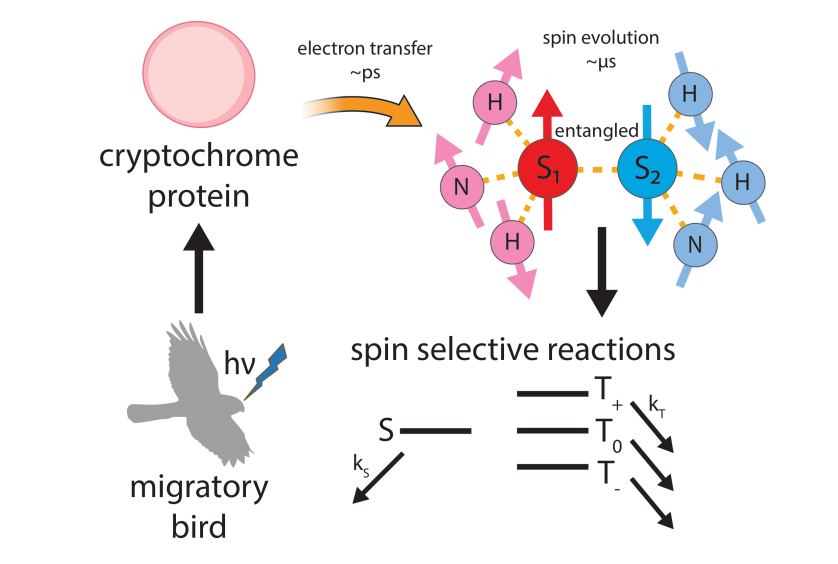
Radical pairs, fleeting intermediates crucial to reactions across diverse scientific fields, present a significant computational challenge when modelling their quantum behaviour, particularly when accounting for the influence of numerous surrounding nuclear spins. Kentaro Hino from Kyoto University, Damyan S. Frantzov from the University of Oxford, Yuki Kurashige from Kyoto University, and Lewis M. Antill from Sungkyunkwan University, overcome this barrier by developing a novel tensor network method. This approach accurately simulates the complex dynamics of radical pair systems, explicitly incorporating interactions with up to thirty nuclear spins and extending to sixty for benchmarking purposes. The team demonstrates the power of their method by modelling biologically relevant systems, revealing how subtle changes in the surrounding environment influence electron transfer processes and highlighting the importance of fully accounting for nuclear interactions in understanding phenomena such as avian magnetoreception, while also providing a robust framework applicable to spintronics and broader areas of spin chemistry and biology.
This method overcomes a major limitation in the field, the exponential increase in computational demands when considering the interactions of radical pairs with numerous nuclear spins. Researchers employed tensor network methods, specifically matrix product state and matrix product density operator representations, to model the complex quantum behavior of these systems. The team successfully simulated radical pair systems while explicitly accounting for hyperfine interactions involving up to 30 nuclear spins, demonstrating accuracy even when extending simulations to include 60 nuclei.
These methods precisely capture anisotropic spin dynamics, revealing how the orientation of magnetic fields influences the yield of spin-selective products. Experiments revealed that specific magnetic field orientations enhance singlet yields, while others diminish them, demonstrating a marked dependence on the surrounding nuclear environment. Importantly, simulations showed that even a small change in the number of included nuclear spins altered the observed directional effects, highlighting the necessity of comprehensive nuclear spin treatments. This breakthrough delivers a robust computational tool applicable to a wide range of scientific problems.
Applying this methodology to a biologically relevant flavin-tryptophan radical pair system, scientists identified that the accurate description of anisotropic magnetic field effects requires accounting for complex many-body interactions. The simulations demonstrate the potential to provide critical insights into mechanisms like avian magnetoreception, where birds utilize quantum effects to sense the Earth’s magnetic field. Researchers anticipate that future improvements, such as incorporating more complex relaxation channels and advanced tensor network approaches, will further enhance the predictive power of this computational framework.
Tensor Networks Simulate Radical Pair Dynamics
Scientists have developed a new computational framework for accurately simulating the behavior of radical pairs, transient intermediates crucial to diverse scientific fields including biology and spintronics. This work addresses a significant computational challenge, namely the exponential increase in memory requirements when accounting for the interactions of radical pairs with numerous nuclear spins. Researchers overcame this limitation by employing tensor network methods, specifically matrix product state and matrix product density operator representations, to model the complex quantum dynamics of these systems. The team successfully simulated radical pair systems while explicitly accounting for hyperfine interactions involving up to 30 nuclear spins, and demonstrated accuracy even when extending simulations to include 60 nuclei. These methods precisely capture anisotropic spin dynamics, revealing how the orientation of magnetic fields influences the yield of spin-selective products.
Nuclear Spin Effects on Radical Pair Dynamics
This research presents new tensor network techniques for accurately simulating quantum spin dynamics in radical pair systems, overcoming computational limitations caused by the exponential complexity of including many nuclear spins. By employing matrix product state and matrix product density operator representations, scientists achieved detailed simulations incorporating up to 30 nuclear spins, a significant advancement over previous methods. These approaches account for key interactions including Zeeman, hyperfine, exchange, and dipolar effects within a fully quantum treatment, demonstrating substantial computational advantages. Applying this methodology to a flavin-tryptophan radical pair system, relevant to biological processes, revealed how magnetic field orientation influences singlet yields, demonstrating a clear dependence on the surrounding nuclear environment.
Simulations showed that the inclusion of fewer nuclear spins altered the observed directional effects, highlighting the necessity of comprehensive treatments. While current tensor network methods efficiently simulate dynamics on sub-microsecond timescales, extending simulations beyond this timeframe remains a challenge due to increasing computational demands. Future work may focus on exploring alternative tensor network approaches, incorporating more accurate evaluations of interactions, and integrating dynamic structural treatments from molecular dynamics. The team acknowledges that extending simulations beyond the microsecond regime requires further technical development, such as incorporating Clifford disentanglers or exploring alternative network structures.
🗞 Introduction of modelling radical pair quantum spin dynamics with tensor networks
🧠 ArXiv: https://arxiv.org/abs/2509.22104