The behaviour of superfluids and nonlinear systems relies on accurate modelling of complex interactions at multiple scales, a challenge frequently limited by computational constraints. Researchers are now applying tensor networks, a technique originally developed for condensed matter physics, to overcome these limitations in simulating the dynamics of cold atomic gases and similar systems. Ryan J. J. Connor, Callum W. Duncan, and Andrew J. Daley, in their article ‘Tensor network methods for the Gross-Pitaevskii equation on fine grids’, detail a novel application of these networks to the Gross-Pitaevskii equation, a fundamental equation describing the quantum mechanical behaviour of these systems. Their work demonstrates improved efficiency in modelling complex phenomena, such as vortex formation, on significantly larger spatial grids than previously possible with conventional numerical methods.
Tensor networks represent a powerful computational technique for modelling complex gas dynamics, offering advantages over traditional grid-based numerical methods. Researchers currently develop these networks to address challenges in simulating cold atomic gases and nonlinear systems, particularly when accurately representing turbulent dynamics and short-range dipole-dipole interactions proves computationally demanding. This research builds upon the established Gross-Pitaevskii equation, a nonlinear partial differential equation describing the quantum mechanical evolution of Bose-Einstein condensates (BECs), extending its application to dissipative and dipolar gases and enabling simulations on larger spatial grids than previously feasible through physically motivated data compression.
The study details a method for reducing the computational complexity of modelling dipolar interactions, specifically demonstrating a two-dimensional reduction of the three-dimensional dipolar interaction by assuming a uniform condensate along the z-axis. This simplification allows researchers to derive a corresponding two-dimensional interaction kernel, significantly reducing computational cost without sacrificing accuracy, particularly when simulating systems with long-range interactions. Alongside this, a truncation scheme limiting the interaction range to a radius R proves effective, and recovers fully periodic treatment as R approaches infinity, validating its robustness and versatility.
Analysis reveals a logarithmic scaling relationship between the maximal bond dimension—a measure of computational cost within tensor networks—and system size (N), for various truncation parameters. This indicates that computational cost increases relatively slowly with system size, enabling simulations of larger systems.
Researchers establish a pathway for accurately modelling complex cold gas experiments, pushing the boundaries of what is currently achievable in the field. The combination of tensor networks and spectral methods—techniques that decompose functions into a sum of simpler functions—provides a robust framework for investigating a wider range of physical phenomena in dipolar BECs, potentially leading to a deeper understanding of their fundamental properties and behaviour.
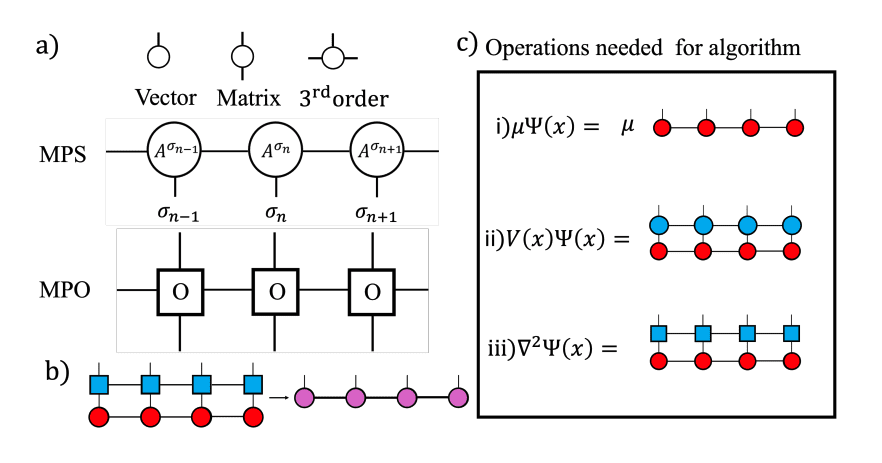
This work demonstrates the effective application of tensor networks, specifically Matrix Product States (MPS), to simulate Bose-Einstein Condensates (BECs) with long-range dipolar interactions. Researchers overcome limitations inherent in traditional grid-based numerical methods by leveraging the data compression capabilities of tensor networks, enabling simulations on significantly larger spatial grids. The core of this advancement lies in the implementation of a matrix product operator representation of the Fourier transform, enabling a spectral approach to calculating both equilibrium states and time-dependent dynamics. This technique proves particularly efficient when analysing non-equilibrium scenarios, such as vortex formation, where conventional methods struggle with computational demands.
Researchers actively confirm the efficiency of this approach, showcasing its ability to handle systems that are computationally intractable for existing methods. The study highlights a direct link between computational efficiency and the physical insights gained, suggesting that the tensor network approach not only facilitates larger-scale simulations but also reveals previously inaccessible details about the behaviour of dipolar BECs. This ability to accurately model these complex phenomena opens avenues for investigating the structure of states generated by these dynamics with greater precision.
Researchers actively investigate the limitations of the current approach and develop strategies to further optimise the MPS representation. The ultimate goal is to establish a versatile and efficient computational tool for exploring the rich physics of dipolar BECs and other complex quantum systems, paving the way for a deeper understanding of their fundamental properties and behaviour.
👉 More information
🗞 Tensor network methods for the Gross-Pitaevskii equation on fine grids
🧠 DOI: https://doi.org/10.48550/arXiv.2507.01149