

The quest to reconcile quantum mechanics and gravity receives a boost from new research into the fundamental structure of spacetime, as scientists explore how networks of quantum entanglement can mimic the behaviour of gravity. Qiang Wen from Southeast University, alongside Mingshuai Xu and Haocheng Zhong, demonstrate a novel approach using holographic tensor networks, which serve as simplified models for complex gravitational systems. Their work establishes that these networks, constructed as tessellations of space using quantum entanglement threads, accurately reproduce key predictions of gravitational theory, specifically the Ryu-Takayanagi formula for calculating the area of spacetime boundaries. This achievement represents a significant step towards a complete theory of quantum gravity, offering a concrete framework for understanding how spacetime emerges from quantum entanglement.
Holographic Entropy Reveals Spacetime Geometry
Researchers are refining methods to understand holographic entanglement entropy, focusing on the connection between tensor networks and the Anti-de Sitter/Conformal Field Theory (AdS/CFT) correspondence. This correspondence proposes a duality between gravity in Anti-de Sitter space and a quantum field theory on its boundary, offering a powerful tool for studying quantum gravity. Key to this research is the Ryu-Takayanagi formula, which relates entanglement entropy to the area of a minimal surface in AdS space. Scientists are employing tensor networks, which represent quantum states as networks of tensors, to efficiently model these complex systems and approximate the wave function of many-body systems.
Recent advancements involve using partial entanglement entropy (PEE) to more precisely capture the entanglement structure of a region. By considering the entanglement between a region and its complement, PEE provides a more detailed analysis than standard entanglement entropy. Researchers are investigating how geometric objects, known as bit threads, represent the entanglement structure within the AdS space, effectively linking the PEE to a geometric representation. The island formula, a modification of the Ryu-Takayanagi formula, is also crucial, allowing for contributions to entanglement entropy from previously disconnected regions and offering insights into black hole physics.
Holographic Networks Map Gravity and Quantum Information
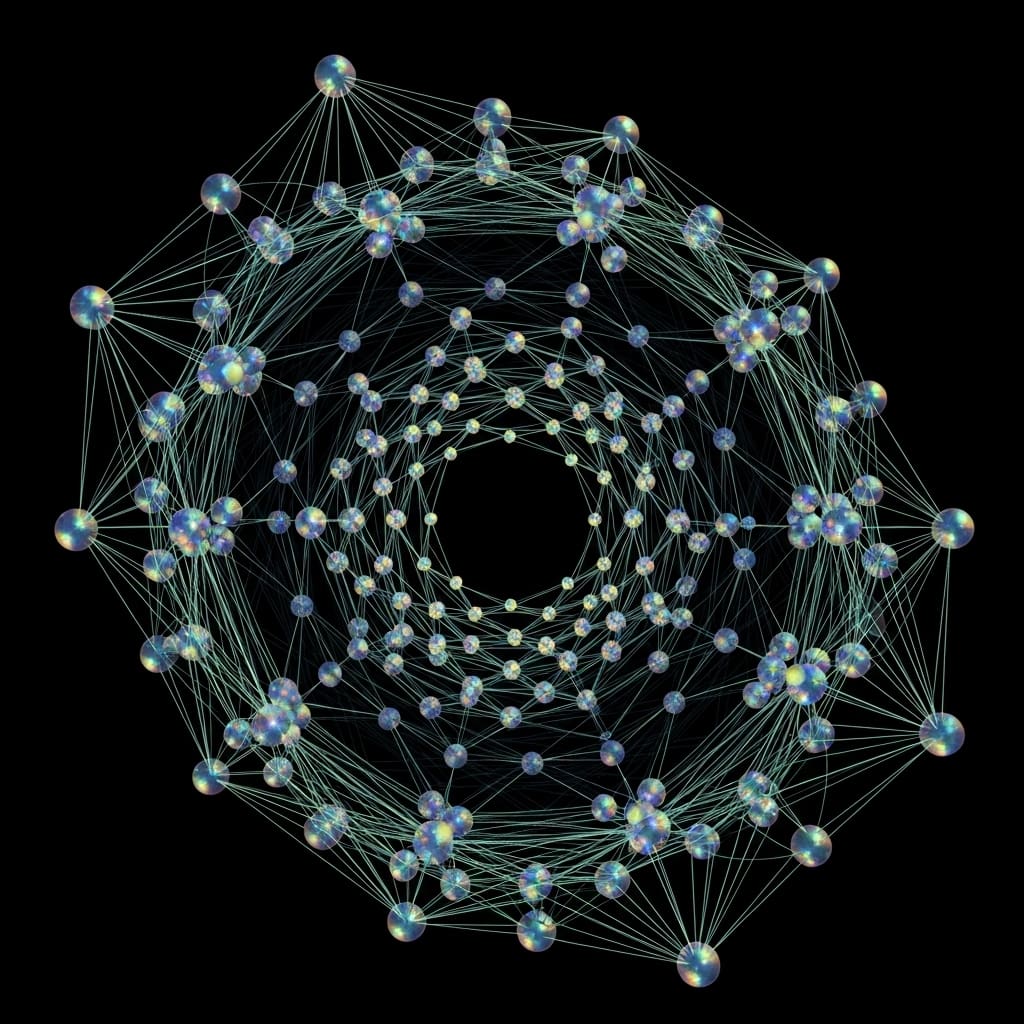
Researchers have developed novel holographic tensor network models that successfully reproduce key features of the Anti-de Sitter/Conformal Field Theory correspondence. Their work centres on constructing networks from “partial-entanglement-entropy” threads, which represent geodesics within the theoretical space of Anti-de Sitter. Importantly, these networks tessellate, or perfectly fill, the space, demonstrating a precise geometric relationship between gravity and quantum information. The team demonstrated that these networks accurately calculate the area of any surface within the space, mirroring established formulas from integral geometry.
This achievement lies in assigning quantum states to the vertices of the PEE network and constructing two distinct tensor network models, both of which reproduce the Ryu-Takayanagi formula, a crucial equation linking gravity and quantum entanglement. The models demonstrate that counting intersections between surfaces and the PEE network precisely determines the area of those surfaces, effectively providing a discrete approximation of continuous geometry. While the current work focuses on a vacuum state, future research will explore applying these networks to different gravitational backgrounds and more realistic physical systems, potentially offering new insights into the fundamental nature of spacetime and quantum gravity.
👉 More information
🗞 Holographic Tensor Networks as Tessellations of Geometry
🧠 ArXiv: https://arxiv.org/abs/2512.19452


