

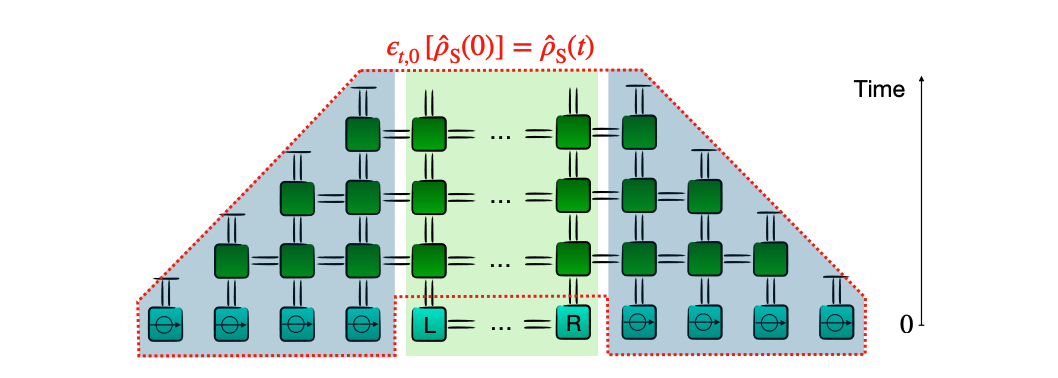
Understanding how interconnected quantum systems evolve over time presents a significant challenge, particularly when those systems are subject to complex environmental influences. Michele Coppola from the Jožef Stefan Institute, Mari Carmen Bañuls from the Max-Planck-Institut für Quantenoptik and the Munich Center for Quantum Science and Technology, and colleagues, now demonstrate a new approach to characterise these dynamics. The researchers develop a method that combines advanced computational techniques with machine learning to effectively ‘learn’ the behaviour of smaller quantum systems embedded within a larger, complex one following a sudden disturbance. This work is significant because it offers a way to predict the long-term evolution of these systems, even beyond the reach of traditional computational methods, and reveals how the degree of environmental influence changes depending on the system’s overall state, with critical systems exhibiting behaviour most closely resembling simpler, predictable models.
Many-body systems, those comprising numerous interacting quantum particles, are frequently modelled as open systems, acknowledging their inevitable interaction with an external environment. Accurately describing the influence of this surrounding environment complicates theoretical descriptions, introducing decoherence and dissipation. Researchers now employ sophisticated tensor network calculations, combined with optimisation tools borrowed from machine learning, to characterise how subsystems evolve within a larger quantum system following a sudden, global change—a process known as a global quench. The study investigates three distinct scenarios , integrable critical, integrable non-critical, and chaotic , to understand how these systems behave under differing conditions and to identify the most effective computational representation for each. This nuanced approach offers insights into the dynamics of complex quantum systems and provides a framework for predicting their behaviour.
Open System Dynamics and Quantum Information Theory
This extensive body of research details investigations into open quantum systems, focusing on the behaviour of quantum systems when interacting with their environment, and the inherent challenges of describing systems exhibiting memory effects. Early theoretical foundations were established by researchers such as Nakajima, Zwanzig, Rivas, Andersson, and Hall, who introduced key concepts like master equations and reduced density matrices. Master equations describe the time evolution of a system’s density matrix, accounting for the influence of the environment. Reduced density matrices, on the other hand, allow researchers to focus on the subsystem of interest by tracing out the environmental degrees of freedom. These tools are essential for modelling environmental influences and understanding decoherence, the loss of quantum coherence due to interaction with the surroundings.
A significant focus within the research is quantifying non-Markovianity, determining whether the environment’s influence is memoryless , as described by Markovian dynamics , or retains information about the system’s past. Numerous measures have been proposed and debated by researchers including Chruściński, Kossakowski, Rivas, Luo, and Wißmann, each attempting to capture the degree of environmental memory. Markovian dynamics simplify calculations but often fail to accurately represent realistic systems where the environment possesses a finite correlation time. Daley’s work highlights the use of quantum trajectories, a stochastic method for simulating open quantum systems using probabilistic wavefunctions, offering an alternative approach to tackling the complexities of environmental interactions. These trajectories allow researchers to sample different realisations of the environmental noise, providing a statistical understanding of the system’s evolution.
A substantial portion of the research concentrates on tensor network methods, including light cone tensor networks and matrix product states, for efficiently simulating the time evolution of open quantum systems. These methods are crucial for overcoming the computational challenges posed by the exponential growth of the system’s complexity with its size, a phenomenon known as the ‘curse of dimensionality’. Tensor networks represent the many-body wavefunction as a network of interconnected tensors, reducing the computational cost by exploiting the entanglement structure of the system, as demonstrated by researchers such as Frías-Pérez, Hastings, and Mahajan. Recent studies by Mazza, Cemin, Carollo, and Lesanovsky explore the use of machine learning techniques, particularly neural networks, to approximate the dynamics of open quantum systems, learn effective models, and accelerate simulations. These machine learning approaches offer the potential to bypass computationally expensive calculations and predict the system’s behaviour with greater efficiency.
Lerose, Sonner, and Abanin’s work on the influence matrix provides a powerful tool for analysing and simulating many-body Floquet dynamics, systems driven by time-periodic forces. The influence matrix characterises the effective interaction between different parts of the system, allowing researchers to understand how the driving force affects the system’s behaviour. The concepts of non-Markovianity are closely linked to quantum information processing, quantum memory, and the preservation of quantum coherence, all crucial for building quantum technologies. The developed methods are applied to study the dynamics of interacting quantum systems, including chaotic systems and Floquet systems, providing insights into a wide range of physical phenomena. Open quantum systems are fundamental to understanding the interaction of light and matter in optical cavities, and the influence matrix approach is particularly relevant for studying these systems.
Kingma’s Adam algorithm, a popular optimisation method used in machine learning, is potentially applicable to training neural networks for approximating quantum dynamics. Adam efficiently updates the network’s parameters, minimising the error between the predicted and actual dynamics. Lerose, Sonner, and Abanin’s work on space-time duality provides a novel approach to overcoming the entanglement barrier in quantum many-body dynamics. This duality maps the quantum system to a different, equivalent system where the entanglement is reduced, simplifying the calculations. Overall, this collection represents a comprehensive overview of current research in open quantum systems, non-Markovian dynamics, and the development of advanced numerical methods for simulating these complex systems. It serves as a valuable resource for researchers in these fields, providing both theoretical foundations and practical tools for tackling challenging problems in quantum physics.
🗞 Learning the non-Markovian features of subsystem dynamics
🧠 DOI: https://doi.org/10.48550/arXiv.2507.14133


