

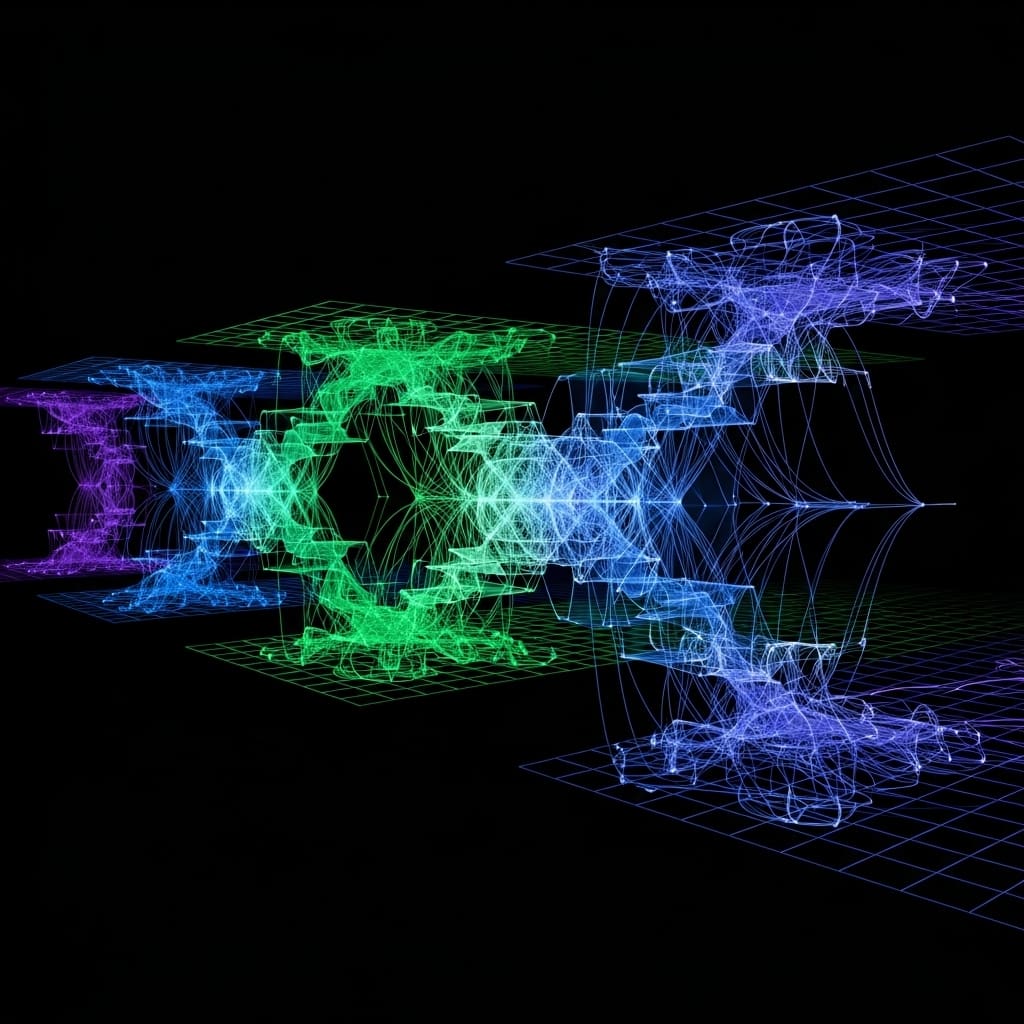
The pursuit of efficient quantum computation relies heavily on accurately simulating quantum circuits, a task that becomes increasingly challenging as circuit complexity grows. Aaron C. Hoyt, Jonathan S. Bersson, and Sean Garner, all from the University of Washington, alongside Chenxu Liu and Ang Li, have addressed this problem by developing TN-Sim, a new tensor network simulator. This implementation operates within the NWQ-Sim software package and leverages the Tensor Algebra for Many-body Methods (TAMM) framework to unlock the potential of exascale high-performance computing for quantum simulation. By enabling simulations that scale from individual systems to large HPC clusters like Perlmutter, this work represents a significant step towards overcoming the limitations of current quantum resources and optimising circuit compilation. The team’s task-based parallelisation scheme promises to deliver substantial improvements in simulating wide and deep quantum circuits, paving the way for more robust complexity-theoretic bounds and advanced quantum algorithms.
Researchers have addressed this problem by developing TN-Sim, a new tensor network simulator implemented within the NWQ-Sim software package. This work represents a significant step towards overcoming the limitations of current quantum resources and optimising circuit compilation.
Tensor Network Simulation within NWQ-Sim Framework
Implementation of Tensor Network Simulation (TN-Sim) extends the functionality of the NWQ-Sim framework, a high-performance computing infrastructure designed for tackling complex quantum many-body problems. The implementation provides a flexible and efficient platform for exploring various tensor network algorithms and their application to diverse physical systems, with particular attention given to optimising performance on large-scale parallel computing architectures. TN-Sim supports a range of tensor network contraction techniques, including those optimised for sparse tensors and utilising advanced memory management strategies.
It allows users to define custom tensor network geometries and connectivity patterns, enabling the investigation of both regular and irregular lattice structures. Integration with NWQ-Sim facilitates seamless access to its existing suite of quantum chemistry and physics tools, streamlining the simulation workflow. TN-Sim is designed to run efficiently on a variety of hardware platforms, from single-node workstations to large supercomputing facilities, with a code base structured to promote modularity and extensibility. This work leverages the TAMM framework, enabling both distributed high-performance computing (HPC) simulations and local computations utilising ITensor. TN-Sim allows the simulation of circuits with hundreds of qubits, particularly those exhibiting entanglement that adheres to the area law, by trading fidelity for execution speed. This work leverages the TAMM framework, enabling both distributed high-performance computing (HPC) simulations and local computations using ITensor. The team implemented a task-based parallelization scheme to optimise computational scale-up across multiple nodes, demonstrating parallelised gate contraction for wide quantum circuits.
Experiments demonstrate the simulator’s ability to scale from single workstation systems to full HPC clusters, opening new avenues for complex quantum system modelling. Optimisation of the sampling function was achieved through memoization of networks corresponding to substrings of previous results, effectively trading memory scaling for time scaling, allowing for efficient computation of marginal qubit probabilities and random selection. Measurements confirm that this dynamic programming technique significantly speeds up the sampling process by reusing previously calculated data.
The core of TN-Sim utilises a dual-backend architecture, employing ITensor for local computation and TAMM for large-scale distributed simulations. Gate fusion, implemented via the fuse_circuit_sv function within NWQ-Sim, simplifies quantum circuits to lists of one and two-qubit gates, compressing sequential gates with shared qubits to reduce the total number of contractions required.
Initialisation of the tensor network with n sites, each represented by a rank-3 tensor, establishes the foundation for simulating quantum states. Further advancements include a parallelization strategy for the TAMM backend, decomposing quantum circuits into layers of non-overlapping gates executable in parallel, and a dynamic work-stealing model utilising an AtomicCounterGA within TAMM to manage shared global memory and distribute work efficiently among available ranks. This approach accelerates quantum circuits with dense layers, although performance is impacted by synchronization time as bond dimension increases. Layering algorithms, pre-computing gate dependencies, ensure independent and parallel execution, while the system dynamically balances workload across ranks to maximise utilisation.
TN-Sim Integration Enables Scalable Quantum Simulation This work
This work details the successful integration of a tensor network simulation backend, TN-Sim, into the NWQ-Sim software package. By leveraging the TAMM library, researchers have created a scalable system for performing tensor algebra operations across a range of GPU architectures, demonstrated on the Perlmutter supercomputer. The resulting environment facilitates quantum circuit simulation, offering a pathway to optimise computations for limited quantum resources.
The significance of this achievement lies in its portability and configurability, allowing for potential deployment on diverse high-performance computing platforms including Frontier and Aurora. The modular design and use of TAMM enable adaptation to different GPU types through appropriate linear algebra routines. While acknowledging current limitations to pure-state Matrix Product State simulations and single GPU allocation per subgroup, the authors outline clear future research directions. These include incorporating alternative tensor network topologies like Projected Entangled Pair States and Tree Tensor Networks, implementing dynamic group sizing, and extending the framework to include matrix product operators for modelling quantum noise.
👉 More information
🗞 Implementation of Tensor Network Simulation TN-Sim under NWQ-Sim
🧠 ArXiv: https://arxiv.org/abs/2601.04422

