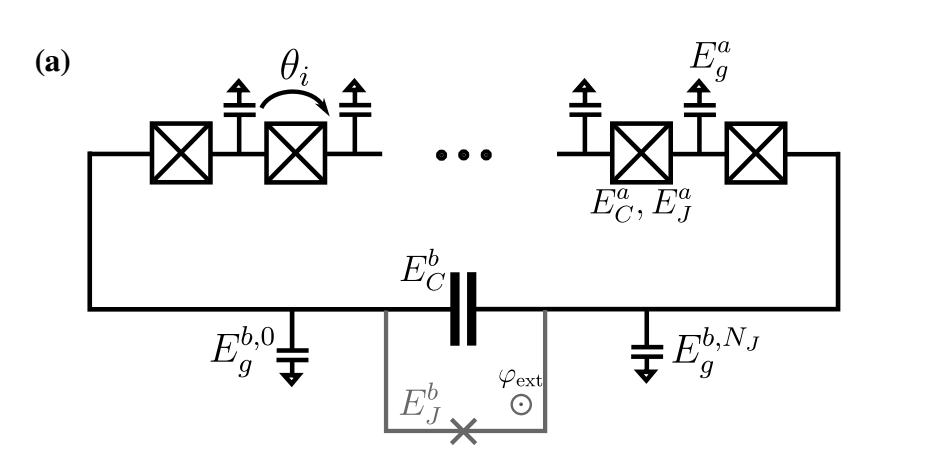
Josephson junction arrays represent a promising technology for building advanced circuits, offering large inductance necessary for complex designs, but accurately modelling their behaviour proves remarkably difficult. Emilio Rui, Joachim Cohen, and Alexandru Petrescu, all from Ecole Normale Superieure and affiliated institutions, now present a new approach that overcomes longstanding challenges in understanding these arrays. The team developed a powerful computational method based on tensor networks, allowing them to calculate the excitation spectra of these circuits without relying on approximations. This breakthrough enables a fully non-perturbative analysis, revealing significant discrepancies with previous theoretical treatments and paving the way for more accurate designs and improved performance in low-impedance Josephson junction arrays.
Integrating circuits based on Josephson junction arrays presents significant challenges, as these arrays provide the large inductances required for qubit designs, yet their intrinsically many-body nature is typically reduced to simplified descriptions. Previous attempts to include the collective behaviour of these arrays relied on approximations, but a fully nonperturbative analysis remained elusive due to the complex interactions between their components. This research overcomes this difficulty by employing the DMRG-X algorithm, an advanced tensor-network method capable of accurately calculating excitation spectra without relying on approximations. A key advance lies in the construction of trial states directly from the linearized mode structure, enabling the direct computation of excitations and a more accurate representation of the system’s behaviour.
Fluxonium Qubit Interactions and Circuit Analysis
Scientists have achieved a breakthrough in modelling the complex behaviour of Josephson junction arrays, crucial components in superconducting quantum circuits. These arrays, used to create large inductors, possess a collective behaviour that is typically simplified in standard circuit analysis. The team overcame the challenges of analysing this many-body system by employing the DMRG-X algorithm, an advanced tensor-network method capable of accurately calculating excitation spectra without relying on approximations. Experiments revealed significant deviations from existing perturbative treatments, particularly in the low array junction impedance regime.
Specifically, the team accurately computed the frequencies of chain modes within the Josephson junction arrays, demonstrating a clear improvement over previous theoretical predictions. The DMRG-X method successfully resolved the full spectrum of single-excitation chain modes in a lumped-element LC resonator, a key component in many quantum circuits. Further analysis focused on the fluxonium qubit, revealing substantial quantitative differences between DMRG-X results and perturbative calculations of cross-Kerr nonlinearities, a measure of interaction between quantum states. Measurements confirm that the team’s method accurately captures the complex interplay between the qubit’s fundamental mode and the coupled chain modes.
The team also demonstrated the method’s ability to model charge-offset effects within the array, achieved by analysing a fluxonium device constructed with high-impedance junctions. These results pave the way for improved design and control of superconducting quantum circuits, enabling more accurate modelling of complex interactions and potentially enhancing qubit performance. The team’s approach, validated through detailed simulations, offers a powerful tool for refining perturbative treatments and advancing the field of quantum information processing.
Accurate Modelling of Josephson Junction Excitations
Scientists have developed a new computational method for accurately modelling the complex behaviour of Josephson junction arrays, which are crucial components in superconducting circuits. Results demonstrate that this method accurately predicts the behaviour of these arrays, even in regimes where previous perturbative methods fail, including situations where quantum phase slips become significant. This improved accuracy is particularly important for understanding and harnessing the chain modes within these arrays, which may serve as valuable resources in future quantum information technologies. The authors acknowledge that the accuracy of the trial states diminishes in strongly nonlinear regimes, reflecting the limitations of the underlying harmonic approximation used in their construction. Nevertheless, the method maintains convergence and reliability even in these challenging conditions. Future work will likely focus on extending this approach to even more complex superconducting circuits with a greater number of interacting degrees of freedom, potentially unlocking new possibilities for quantum computation and sensing.
🗞 Tensor-network representation of excitations in Josephson junction arrays
🧠 ArXiv: https://arxiv.org/abs/2510.08680